How a second pet can change your first pet’s behavior

A new companion may encourage play and social learning, but it can also trigger competition, anxiety, or withdrawal. The outcome depends on each animal’s temperament, history, resources, and introduction.
Bringing home a second pet changes the resident animal’s social environment overnight. The first pet may become more playful and confident—or start guarding food, hiding, vocalizing, or following new habits picked up from the newcomer.
None of these outcomes is guaranteed. Dogs and cats respond as individuals, and a relationship that looks promising during the first meeting may take weeks or months to settle.
One animal can influence another
Pets do not behave in isolation. They watch, respond to, and sometimes learn from the animals around them.
A 2025 review of 61 publications on social learning in dogs found extensive evidence that dogs use information from both other dogs and humans. This does not mean that one dog will automatically imitate everything another does. Social learning is selective and shaped by familiarity, attention, past experience, and the situation.
In everyday life, that influence may be easy to notice. A dog that previously ignored the doorbell might begin barking when its new housemate does. A timid dog may become more willing to investigate the yard after watching a confident companion. Play, excitement, alertness, and routines can all spread between animals.
That influence can work in either direction. A calm pet may provide a useful behavioral model, while a highly reactive newcomer may increase noise and arousal throughout the home.
The household itself has changed
Some behavioral shifts have less to do with friendship and more to do with disruption.
The resident pet suddenly faces unfamiliar smells, altered feeding arrangements, divided human attention, and another animal occupying its resting or play areas. Even a sociable pet may need time to process those changes.
Dogs can become tense when they must compete for food, toys, sleeping spots, territory, or access to people. Veterinary behavior guidance recommends considering the resident dog’s health, activity level, personality, and ability to communicate with other dogs before adopting a companion.
A quiet older dog, for example, may find an energetic puppy exhausting rather than entertaining. Two dogs that enjoy meeting outdoors may also behave differently when valuable resources are present inside the home.
Cats require even more caution. Some cats form close relationships and sleep, groom, or play together. Others merely tolerate sharing a home, while certain adult cats may never comfortably accept an unfamiliar cat.
A resident cat’s previous friendship with one particular animal does not guarantee compatibility with another. Temperament and early social experience often matter more than an owner’s intention to provide company.
A second dog is not a treatment for separation distress
One common reason for adopting another dog is the hope that it will stop the first dog from becoming distressed when left alone. Evidence does not support treating this as a reliable solution.
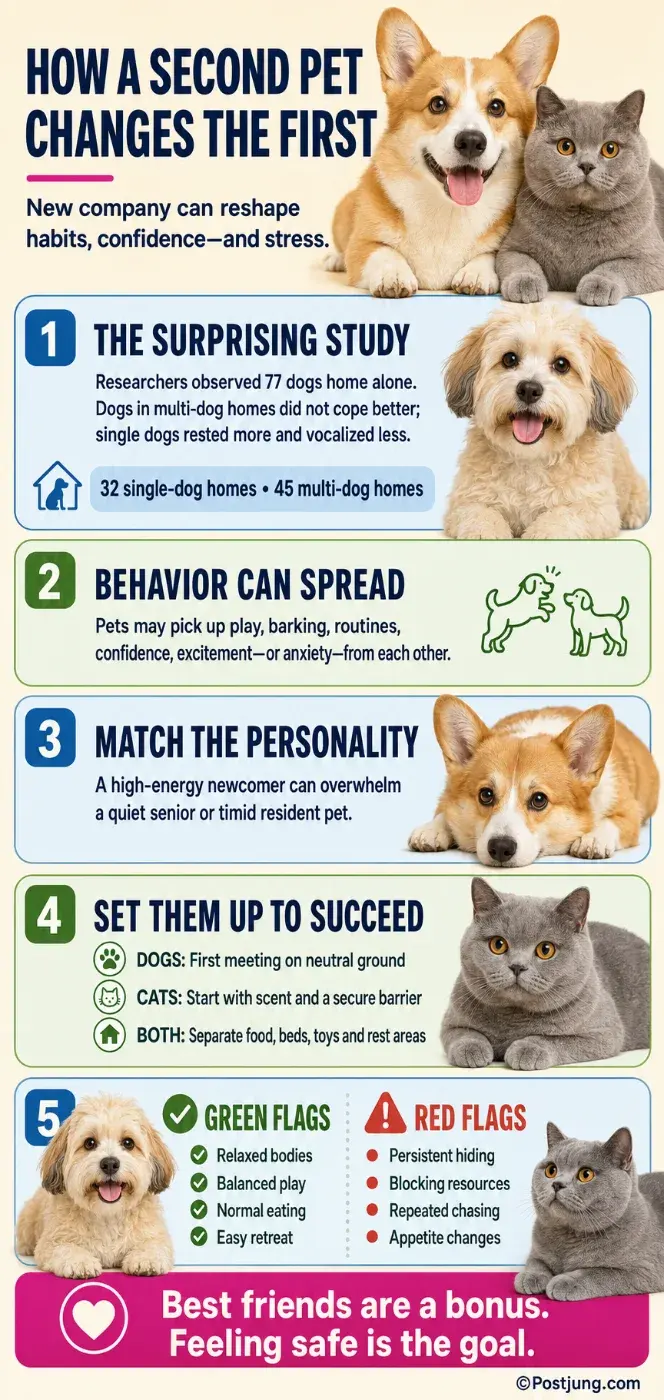
A video-based study observed 32 dogs in single-dog homes and 45 dogs in multi-dog homes during their normal periods without their owners. The researchers did not find that living with another dog helped the animals cope better with separation. Dogs in single-dog homes actually rested more and vocalized less in the observed sessions.
The study was relatively small, and individual dogs may still benefit from a familiar companion. Its findings nevertheless show why owners should not adopt another animal solely to fix barking, destruction, pacing, or other separation-related behavior.
Those signs may require an individual assessment and a structured behavior plan. Adding a second pet can leave the original problem unchanged while doubling the household’s care and training responsibilities.
Introductions shape what happens next
Good matches still need careful introductions. For dogs, an initial meeting in a calm, neutral location can reduce pressure. Short sessions, close supervision, separate feeding areas, and individual rest periods help prevent competition while the relationship develops.
Growling should not automatically be punished. It is a warning signal, and suppressing that communication can make conflict harder to predict. Redirect the dogs calmly and separate them before tension escalates.
New cats should usually begin in separate areas. Scent exchanges can come before visual access, followed by brief meetings through a secure barrier. Shared access should increase only while both cats remain relaxed.
Each cat also needs dependable access to food, water, litter boxes, beds, hiding places, scratching areas, and elevated spaces. Spreading these resources around the home makes it harder for one cat to block another.
Watch the first pet, not just the newcomer
A successful introduction does not require instant friendship. Calmly ignoring one another can be an excellent early result.
Positive signs include relaxed bodies, voluntary approaches, balanced play, normal eating and sleeping, and the ability to move away without being pursued. Warning signs include persistent hiding, appetite changes, urine marking, resource guarding, repeated chasing, blocked doorways, escalating fights, or an inability to rest.
Sudden behavioral changes can also have medical causes. A veterinarian should evaluate a pet that stops eating, becomes unusually aggressive, eliminates outside its normal area, or shows a major change in activity or social behavior.
A second pet can enrich the first pet’s life, but companionship cannot be assigned by the owner. The most realistic goal is not to make two animals become best friends. It is to create enough space, security, and choice for each one to feel safe while their relationship develops.
SOURCES USED:
- Biologia Futura — Social learning in dogs from an ecologically valid perspective
- Applied Animal Behaviour Science — Pet dogs home alone: A video-based study
- VCA Animal Hospitals — Introducing a new dog to your family dog
- VCA Animal Hospitals — Considerations when getting a second cat
- ASPCA — Aggression between cats in your household

เขียนโดย Postjung Insights
 รู้หรือไม่? เปิดรายได้พนักงานส่งพัสดุของแต่ละแอป วันหนึ่งได้เท่าไร
 อำเภอที่มีชื่ออำเภอสั้นที่สุด 3 อำเภอเท่านั้นในประเทศไทย
 7 บทเพลงไวรัลยุคโบราณ! เพลงงานวัดที่เปิดเมื่อไหร่ คนก็ลุกขึ้นรำวงเมื่อนั้น
 โรงเรียนที่มีนักเรียนมากที่สุดในไทย
 เปิด 5 โรงเรียนหญิงล้วนเก่าแก่ของไทย ที่มีประวัติยาวนานกว่าศตวรรษ
 5 ไอเทมป้องกันความร้อนให้บ้านแบบโบราณ! ภูมิปัญญาเก่าที่ช่วยบ้านเย็นลงได้ 3-5 องศา
 ตาราง “เด่นเหนือเด่นใต้” งวด 1 ต.ค. 69 เปิดข้อมูลตามโพย เลขไหนอยู่ตรงไหน
 เช็กด่วน ! ข่าวบัตรสวัสดิการแจก 10,000 บาท ก.ย. 69 จริงหรือ ? ก่อนเชื่อควรรู้อะไร
 แปลปกสลาก งวด 1 ต.ค. 69 ส่องตัวเลขจากภาพปกสลากกินแบ่งรัฐบาล
 7 คันเบ็ดตกปลาโบราณ สายเรโทรยอมทุ่มเงินซื้อ! ยิ่งเก่า ยิ่งหายาก ยิ่งมีเรื่องราว
 ส่องเลข 3 สำนักพิมพ์ งวด 1 ต.ค. 69 ตัวไหนมีข้อมูลตรงกัน
 รู้หรือไม่? ความทรงจำวัยเด็กอาจไม่ได้เหมือนที่เราเคยจำ! สมองสามารถ “เติมเรื่อง” ให้เราได้อำเภอที่มีชื่ออำเภอสั้นที่สุด 3 อำเภอเท่านั้นในประเทศไทย
 English Edition