Crate training can ease stress—but only when dogs feel safe

A crate can offer a dog a quiet, predictable place to rest during busy or unfamiliar situations. The benefit depends on patient, reward-based training—and some anxious dogs need a different solution.
A crate does not automatically calm a dog. When introduced gradually and associated with food, rest, and safety, however, it can become a familiar retreat that helps some dogs cope with noise, visitors, travel, and other overwhelming situations.
The crucial distinction is choice and positive association. A dog that willingly enters a comfortable crate may experience it as a protected resting place. A dog that is forced inside, confined too long, or already frightened by enclosed spaces may feel trapped instead.
Predictability can make stressful situations easier
Dogs often cope better when they know where they can rest without being approached or disturbed. A familiar crate provides consistent boundaries, bedding, smells, and objects even when activity elsewhere in the home changes.
That predictability can be useful during parties, visits from unfamiliar people, household repairs, or periods when children are active. Instead of remaining exposed to every sound and movement, a dog can retreat to a quieter area.
Blue Cross, a British animal welfare charity, recommends giving stressed dogs a separate, undisturbed space. Depending on the individual dog, this might be a comfortable crate, a bed, or an area divided by a safety gate.
The crate door can remain open when confinement is unnecessary, allowing the dog to choose whether to enter or leave. That choice is an important part of making the space feel secure.
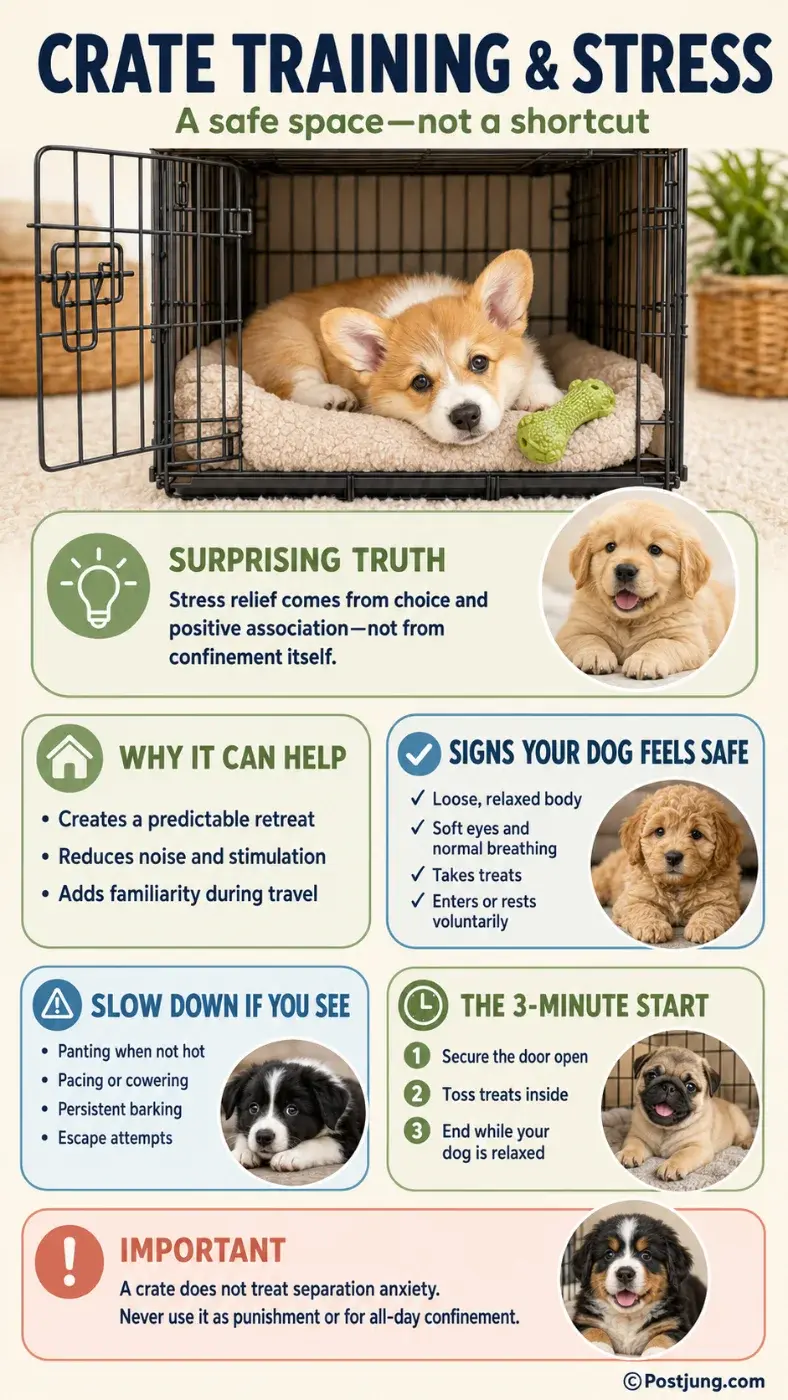
Positive associations change what the crate means
Successful crate training relies on teaching the dog that entering the crate predicts something pleasant.
The Royal Society for the Prevention of Cruelty to Animals recommends beginning with the door secured open. Treats, meals, safe chew toys, and comfortable bedding can encourage voluntary exploration. Training sessions should be brief, and the door should be closed only after the dog is entering comfortably.
Time inside can then increase in small increments. This gradual process helps the crate become associated with eating, resting, and quiet activity rather than isolation or punishment.
The American Veterinary Society of Animal Behavior recommends reward-based methods for dog training. Punishment and other aversive techniques can damage welfare and the relationship between dogs and their caregivers.
Using a crate as a “time-out” after unwanted behavior works against the goal. If entering the crate repeatedly predicts anger, isolation, or frustration, the dog may begin avoiding it.
Familiarity can help beyond the home
Crate training may also reduce the novelty of situations in which temporary confinement is necessary. Dogs may encounter crates or carriers during transportation, boarding, grooming, veterinary care, emergency evacuation, or recovery from certain medical procedures.
A familiar crate does not remove every source of stress in these situations. It can, however, give the dog one recognizable element in an unfamiliar environment.
This preparation should happen before the crate is urgently needed. Attempting to introduce confinement for the first time during a frightening journey or emergency can make the experience harder.
Watch the dog, not the clock
Training should progress according to the dog’s behavior rather than a fixed schedule. Some dogs become comfortable within days, while others need weeks.
Possible signs of stress include panting when the dog is not hot, pacing, repeated lip licking, pinned-back ears, trembling, cowering, loss of interest in food, persistent barking, or attempts to escape.
If these behaviors begin after the door is closed or the handler steps away, the session may have advanced too quickly. Return to an easier stage, shorten the duration, and allow the dog to regain comfort.
The crate must also be large enough for the dog to stand normally, turn around, lie down, and stretch. It should be placed away from excessive heat and constant noise, with safe bedding and access to water when appropriate.
Crating cannot replace exercise, toilet breaks, mental stimulation, social contact, or training. Prolonged confinement can contribute to frustration and anxiety rather than relieve them.
A crate is not a treatment for separation anxiety
Dogs with separation anxiety or fear of confinement require particular caution. Some may bark continuously, drool, eliminate, damage the crate, or injure themselves while trying to escape.
VCA Animal Hospitals advises that a crate may be inappropriate when destructive behavior is caused by separation anxiety. A larger secure room, an exercise pen, or another carefully managed area may be better tolerated.
Persistent distress should not be dismissed as stubbornness, and leaving a panicking dog inside to “get used to it” can intensify the problem. A veterinarian can check for medical contributors and, when needed, refer the dog to a qualified veterinary or clinical animal behaviorist.
Crate training reduces stress only when the dog’s behavior shows that the space genuinely feels safe. The most successful crate is not simply one that contains a dog—it is one the dog willingly chooses as a place to settle.
SOURCES USED:

เขียนโดย Postjung Insights
 7 คันเบ็ดตกปลาโบราณ สายเรโทรยอมทุ่มเงินซื้อ! ยิ่งเก่า ยิ่งหายาก ยิ่งมีเรื่องราว
 อำเภอที่มีชื่ออำเภอสั้นที่สุด 3 อำเภอเท่านั้นในประเทศไทย
 รู้หรือไม่? เปิดรายได้พนักงานส่งพัสดุของแต่ละแอป วันหนึ่งได้เท่าไร
 5 ไอเทมป้องกันความร้อนให้บ้านแบบโบราณ! ภูมิปัญญาเก่าที่ช่วยบ้านเย็นลงได้ 3-5 องศา
 เปิด 5 โรงเรียนหญิงล้วนเก่าแก่ของไทย ที่มีประวัติยาวนานกว่าศตวรรษ
 7 บทเพลงไวรัลยุคโบราณ! เพลงงานวัดที่เปิดเมื่อไหร่ คนก็ลุกขึ้นรำวงเมื่อนั้น
 โรงเรียนที่มีนักเรียนมากที่สุดในไทย
 รู้หรือไม่? ความทรงจำวัยเด็กอาจไม่ได้เหมือนที่เราเคยจำ! สมองสามารถ “เติมเรื่อง” ให้เราได้
 ส่องเลข 3 สำนักพิมพ์ งวด 1 ต.ค. 69 ตัวไหนมีข้อมูลตรงกัน
 โรงเรียนชายล้วนแห่งแรกของไทยคือที่ไหน? ย้อนดูจุดเริ่มต้นโรงเรียนสวนกุหลาบวิทยาลัย
 ตาราง “เด่นเหนือเด่นใต้” งวด 1 ต.ค. 69 เปิดข้อมูลตามโพย เลขไหนอยู่ตรงไหน
 แปลปกสลาก งวด 1 ต.ค. 69 ส่องตัวเลขจากภาพปกสลากกินแบ่งรัฐบาลอำเภอที่มีชื่ออำเภอสั้นที่สุด 3 อำเภอเท่านั้นในประเทศไทย
 English Edition