Why pets still need ID tags even when they are microchipped

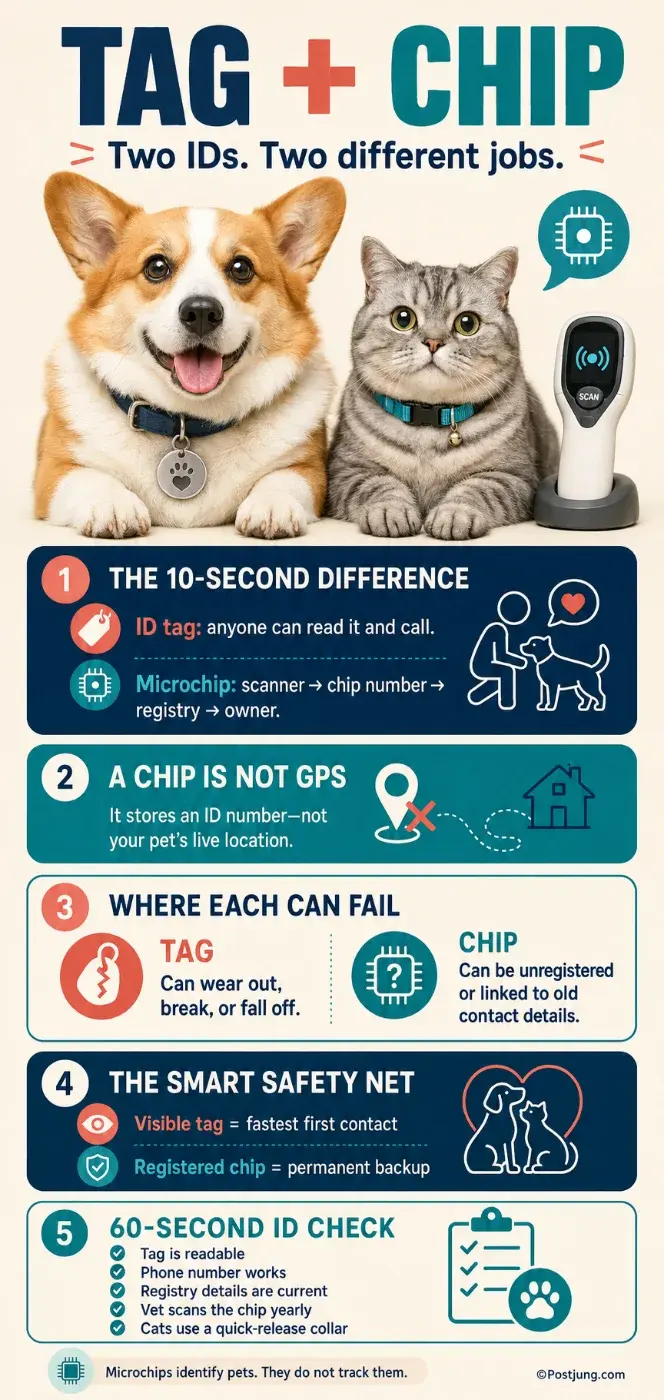
A microchip provides permanent identification, but it cannot be read without a scanner and a current registry record. A visible tag gives almost anyone who finds a lost pet a faster way to contact the owner.
A microchip may remain with a pet for life, but a simple collar tag can still produce the fastest trip home. Anyone who can safely approach the animal can read the tag and call its owner—without locating a scanner, identifying a registry, or waiting for an intermediary.
That does not make microchips unnecessary. It means tags and chips perform different jobs. One is visible and immediate; the other is permanent backup. For many dogs and cats, the strongest identification system uses both.
A microchip is an ID number, not a tracker
A pet microchip is a small electronic device implanted beneath the skin. When an appropriate scanner passes over it, the chip returns a unique identification number.
It does not continuously transmit the pet’s location, and it is not a GPS tracker. According to the American Animal Hospital Association, the chip itself normally stores only its identification number. The owner’s contact details are maintained separately by a microchip registry.
Several things must therefore happen before a chip can lead to a reunion:
- Someone must safely contain the lost animal.
- The animal must be taken to a shelter, veterinary hospital, or another location with a compatible scanner.
- The chip must be detected and read correctly.
- The relevant registry must be identified.
- That registry must contain accurate, current contact information.
- The owner must be reachable.
This system is valuable, especially when a pet has lost its collar. But it contains more steps than reading a phone number from a visible tag.
Why the old-fashioned tag remains useful
The main advantage of a tag is speed. A neighbor, delivery driver, park visitor, or other member of the public may be able to contact the owner immediately.
The ASPCA describes personalized tags as likely to be the fastest route home because almost anyone can read them. Its position on pet identification supports pairing a collar and tag with an implanted microchip.
A visible tag can also signal that an animal has a home. This distinction may be especially useful for a friendly outdoor cat or a dog wandering only a short distance from its neighborhood.
When there is no visible identification, the finder needs to take an additional step. AAHA advises taking a safely contained animal to a veterinary hospital, shelter, or animal-control facility for scanning.
Each system covers the other’s weakness
Tags are easy to use, but they are not permanent. A collar can slip off or break, and engraved details can become unreadable. That is where the microchip becomes critical: it may remain detectable even when every piece of visible identification is gone.
Microchips have their own vulnerabilities. A chip may never have been registered, the owner may have changed phone numbers, or a registry record may no longer be accessible. AAHA also notes that scanners are not universally effective with every chip and recommends having pets scanned annually to confirm the chip’s function and location.
The practical logic is straightforward:
- The tag is the first line of identification.
- The microchip is the durable backup.
- Neither should be treated as an excuse to neglect the other.
In England, the distinction is even reflected in law. Dogs generally must be microchipped, but they must also wear legally compliant collar identification in public. Requirements differ between countries and local jurisdictions, so owners should check the rules where they live or travel.
What belongs on a pet’s tag?
At minimum, include a phone number that is likely to be answered. An alternate number can help if the primary owner is unavailable.
Depending on the space available and local requirements, the tag may also carry:
- The owner’s name
- A second contact number
- A brief “I’m microchipped” message
- Essential medical or care information
- An address or locality when legally required
The pet’s name is optional unless local rules say otherwise. Owners who are uncomfortable displaying a full address should first determine what their jurisdiction requires rather than assuming a phone number alone is sufficient.
For travel, a temporary tag with local accommodation details or a destination contact can be useful. Registry details should also be checked before the trip, particularly when crossing national borders.
Identification needs routine maintenance
A tag and chip work only when the information behind them is usable. A short recurring check can prevent common failures:
- Inspect the tag for worn or unreadable engraving.
- Confirm that the collar still fits securely.
- Update both the tag and microchip registry after changing a phone number or address.
- Ask a veterinarian to scan the chip during an annual checkup.
- Keep the chip number and registry contact details in an accessible record.
- Check local identification laws before moving or traveling.
Collar safety matters, too. Cats Protection recommends a properly fitted quick-release collar for cats so it can open if caught on a branch, fence, or other object. Because a safety collar is designed to come off under pressure, the microchip becomes particularly important as the identification that remains with the cat.
The goal is not to choose between old and new technology. A readable tag reduces the distance between “pet found” and “owner called,” while a registered microchip provides another path home when the collar is no longer there. Together, they create a simple but resilient safety net.
SOURCES USED:
- American Animal Hospital Association — Frequently Asked Questions About Pet Microchipping
- American Animal Hospital Association — Animal Identification and Microchipping
- American Animal Hospital Association — Microchip Registry Lookup
- ASPCA — Position Statement on Pet Identification
- Oxford City Council — Collar, Tag and Microchip Your Dog
- Cats Protection — Choosing a Cat Collar

เขียนโดย Postjung Insights
 อำเภอที่มีชื่ออำเภอสั้นที่สุด 3 อำเภอเท่านั้นในประเทศไทย
 โรงเรียนที่มีนักเรียนมากที่สุดในไทย
 รู้หรือไม่? เปิดรายได้พนักงานส่งพัสดุของแต่ละแอป วันหนึ่งได้เท่าไร
 7 คันเบ็ดตกปลาโบราณ สายเรโทรยอมทุ่มเงินซื้อ! ยิ่งเก่า ยิ่งหายาก ยิ่งมีเรื่องราว
 5 ไอเทมป้องกันความร้อนให้บ้านแบบโบราณ! ภูมิปัญญาเก่าที่ช่วยบ้านเย็นลงได้ 3-5 องศา
 7 บทเพลงไวรัลยุคโบราณ! เพลงงานวัดที่เปิดเมื่อไหร่ คนก็ลุกขึ้นรำวงเมื่อนั้น
 รู้หรือไม่? ความทรงจำวัยเด็กอาจไม่ได้เหมือนที่เราเคยจำ! สมองสามารถ “เติมเรื่อง” ให้เราได้
 เปิด 5 โรงเรียนหญิงล้วนเก่าแก่ของไทย ที่มีประวัติยาวนานกว่าศตวรรษ
 มารู้จัก“ชมพู่สีม่วงดำ”ผลไม้หน้าตาแปลก สีเข้มจนเกือบดำ
 ตาราง “เด่นเหนือเด่นใต้” งวด 1 ต.ค. 69 เปิดข้อมูลตามโพย เลขไหนอยู่ตรงไหน
 โรงเรียนเพียงแห่งเดียวของประเทศไทย ที่อยู่มาตั้งแต่ยุครัชกาลที่ 4
 ทำไมบ้านเลขที่ 23–24 Leinster Gardens จึงไม่มีห้องอยู่ด้านหลังอำเภอที่มีชื่ออำเภอสั้นที่สุด 3 อำเภอเท่านั้นในประเทศไทย
 English Edition