How Quality-of-Life Checks Guide Difficult Pet Care Decisions

A structured check cannot decide for a family, but it can reveal changes in comfort, function, and enjoyment that are easy to miss during a gradual decline.
Decisions about an aging or seriously ill pet rarely come down to one obvious moment. More often, owners must interpret a series of small changes: a meal left unfinished, a walk refused, difficulty standing, or less interest in family life.
Quality-of-life checks give those observations a consistent structure. Used repeatedly and discussed with a veterinarian, they can help families recognize when treatment should change, when additional comfort care may be needed, or when an end-of-life conversation should begin.
What a quality-of-life check measures
Quality of life is a broad assessment of a pet’s physical comfort, daily function, and emotional well-being. It is not the same as measuring temperature, weight, or a laboratory result.
The American Animal Hospital Association, or AAHA, describes quality of life as subjective because each animal has different routines, preferences, and limitations. Sleeping for most of the day might be normal for one pet but represent a major change in another.
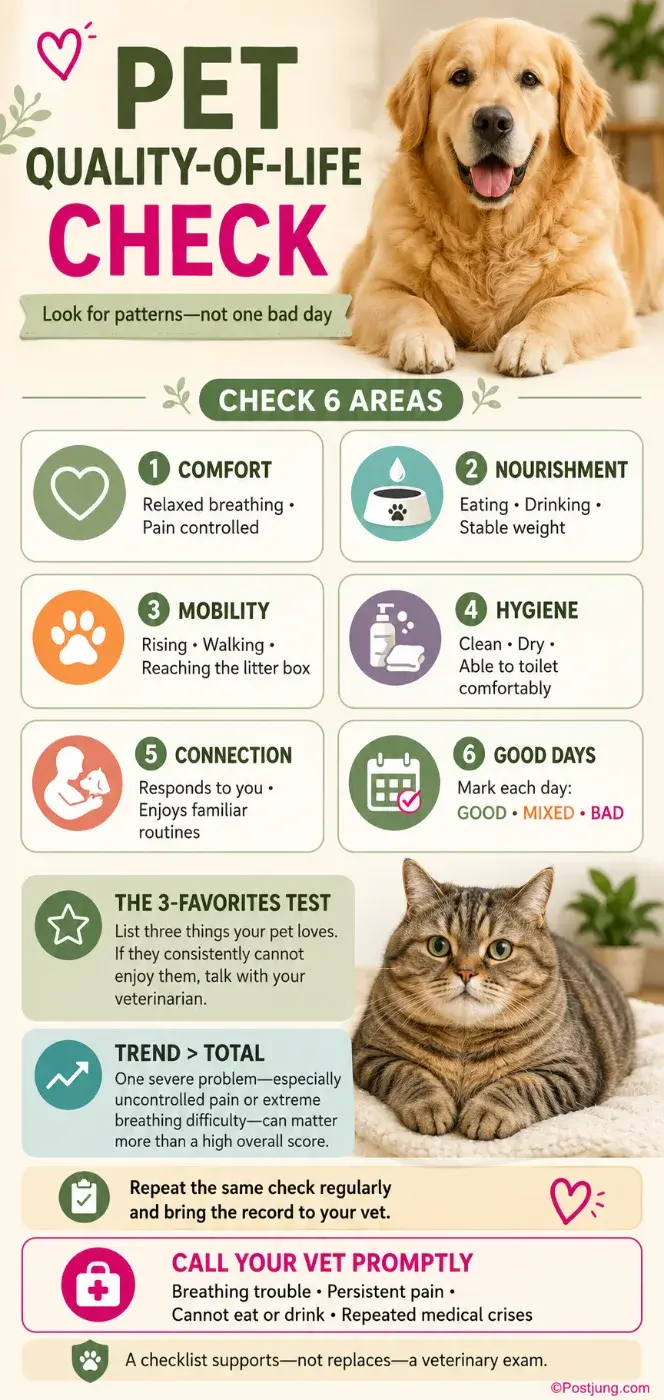
Most assessments therefore examine several parts of daily life rather than focusing only on a diagnosis. Common areas include:
- Pain and breathing comfort
- Appetite, drinking, and weight
- Mobility and ability to stand
- Urination and bowel habits
- Hygiene and grooming
- Awareness and interaction
- Interest in favorite activities
- The balance between good and bad days
One widely recognized framework is the HHHHHMM scale: hurt, hunger, hydration, hygiene, happiness, mobility, and more good days than bad. Other questionnaires use different wording but examine similar aspects of an animal’s day-to-day experience.
Why tracking changes matters
A pet’s decline may be difficult to recognize when it happens slowly. Owners adapt routines, lift a dog onto furniture, move food bowls closer, or help a cat enter its litter box. These adjustments can be compassionate and useful, but they can also make the overall pattern harder to see.
The Ohio State University Veterinary Medical Center recommends repeating a quality-of-life worksheet at a regular interval. Looking at several entries can reveal whether comfort and function are stable, improving after treatment, or steadily declining.
A simple calendar can also help. An owner might mark each day as generally good, mixed, or bad and record a short reason, such as “ate normally,” “could not settle,” or “needed help standing.”
The goal is not to reduce a pet’s life to a number. It is to create a record that can be compared over time and shared with the veterinary team.
Photos and videos from before an illness can provide another useful reference. Families may not notice gradual changes in posture, movement, alertness, or social interaction until they compare the present with an earlier baseline.
Start with what makes life enjoyable
The Ohio State guide suggests identifying three to five activities that matter to the individual pet. These might include greeting family members, eating meals, exploring the yard, playing with a toy, sitting by a window, or resting beside a favorite person.
Losing one activity does not automatically mean a pet has an unacceptable quality of life. An animal may adapt, especially when pain treatment, environmental changes, or mobility support are available.
The pattern becomes more concerning when the pet can no longer enjoy several important activities, discomfort cannot be adequately controlled, or bad days increasingly outnumber good ones.
Certain problems should also carry more weight than a total score. The Ohio State guide notes that unrelenting pain or extreme difficulty breathing may indicate very poor quality of life even when some other areas remain positive.
AAHA advises owners to contact their veterinarian about signs such as persistent pain, difficulty breathing, inability to eat or drink normally, trouble standing or walking, withdrawal from family, or repeated medical crises.
A score is a conversation starter, not a verdict
Quality-of-life scales have limitations. AAHA’s senior-care guidance notes that relatively few available animal quality-of-life scales have been formally validated, even though many questionnaires can still help owners organize and communicate their observations.
Different family members may also score the same pet differently. One person may focus on appetite, while another notices changes in sleep, mobility, or interaction. Completing the assessment separately and comparing responses can expose important details rather than prove that one person is correct.
A veterinarian adds the medical context that a worksheet cannot provide. The veterinary team can assess pain, explain the likely course of an illness, identify treatment options, and discuss hospice, palliative care, or humane euthanasia when appropriate.
Some apparently age-related changes may also be caused by treatable problems such as dental disease, arthritis, infection, nausea, or medication effects. A questionnaire cannot distinguish among those causes.
Checking early allows more thoughtful choices
Quality-of-life discussions do not need to wait until a crisis. Starting while a pet is relatively stable gives families time to define what comfort means for that animal, learn which warning signs require attention, and discuss realistic care options.
Owners can ask the veterinarian what improvement would look like, which symptoms signal suffering, what the best- and worst-case outcomes may be, and what should trigger an urgent reassessment.
A quality-of-life check cannot remove grief or produce a universally correct answer. Its value lies in making gradual changes visible and giving families and veterinarians a shared set of observations. During an emotionally difficult period, that clarity can help keep the pet’s comfort at the center of every decision.
SOURCES USED:

เขียนโดย Postjung Insights
 5 ไอเทมป้องกันความร้อนให้บ้านแบบโบราณ! ภูมิปัญญาเก่าที่ช่วยบ้านเย็นลงได้ 3-5 องศา
 รู้หรือไม่? เปิดรายได้พนักงานส่งพัสดุของแต่ละแอป วันหนึ่งได้เท่าไร
 อำเภอที่มีชื่ออำเภอสั้นที่สุด 3 อำเภอเท่านั้นในประเทศไทย
 เปิด 5 โรงเรียนหญิงล้วนเก่าแก่ของไทย ที่มีประวัติยาวนานกว่าศตวรรษ
 รู้หรือไม่? ความทรงจำวัยเด็กอาจไม่ได้เหมือนที่เราเคยจำ! สมองสามารถ “เติมเรื่อง” ให้เราได้
 7 บทเพลงไวรัลยุคโบราณ! เพลงงานวัดที่เปิดเมื่อไหร่ คนก็ลุกขึ้นรำวงเมื่อนั้น
 7 คันเบ็ดตกปลาโบราณ สายเรโทรยอมทุ่มเงินซื้อ! ยิ่งเก่า ยิ่งหายาก ยิ่งมีเรื่องราว
 ส่องเลข 3 สำนักพิมพ์ งวด 1 ต.ค. 69 ตัวไหนมีข้อมูลตรงกัน
 โรงเรียนที่มีนักเรียนมากที่สุดในไทย
 ทำไมหนังสือบางเล่มถึงมีหน้าว่างทั้งหน้า? มันอาจไม่ได้พิมพ์พลาด
 โรงเรียนเพียงแห่งเดียวของประเทศไทย ที่อยู่มาตั้งแต่ยุครัชกาลที่ 4
 มารู้จัก“ชมพู่สีม่วงดำ”ผลไม้หน้าตาแปลก สีเข้มจนเกือบดำอำเภอที่มีชื่ออำเภอสั้นที่สุด 3 อำเภอเท่านั้นในประเทศไทย
 English Edition