Pet emergency signs that should never wait until morning

Breathing difficulty, collapse, seizures, a blocked urinary tract, suspected poisoning and several other symptoms can become life-threatening within hours. Knowing when to call an emergency veterinarian may prevent a dangerous delay.
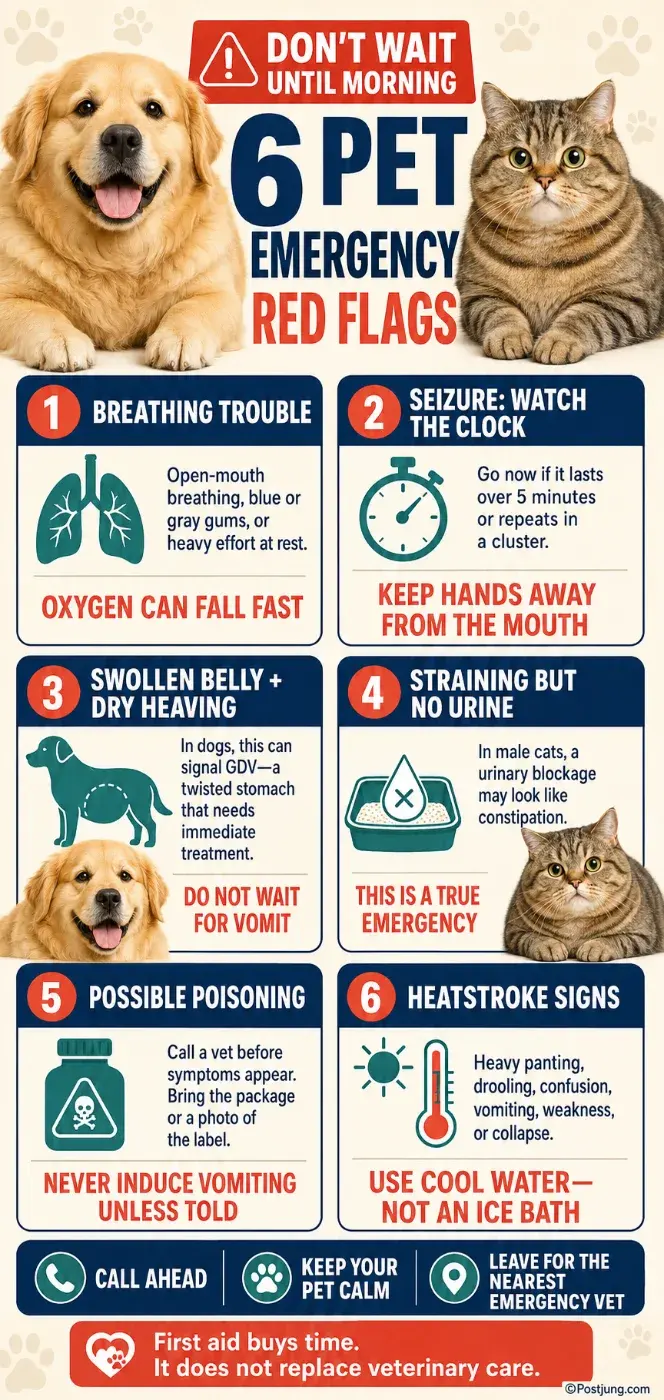
A pet that suddenly struggles to breathe, collapses, cannot urinate or repeatedly tries to vomit without bringing anything up should not simply be monitored until morning. These signs can indicate conditions that interfere with oxygen, circulation or organ function—and some can deteriorate rapidly even when the animal seemed normal earlier in the day.
Emergency symptoms do not identify one particular disease. They indicate that the pet may need stabilization, pain control, diagnostic testing or treatment that cannot be provided safely at home.
Breathing difficulty is always urgent
Labored, unusually fast or noisy breathing is one of the clearest reasons to seek immediate veterinary care. Warning signs include breathing with obvious abdominal effort, stretching the neck to breathe, open-mouth breathing in a cat, or gums and tongue that appear blue, gray, very pale or unusually dark.
Pets with breathing difficulty may not be getting enough oxygen. Stress and unnecessary handling can make the problem worse, so keep the animal calm, minimize restraint and call the veterinary hospital while preparing to leave.
Do not muzzle a pet that is struggling to breathe or has a chest injury.
Collapse, unconsciousness and severe weakness
Sudden collapse, loss of consciousness, inability to stand or profound weakness may reflect internal bleeding, heart disease, shock, heatstroke, poisoning or a neurologic problem. A pet can also have serious internal injuries after being struck by a vehicle or falling from a height even when no external wound is visible.
Move an injured animal as little as possible. A firm board, thick cardboard or folded blanket can serve as a stretcher for a larger pet. Keep the head, neck and spine supported during transport.
Severe or uncontrolled bleeding also requires immediate care. Apply firm pressure using clean gauze or a towel. If blood soaks through, add more material on top rather than removing the first layer and disturbing a developing clot.
Seizures require careful timing
Keep hands away from a seizing animal’s mouth and remove nearby furniture or objects that could cause injury. Do not restrain the pet or try to pull out its tongue.
If it can be done safely, time the episode and record a short video for the veterinarian. Cornell University’s Riney Canine Health Center advises emergency care when a seizure lasts longer than five minutes or when several seizures occur close together. A first-time seizure should also prompt veterinary evaluation, even if the animal appears to recover.
Loss of consciousness, continued disorientation, breathing trouble or suspected toxin exposure makes the situation especially urgent.
A swollen belly with unsuccessful retching
In dogs, a rapidly enlarging or painful abdomen combined with restlessness, drooling and repeated attempts to vomit without producing anything may indicate gastric dilatation-volvulus, commonly called GDV or bloat.
GDV occurs when the stomach becomes distended and twists. The twisting can restrict blood flow, contribute to shock, interfere with breathing and damage the stomach and nearby organs. Cornell’s College of Veterinary Medicine describes it as a life-threatening condition requiring immediate medical and surgical intervention.
Large, deep-chested dogs face the greatest risk, but suspicious symptoms should be treated as an emergency regardless of breed. Do not wait to see whether the swelling resolves.
Straining without producing urine
Repeated visits to the litter box can be mistaken for constipation. In a cat—particularly a male cat—straining while producing little or no urine may instead mean the urethra is blocked.
A blockage prevents the bladder from emptying. Pressure can affect the bladder and kidneys, while waste products and dangerous electrolyte abnormalities accumulate in the blood. The University of Illinois College of Veterinary Medicine warns that affected cats may vocalize, pass small amounts of bloody urine, vomit, stop eating or eventually become weak and collapse.
A cat that cannot urinate needs immediate veterinary care. Owners should not squeeze or repeatedly feel the abdomen in an attempt to confirm the blockage.
Suspected poisoning can be urgent before symptoms appear
Do not wait for vomiting, tremors or seizures after a pet consumes a potentially toxic food, medication, plant, chemical or pest-control product. Some poisons cause delayed symptoms, and treatment may be most effective before the animal appears ill.
Contact a veterinarian, an emergency hospital or an animal poison-control service immediately. In the United States, ASPCA Animal Poison Control operates at 888-426-4435; a consultation fee may apply. Owners elsewhere should use a locally available veterinary poison service.
Keep the product packaging and note the pet’s weight, the suspected substance, the possible amount and the time of exposure. Do not induce vomiting or give medication, milk, oil, activated charcoal or another home treatment unless a veterinarian or poison specialist specifically instructs you to do so.
Heatstroke can continue damaging the body
Heavy panting, excessive drooling, weakness, confusion, vomiting, loss of coordination or collapse after heat exposure may signal heatstroke. Move the pet into shade or an air-conditioned area and begin cooling with room-temperature or cool water and moving air while arranging emergency transport.
Avoid ice baths or immersing the animal in very cold water. Cooling measures are first aid, not a substitute for examination, because organ damage may continue even after the pet appears cooler.
What to do when you are uncertain
Other reasons for prompt emergency assessment include choking, severe pain, major trauma, eye injuries, facial swelling with breathing or gastrointestinal symptoms, repeated vomiting that prevents a pet from keeping water down, venomous bites and contact with electrical cords.
Call the nearest veterinary clinic or emergency hospital and describe what happened, when the pet was last normal, current symptoms, medications and known medical conditions. Calling ahead lets the veterinary team advise on safe transport and prepare for the animal’s arrival.
A veterinarian may decide that careful home monitoring is reasonable, but that decision should be based on the pet’s specific circumstances. When breathing, consciousness, circulation, urination or possible toxin exposure is involved, waiting overnight can remove valuable treatment time.
SOURCES USED:
- Merck Veterinary Manual — What to Do in a Dog or Cat Emergency
- Cornell University College of Veterinary Medicine — When to Go to the ER
- Cornell University College of Veterinary Medicine — Gastric Dilatation-Volvulus or Bloat
- University of Illinois College of Veterinary Medicine — Blocked Cats: An Emergency for Male Cats
- ASPCA — How Do I Know If I Should Bring My Pet to the Veterinary Hospital?
- American Veterinary Medical Association — Pet First Aid

เขียนโดย Postjung Insights
 รู้หรือไม่? เปิดรายได้พนักงานส่งพัสดุของแต่ละแอป วันหนึ่งได้เท่าไร
 5 ไอเทมป้องกันความร้อนให้บ้านแบบโบราณ! ภูมิปัญญาเก่าที่ช่วยบ้านเย็นลงได้ 3-5 องศา
 7 บทเพลงไวรัลยุคโบราณ! เพลงงานวัดที่เปิดเมื่อไหร่ คนก็ลุกขึ้นรำวงเมื่อนั้น
 อำเภอที่มีชื่ออำเภอสั้นที่สุด 3 อำเภอเท่านั้นในประเทศไทย
 โรงเรียนที่มีนักเรียนมากที่สุดในไทย
 7 คันเบ็ดตกปลาโบราณ สายเรโทรยอมทุ่มเงินซื้อ! ยิ่งเก่า ยิ่งหายาก ยิ่งมีเรื่องราว
 รู้หรือไม่? ความทรงจำวัยเด็กอาจไม่ได้เหมือนที่เราเคยจำ! สมองสามารถ “เติมเรื่อง” ให้เราได้
 โรงเรียนชายล้วนแห่งแรกของไทยคือที่ไหน? ย้อนดูจุดเริ่มต้นโรงเรียนสวนกุหลาบวิทยาลัย
 ส่องเลข 3 สำนักพิมพ์ งวด 1 ต.ค. 69 ตัวไหนมีข้อมูลตรงกัน
 ทำไมหนังสือบางเล่มถึงมีหน้าว่างทั้งหน้า? มันอาจไม่ได้พิมพ์พลาด
 ตาราง “เด่นเหนือเด่นใต้” งวด 1 ต.ค. 69 เปิดข้อมูลตามโพย เลขไหนอยู่ตรงไหน
 เปิด 5 โรงเรียนหญิงล้วนเก่าแก่ของไทย ที่มีประวัติยาวนานกว่าศตวรรษอำเภอที่มีชื่ออำเภอสั้นที่สุด 3 อำเภอเท่านั้นในประเทศไทย
 English Edition