Why senior pets may need different food as they age
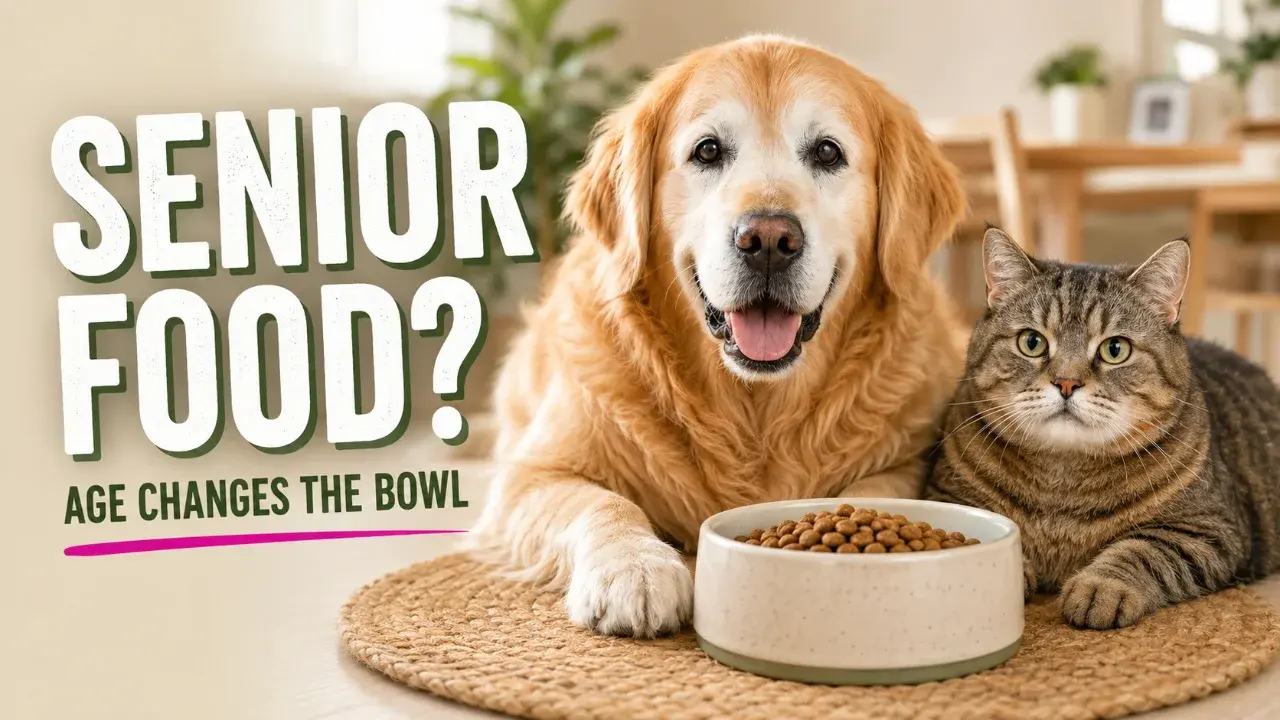
Older animals can experience changes in calorie use, digestion, muscle mass, and appetite. But a “senior” label does not automatically make a food suitable for every aging dog or cat.
Aging can change how a dog or cat uses calories, digests nutrients, and maintains muscle. Those changes may make a different food—or simply a different portion—helpful, but reaching a certain birthday is not, by itself, a reason to switch diets.
There is no single nutritional formula for all senior pets. An older dog gaining fat while losing muscle has different needs from an aging cat that is becoming thin, and either animal may require a therapeutic diet if kidney disease, diabetes, digestive problems, or another medical condition develops.
“Senior food” is not a standardized category
Pet food labels can make the transition sound simple: adult food today, senior food tomorrow. Veterinary guidance is more nuanced.
The American Animal Hospital Association, or AAHA, notes that the Association of American Feed Control Officials does not establish a separate nutrient profile for senior or geriatric dogs and cats. Manufacturers may therefore use different definitions and formulations for foods marketed as “senior.”
An older pet doing well on a complete and balanced adult-maintenance diet may not need to change food at all. The decision should be based on the animal’s weight, muscle condition, activity, appetite, health, and the actual nutrient and calorie profile of the food—not its marketing category.
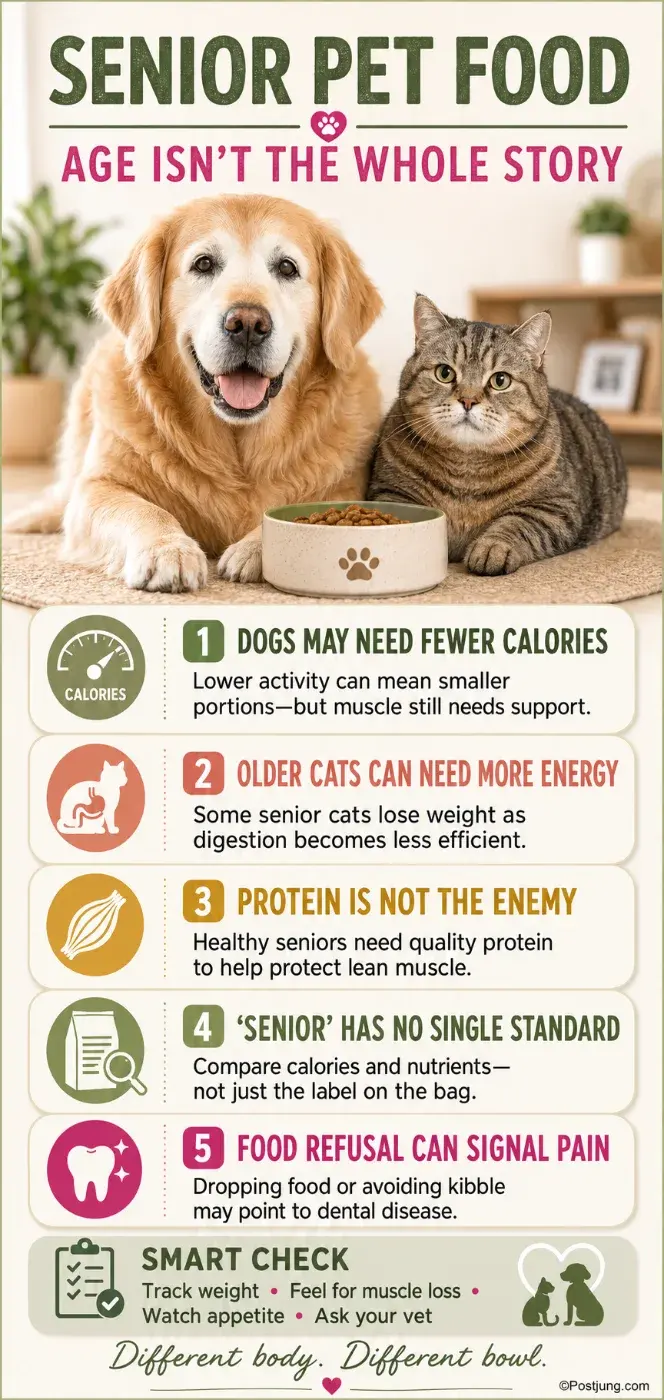
Older dogs may need fewer calories
Dogs’ maintenance energy requirements generally decrease over their lifetime. As activity falls, continuing to serve the same calorie-dense diet in the same amount can lead to weight gain.
A suitable diet for some healthy senior dogs may provide fewer calories per serving and more fiber while still supplying enough high-quality protein to help preserve lean tissue. Portion size matters just as much as the name of the formula.
This is not an argument for making every older dog thin. Aging dogs may lose muscle even while their weight remains stable or their body fat increases. Looking only at the number on a scale can therefore miss an important change in body composition.
Veterinarians assess both body condition and muscle condition. Body condition reflects fat stores, while muscle condition evaluates areas such as the spine, shoulder blades, skull, and hips for muscle loss.
Senior cats can follow a different pattern
Cats complicate the assumption that older animals always need less energy. AAHA guidance says feline energy requirements may decline until around age 10 and then increase in later life, although individual variation is considerable.
Some senior cats also become less efficient at digesting nutrients. AAHA cites evidence that protein digestibility is reduced in about 20% of cats older than 11, while fat digestibility may be reduced in up to one-third. That can contribute to weight and muscle loss even when a cat appears to be eating normally.
For a healthy older cat becoming too thin, a veterinarian may recommend food that is more calorie-dense, digestible, palatable, or protein-rich. Smaller, more frequent meals may also help.
The lesson is important: feeding less simply because a cat is old can be the wrong response if that cat is already losing weight.
Older pets still need protein
One persistent misconception is that all senior pets should eat a low-protein diet to protect their kidneys. Healthy older animals should not automatically have protein restricted.
Aging is associated with loss of lean body mass, known as sarcopenia. Adequate high-quality protein can help support muscle maintenance, particularly in senior cats. AAHA’s feline guidance recommends against protein restriction in healthy mature and senior cats.
Kidney disease changes the calculation. Cats and dogs diagnosed with chronic kidney disease may benefit from a veterinary renal diet designed with controlled phosphorus, modified protein, and other nutritional adjustments. A general senior formula is not necessarily a substitute for such a diet.
Restricting nutrients before a disease has been diagnosed may be unnecessary, while choosing a random “senior” product for a pet with kidney disease could provide an unsuitable phosphorus level. Disease-specific dietary decisions should be based on veterinary examination and testing.
Appetite changes may not be about the food
An older pet that suddenly avoids dry food, drops pieces while chewing, eats on one side of the mouth, or approaches the bowl and backs away may have dental pain rather than a new preference.
Senior animals face increased risks of periodontal disease, broken or resorbing teeth, and oral growths. Softening food or changing texture may make eating easier temporarily, but it should not replace an oral examination when chewing becomes difficult.
Loss of appetite can also accompany pain, nausea, kidney disease, hyperthyroidism, cancer, digestive disorders, or other conditions. Unexplained weight loss, muscle loss, vomiting, diarrhea, increased thirst, or a persistent appetite change deserves veterinary attention.
Choose food by evidence, not package design
The World Small Animal Veterinary Association recommends checking whether a food is nutritionally complete, who formulated it, what quality-control procedures the manufacturer uses, and whether calorie information is available.
The ingredient list alone cannot reveal the overall nutritional quality of a food. Animals require the right balance of nutrients, and two products with similar-looking ingredients can differ substantially in formulation and quality control.
For senior pets, the most useful monitoring happens at home: record body weight regularly, notice changes in the ribs and waist, watch for thinning around the spine or hips, and track appetite and stool quality. Bring those observations—and the food’s label or product information—to veterinary appointments.
The best senior diet is not necessarily the one with the largest “senior” label. It is the one that keeps an individual animal at a healthy weight, protects muscle, remains enjoyable to eat, and accounts for any diagnosed medical condition.
SOURCES USED:
- American Animal Hospital Association — Nutrition: 2023 AAHA Senior Care Guidelines
- American Animal Hospital Association — Age-specific and breed-specific diets
- American Animal Hospital Association — Nutrition and weight: Mature adult and senior cats
- World Small Animal Veterinary Association — Global Nutrition Guidelines
- WSAVA — Guidelines on selecting pet foods
- Merck Veterinary Manual — Overview of nutrition in small animals

เขียนโดย Postjung Insights
 5 ไอเทมป้องกันความร้อนให้บ้านแบบโบราณ! ภูมิปัญญาเก่าที่ช่วยบ้านเย็นลงได้ 3-5 องศา
 7 บทเพลงไวรัลยุคโบราณ! เพลงงานวัดที่เปิดเมื่อไหร่ คนก็ลุกขึ้นรำวงเมื่อนั้น
 รู้หรือไม่? เปิดรายได้พนักงานส่งพัสดุของแต่ละแอป วันหนึ่งได้เท่าไร
 7 คันเบ็ดตกปลาโบราณ สายเรโทรยอมทุ่มเงินซื้อ! ยิ่งเก่า ยิ่งหายาก ยิ่งมีเรื่องราว
 อำเภอที่มีชื่ออำเภอสั้นที่สุด 3 อำเภอเท่านั้นในประเทศไทย
 ตาราง “เด่นเหนือเด่นใต้” งวด 1 ต.ค. 69 เปิดข้อมูลตามโพย เลขไหนอยู่ตรงไหน
 รู้หรือไม่? ความทรงจำวัยเด็กอาจไม่ได้เหมือนที่เราเคยจำ! สมองสามารถ “เติมเรื่อง” ให้เราได้
 เช็กด่วน ! ข่าวบัตรสวัสดิการแจก 10,000 บาท ก.ย. 69 จริงหรือ ? ก่อนเชื่อควรรู้อะไร
 เปิด 5 โรงเรียนหญิงล้วนเก่าแก่ของไทย ที่มีประวัติยาวนานกว่าศตวรรษ
 โรงเรียนที่มีนักเรียนมากที่สุดในไทย
 โรงเรียนเพียงแห่งเดียวของประเทศไทย ที่อยู่มาตั้งแต่ยุครัชกาลที่ 4
 มารู้จัก“ชมพู่สีม่วงดำ”ผลไม้หน้าตาแปลก สีเข้มจนเกือบดำอำเภอที่มีชื่ออำเภอสั้นที่สุด 3 อำเภอเท่านั้นในประเทศไทย
 English Edition