Why grain-free pet food became so controversial

Grain-free diets rose on promises of natural ingredients and allergy relief, then became linked to reports of canine heart disease. The evidence remains complex, but it has changed how veterinarians assess these foods.
Grain-free pet food went from a premium wellness trend to one of the most disputed categories in animal nutrition. The debate intensified after veterinarians and U.S. regulators began examining cases of dilated cardiomyopathy, or DCM, in dogs eating certain diets—many of which were grain-free and contained large amounts of peas, lentils or other pulses.
That did not establish that every grain-free food causes heart disease. It did reveal a more complicated problem: a simple label on the front of a package says remarkably little about the nutritional quality of the formula inside.
Why grain-free food became popular
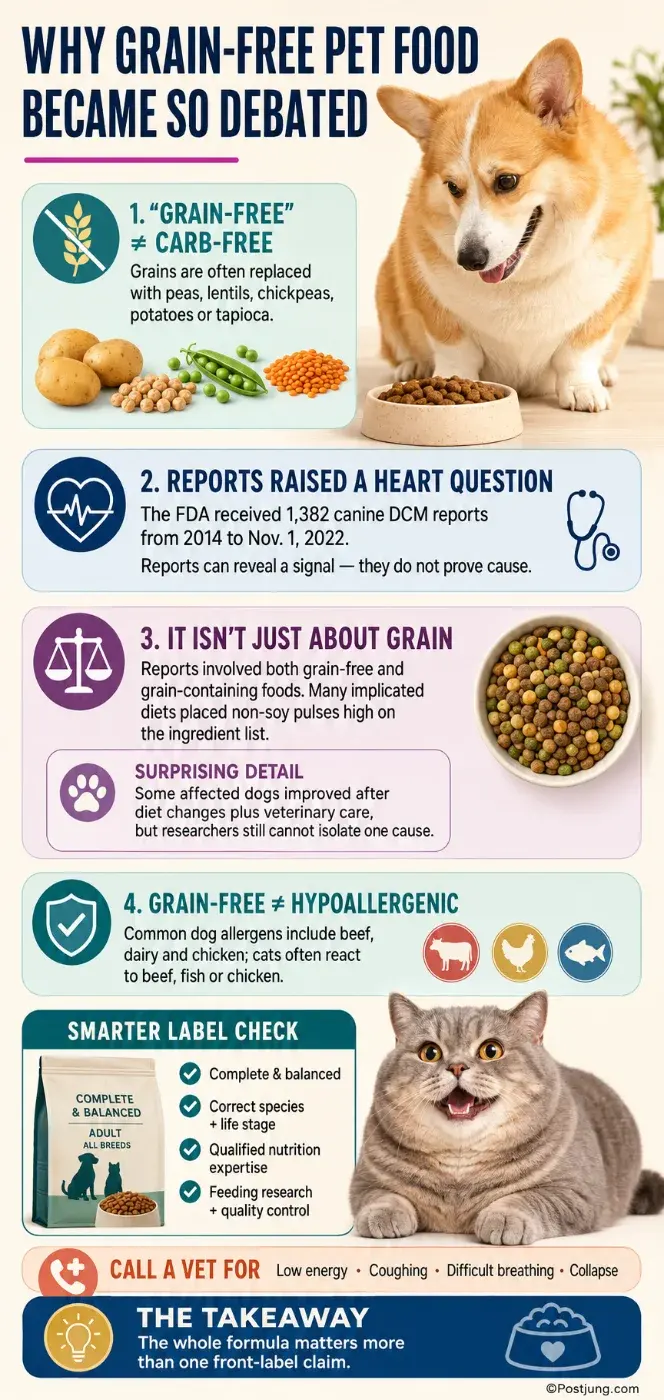
Grain-free pet food excludes cereal grains such as wheat, corn, rice, barley and oats. Manufacturers typically replace them with other carbohydrate and fiber sources, including peas, lentils, chickpeas, potatoes, sweet potatoes or tapioca.
The idea appealed to owners who associated “grain-free” with natural, ancestral, premium or allergy-friendly eating. It also reflected human food preferences. A 2021 survey of 3,298 dog owners in the United States, Canada, the United Kingdom, France and Germany found that people who avoided grains in their own diets or believed their dog had a food allergy were more likely to seek grain-free food.
The same PLOS One study noted that grain-free products accounted for more than 40% of dry dog foods available in the United States at the time.
But “grain-free” does not mean carbohydrate-free, low-carbohydrate or automatically higher in meat. It describes what the recipe leaves out, not whether the resulting combination is nutritionally superior.
The heart-disease investigation changed the conversation
In July 2018, the U.S. Food and Drug Administration announced that it was investigating reports of DCM in dogs eating certain foods. DCM weakens and enlarges the heart, making it harder to pump blood effectively. Some affected dogs belonged to breeds without a well-known genetic predisposition to the condition.
Many reported diets were labeled grain-free and listed peas, lentils, other pulses or potatoes among their prominent ingredients. By November 1, 2022, the FDA had received 1,382 reports in which one or more dogs were said to have DCM.
Those numbers require context. Reports were voluntary, the FDA could not verify every case and reporting increased after the agency publicized the issue. The United States also lacks a comprehensive surveillance system capable of establishing the normal background rate of non-hereditary DCM in dogs.
The FDA’s current position is therefore more cautious than either side of the debate sometimes suggests. The agency has not established a specific cause, declared all grain-free foods unsafe or requested recalls on that basis.
Reports have involved grain-free and grain-containing foods. What many of the diets had in common was a high placement of non-soy pulses—such as peas and lentils—on their ingredient lists. The FDA also stresses that legumes have been used in pet foods for years without evidence that they are inherently dangerous.
Possible explanations under investigation include the amount and combination of ingredients, nutrient availability, processing, formulation, feeding practices, genetics and underlying health conditions.
What clinical research has found
Several studies have found changes that keep the concern scientifically relevant, even though they do not prove that all grain-free diets cause DCM.
A 2022 prospective study followed 60 dogs with DCM and 16 dogs with less advanced cardiac abnormalities. Dogs previously eating what researchers classified as nontraditional diets showed small but statistically significant improvements in some heart measurements after their food was changed.
However, most of the dogs also received taurine supplements and medical care. That makes it difficult to identify how much of the improvement resulted from changing food alone. The study groups were also uneven: 51 dogs with DCM had eaten nontraditional diets, compared with nine that had eaten traditional diets.
Other research has not found significant differences in cardiac measurements between healthy animals eating diets with different pulse contents. A 2025 scientific review concluded that a causal relationship between grain-free food and DCM remains unclear and that the overall formulation matters more than the presence or absence of grain.
Most of the evidence and regulatory attention concern dogs. Research into a comparable dietary relationship in cats remains much more limited, so findings in dogs should not automatically be generalized to cats.
Grain-free is not automatically hypoallergenic
Food allergy is another reason owners choose these products, but removing every grain is rarely a substitute for diagnosis.
According to the Merck Veterinary Manual, commonly reported allergens include beef, dairy, chicken, wheat and lamb in dogs, and beef, fish and chicken in cats. The prevalence of food allergy among all dogs and cats receiving veterinary care is estimated to be relatively low, although it is higher among animals treated for itching or dermatitis.
A grain-free product may still contain the animal protein causing a reaction. Conversely, a pet with a confirmed sensitivity to a particular grain may benefit from avoiding that ingredient without needing to avoid every grain.
A supervised elimination diet followed by a controlled rechallenge is considered the reliable method for diagnosing a food allergy. Changing foods repeatedly based on itching or digestive symptoms can obscure the cause.
What matters more than the front label
The useful question is not simply whether a food contains grain. Owners should consider whether the product is nutritionally complete for the correct species and life stage, who formulated it, how it is tested and what quality-control systems the manufacturer uses.
In the United States, the nutritional adequacy statement is one of the most informative parts of a pet-food label. The Association of American Feed Control Officials explains that “complete” means the product supplies all required nutrients, while “balanced” means those nutrients are present in appropriate ratios.
The World Small Animal Veterinary Association also advises looking beyond individual ingredients. An ingredient list cannot show digestibility, nutrient bioavailability or the manufacturer’s expertise and quality controls.
Owners should contact a veterinarian promptly if a dog develops unusual fatigue, coughing, rapid or difficult breathing, fainting or collapse. Those signs have numerous possible causes and require veterinary assessment rather than an unsupervised food change.
For healthy pets, switching diets abruptly because of a frightening headline is not necessary. A veterinarian can review the complete feeding history—including treats, supplements and table food—and determine whether a current diet is appropriate.
The grain-free debate ultimately exposed the weakness of judging pet food by one reassuring phrase. A grain-free formula can be nutritionally adequate, and a grain-containing formula can be poorly designed. What matters is the complete recipe, the evidence behind it and whether it meets the needs of the individual animal.
SOURCES USED:
- U.S. Food and Drug Administration — Questions and answers on potential causes of non-hereditary DCM in dogs
- U.S. Food and Drug Administration — Investigation into certain diets and canine DCM
- Journal of Veterinary Internal Medicine — Prospective study of DCM in dogs eating nontraditional or traditional diets
- PLOS One — Survey of dog-owner purchasing habits related to grain-free foods
- Merck Veterinary Manual — Cutaneous food allergy in animals
- World Small Animal Veterinary Association — Global nutrition guidelines

เขียนโดย Postjung Insights
 โรงเรียนที่มีนักเรียนมากที่สุดในไทย
 7 คันเบ็ดตกปลาโบราณ สายเรโทรยอมทุ่มเงินซื้อ! ยิ่งเก่า ยิ่งหายาก ยิ่งมีเรื่องราว
 7 บทเพลงไวรัลยุคโบราณ! เพลงงานวัดที่เปิดเมื่อไหร่ คนก็ลุกขึ้นรำวงเมื่อนั้น
 รู้หรือไม่? ความทรงจำวัยเด็กอาจไม่ได้เหมือนที่เราเคยจำ! สมองสามารถ “เติมเรื่อง” ให้เราได้
 รู้หรือไม่? เปิดรายได้พนักงานส่งพัสดุของแต่ละแอป วันหนึ่งได้เท่าไร
 5 ไอเทมป้องกันความร้อนให้บ้านแบบโบราณ! ภูมิปัญญาเก่าที่ช่วยบ้านเย็นลงได้ 3-5 องศา
 เช็กด่วน ! ข่าวบัตรสวัสดิการแจก 10,000 บาท ก.ย. 69 จริงหรือ ? ก่อนเชื่อควรรู้อะไร
 อำเภอที่มีชื่ออำเภอสั้นที่สุด 3 อำเภอเท่านั้นในประเทศไทย
 เปิด 5 โรงเรียนหญิงล้วนเก่าแก่ของไทย ที่มีประวัติยาวนานกว่าศตวรรษ
 ตาราง “เด่นเหนือเด่นใต้” งวด 1 ต.ค. 69 เปิดข้อมูลตามโพย เลขไหนอยู่ตรงไหน
 5 เมนูอาหารไทยโบราณที่หาทานยาก ชื่อคุ้นหู แต่คนรุ่นใหม่อาจไม่เคยชิม
 แปลปกสลาก งวด 1 ต.ค. 69 ส่องตัวเลขจากภาพปกสลากกินแบ่งรัฐบาลอำเภอที่มีชื่ออำเภอสั้นที่สุด 3 อำเภอเท่านั้นในประเทศไทย
 English Edition