Why Background Noise Can Help Some Pets Stay Calm

Steady, low-volume sound may soften disruptive noises and encourage relaxed behavior in some dogs and cats. The benefit depends on the animal, the setting, and what is playing.
A quiet radio, gentle music, or another steady sound can make a noisy environment easier for some pets to tolerate. It may soften sudden disturbances, provide auditory enrichment, or simply make an unfamiliar setting feel less stark.
That does not mean every pet needs a soundtrack. Background sound can also become another source of stress when it is loud, unpredictable, or filled with noises an animal finds threatening.
Background sound can reduce contrast
A door slamming or a firework is especially startling when it breaks complete silence. Steady background sound may partly mask distant traffic, voices in a hallway, barking dogs, or bangs outside, reducing the contrast between the room and the disturbance.
This is why the Royal Society for the Prevention of Cruelty to Animals recommends music or television as one tool for masking fireworks. The organization also advises closing windows and curtains, providing a secure hiding place, and watching the pet for signs of distress.
Masking has limits. A household speaker cannot make nearby fireworks harmless, and turning up the volume may leave the animal coping with two unpleasant sounds instead of one.
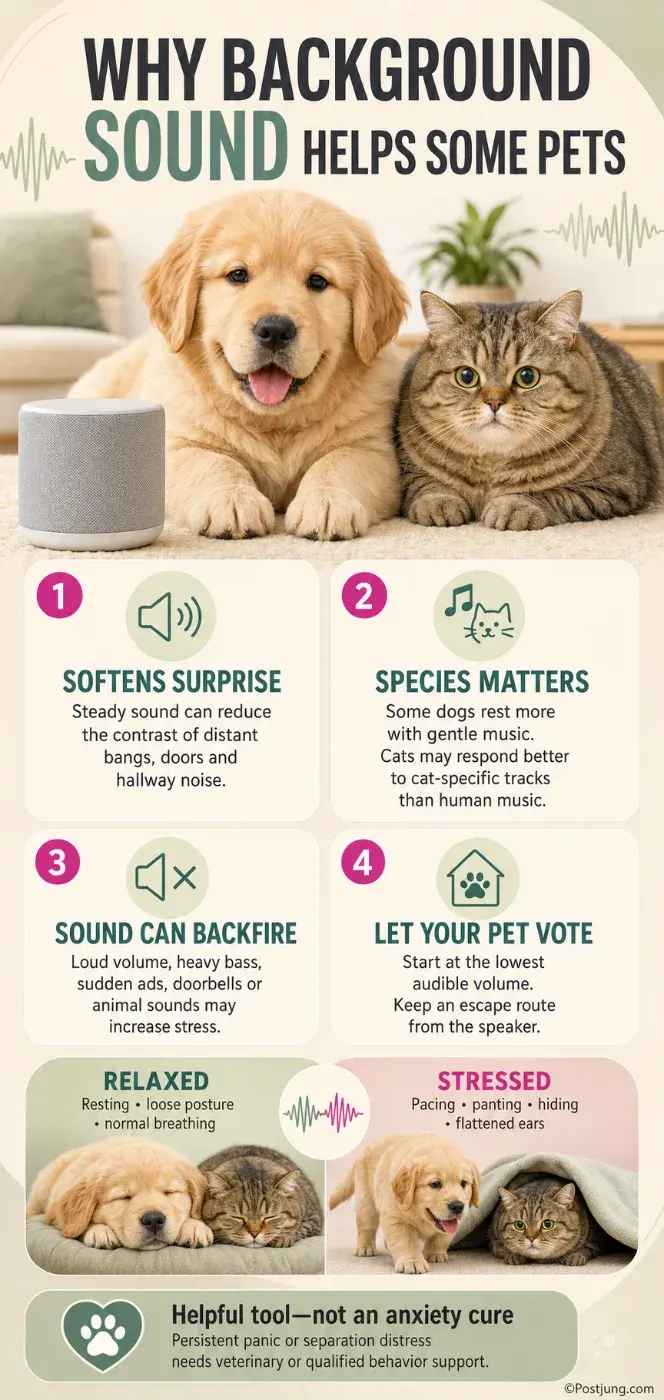
Dogs may respond to more than one kind of audio
Studies of kenneled dogs have repeatedly found behavioral changes during music playback. A 2020 review in the journal Animals concluded that classical music generally appeared to have a calming influence on dogs in stressful environments, although the studies varied considerably in their methods and results.
Observed changes have included more time resting or lying down and less standing, barking, or nervous movement. One study involving 60 shelter dogs found that animals exposed to classical music spent more time lying with their heads down, a posture consistent with resting.
The category printed on a playlist is not a guarantee, however. Research involving 38 kenneled dogs found higher heart-rate variability—generally consistent with lower stress—during soft rock and reggae in particular. The dogs’ responses also changed across days, suggesting that novelty and habituation may affect the result.
Spoken audio may work for certain dogs as well. Audiobooks have encouraged resting behavior in kennel studies, possibly because a calm human voice provides a form of social or environmental enrichment. This does not prove that recorded voices make a dog feel accompanied, but it shows that “calming audio” is not limited to classical music.
Cats may prefer sound made for feline ears
Cats do not necessarily respond to human music in the same way dogs do. Their hearing range, vocal communication, and early-life rhythms differ from ours, which has led researchers to test music composed with feline-relevant frequencies and tempos.
In a veterinary-clinic study, cats listening to cat-specific music had lower behavioral stress and handling scores than cats exposed to classical music or silence. The music did not produce a detectable difference in the study’s physiological measure, the neutrophil-to-lymphocyte ratio, and the behavioral differences were modest.
That distinction matters. Cat-specific music may be a useful addition to a low-stress environment, but it cannot compensate for frightening handling, a noisy waiting room, an exposed carrier, or the absence of a place to hide.
Silence may still be the best choice
Animal sound research is highly dependent on species and context. A 2022 review of captive-animal soundscapes noted that frequency, intensity, timing, reverberation, background conditions, and the animal’s own hearing abilities can all influence a response. Researchers also lack a single evidence-based maximum-noise threshold that applies across animal species.
A television program may seem gentle until it plays a doorbell, shouting, an animal vocalization, or a loud advertisement. Music with abrupt changes, intense bass, or high-pitched effects can be equally unsuitable. Small mammals may be particularly sensitive to frequencies that people barely notice or cannot hear.
An animal should therefore be able to move away from the speaker. Sound should never be delivered through headphones or placed directly beside a carrier, cage, bed, or hiding space.
Let the pet’s behavior guide the experiment
Test a new sound while you are present, beginning at the lowest practical volume. Look for normal resting, loose posture, ordinary breathing, grooming, eating, or a willingness to settle.
Stop or change the sound if the pet begins pacing, panting, trembling, hiding more than usual, flattening its ears, vocalizing, scanning the room, or trying to escape. Compare the same setting with and without audio rather than assuming a branded “pet-calming” playlist must be working.
Background sound is an environmental aid, not a treatment for separation anxiety, noise phobia, pain, or persistent distress. A pet that panics when left alone, stops eating, injures itself, or reacts severely to ordinary sounds should be assessed by a veterinarian. A qualified clinical animal behaviorist may also be needed to identify triggers and build a gradual, individualized plan.
The useful question is not whether music calms pets in general. It is whether a particular sound, at a particular volume, helps this animal behave more comfortably in this setting.
SOURCES USED:
- Animals — Musical Dogs: A Review of the Influence of Auditory Enrichment on Canine Health and Behavior
- Animals — Effects of Olfactory and Auditory Enrichment on the Behaviour of Shelter Dogs
- Physiology & Behavior — The Effect of Different Genres of Music on the Stress Levels of Kennelled Dogs
- Journal of Feline Medicine and Surgery — Effects of Music on Behavior and Physiological Stress Response of Domestic Cats in a Veterinary Clinic
- Frontiers in Veterinary Science — From Soundwave to Soundscape: A Guide to Acoustic Research in Captive Animal Environments
- RSPCA — Keeping Dogs, Cats and Other Small Pets Safe During Fireworks

เขียนโดย Postjung Insights
 อำเภอที่มีชื่ออำเภอสั้นที่สุด 3 อำเภอเท่านั้นในประเทศไทย
 5 ไอเทมป้องกันความร้อนให้บ้านแบบโบราณ! ภูมิปัญญาเก่าที่ช่วยบ้านเย็นลงได้ 3-5 องศา
 7 บทเพลงไวรัลยุคโบราณ! เพลงงานวัดที่เปิดเมื่อไหร่ คนก็ลุกขึ้นรำวงเมื่อนั้น
 รู้หรือไม่? ความทรงจำวัยเด็กอาจไม่ได้เหมือนที่เราเคยจำ! สมองสามารถ “เติมเรื่อง” ให้เราได้
 7 คันเบ็ดตกปลาโบราณ สายเรโทรยอมทุ่มเงินซื้อ! ยิ่งเก่า ยิ่งหายาก ยิ่งมีเรื่องราว
 เปิด 5 โรงเรียนหญิงล้วนเก่าแก่ของไทย ที่มีประวัติยาวนานกว่าศตวรรษ
 รู้หรือไม่? เปิดรายได้พนักงานส่งพัสดุของแต่ละแอป วันหนึ่งได้เท่าไร
 โรงเรียนที่มีนักเรียนมากที่สุดในไทย
 แปลปกสลาก งวด 1 ต.ค. 69 ส่องตัวเลขจากภาพปกสลากกินแบ่งรัฐบาล
 ตาราง “เด่นเหนือเด่นใต้” งวด 1 ต.ค. 69 เปิดข้อมูลตามโพย เลขไหนอยู่ตรงไหน
 ส่องเลข 3 สำนักพิมพ์ งวด 1 ต.ค. 69 ตัวไหนมีข้อมูลตรงกัน
 โรงเรียนชายล้วนแห่งแรกของไทยคือที่ไหน? ย้อนดูจุดเริ่มต้นโรงเรียนสวนกุหลาบวิทยาลัยอำเภอที่มีชื่ออำเภอสั้นที่สุด 3 อำเภอเท่านั้นในประเทศไทย
 English Edition