Comfort care helps senior pets live better, not simply longer

Comfort care is not limited to a pet’s final days. Managing pain, adapting the home, and tracking everyday wellbeing can preserve dignity and enjoyment throughout an animal’s later years.
Aging does not automatically mean that a dog or cat must live with persistent pain, anxiety, or difficulty moving. Comfort-focused care can address these problems while helping older pets continue enjoying familiar people, routines, food, rest, and activities.
The approach is not necessarily about extending life at any cost. Its purpose is to protect quality of life—and to recognize when a change that looks like “old age” may actually be a treatable medical problem.
Comfort care is broader than hospice
Comfort care is an informal term that can include pain management, symptom relief, environmental changes, suitable nutrition, rehabilitation, and emotional support. It may accompany treatment intended to control or cure a disease.
Palliative care has a more specific meaning. It focuses on relieving pain and other symptoms in animals with either curable or incurable conditions. A pet receiving palliative care may still undergo treatment for the underlying disease.
Hospice is generally considered the final stage of palliative care. It is intended for an animal with a life-limiting illness when the main goal has shifted from curing the disease to maintaining comfort and minimizing suffering.
That distinction matters because families sometimes assume comfort care means that treatment has stopped or death is imminent. In reality, a dog with arthritis or a cat with chronic kidney disease may benefit from comfort-focused planning well before the final stage of life.
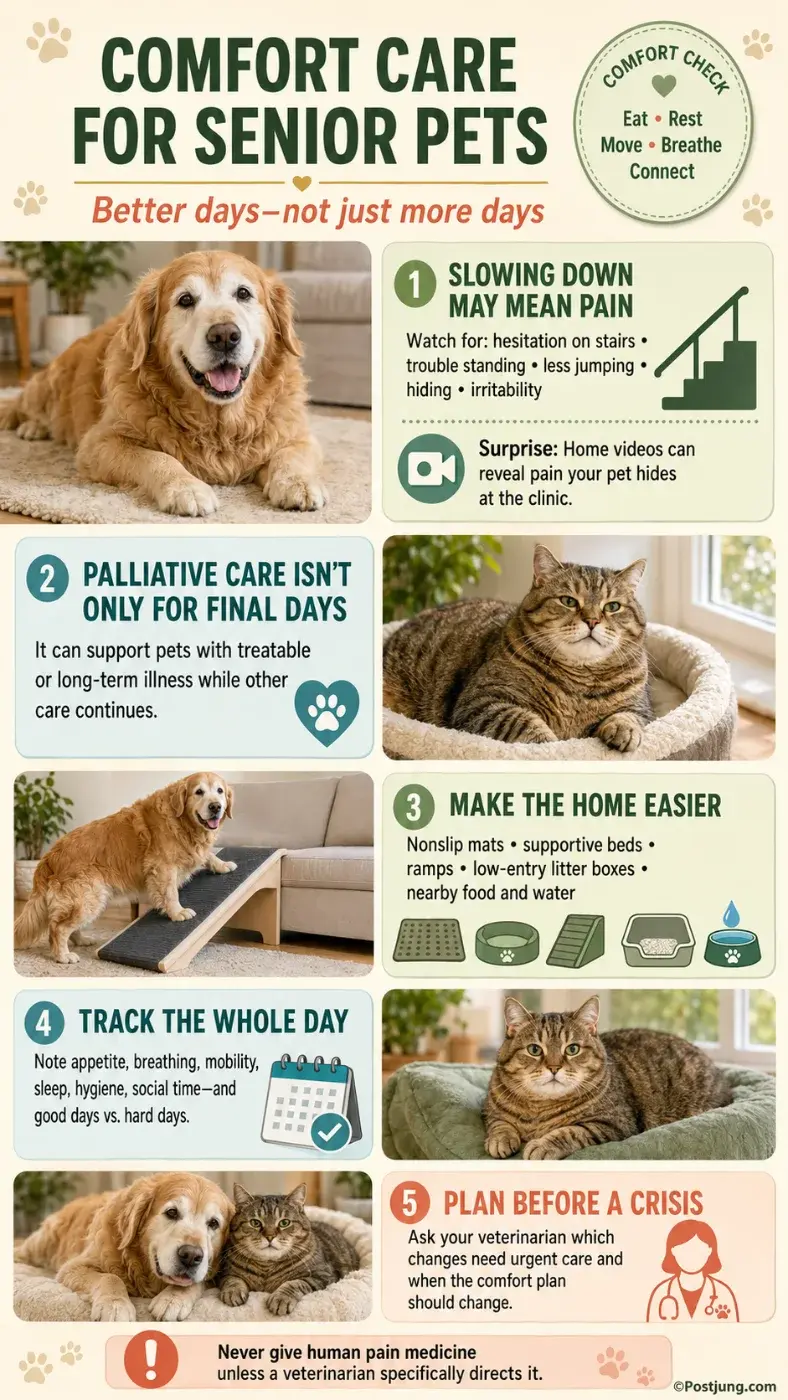
“Slowing down” may be a sign of pain
Changes in older pets can be gradual. A dog may hesitate before climbing stairs, take longer to stand, avoid walks, pant while resting, or become unusually irritable when touched. Cats may stop jumping to favorite places, groom less, hide more often, or have trouble entering a high-sided litter box.
Because these changes appear slowly, families may interpret them as an unavoidable part of aging. Veterinary pain guidelines emphasize that behavior observed at home is important, particularly for chronic pain that may not be obvious during a clinic visit.
Short videos can help a veterinarian see how a pet walks, rises, uses stairs, jumps, eats, or enters a litter box in familiar surroundings. A written record of appetite, sleep, social interaction, toileting, and activity can also reveal patterns that are difficult to recall during an appointment.
Old age itself is not a diagnosis. New changes should be assessed rather than automatically attributed to age.
The home can either reduce or increase discomfort
An older pet’s environment may need to change as strength, balance, vision, hearing, or cognitive function declines.
Practical adjustments can include:
- Placing nonslip mats on smooth floors
- Providing thick, supportive bedding in an easy-to-reach location
- Using ramps or stable steps where appropriate
- Keeping food and water within comfortable reach
- Giving cats low-entry litter boxes and easier access to resting places
- Blocking unsafe stairs or areas where a confused pet could become trapped
- Keeping routines predictable and providing a quiet retreat
- Raising or repositioning bowls when recommended by a veterinarian
The right modification depends on the animal. A ramp that helps one dog may be too steep or unstable for another, while a cat may still value access to an elevated resting spot if safe intermediate steps are provided.
Comfort also includes emotional wellbeing. Older animals may need more uninterrupted rest, shorter activities, gentler handling, or the option to move away from visitors and other pets.
A plan should be individualized
Effective comfort care begins with a veterinary assessment. Pain, nausea, dental disease, breathing difficulty, constipation, dehydration, cognitive changes, and reduced mobility can have different causes and require different responses.
A veterinarian can help establish priorities based on the diagnosis, likely progression, treatment burden, the animal’s preferences, and the family’s ability to provide care. The plan may combine medication, nutritional support, physical rehabilitation, environmental changes, and regular reassessment.
Medication should not be improvised at home. Products intended for people—or prescribed previously for another animal—may be inappropriate or dangerous for a particular dog or cat.
Caregiver limits also deserve honest discussion. A plan that requires lifting a large dog several times a day, complex medication schedules, or constant supervision may not be sustainable for every household. Adjusting the plan is not a failure; realistic care can be safer for both the pet and the person providing it.
Track the whole day, not one good moment
Quality of life includes physical, emotional, and social wellbeing. Appetite matters, but it is only one part of the picture.
Families can monitor whether a pet can:
- Rest and breathe comfortably
- Eat and drink adequately
- Move without severe distress
- Stay clean and eliminate normally
- Interact in ways that remain meaningful to the animal
- Experience more comfortable days than difficult ones
A calendar marking good and bad days can make gradual decline easier to recognize. Families can also list several activities that define enjoyment for their individual pet, such as greeting someone at the door, resting in the sun, sniffing outside, asking for affection, or eating a favorite meal.
Quality-of-life tools can support discussion, but they should not replace veterinary judgment. The American Animal Hospital Association notes that many scales found online have not been formally validated.
Planning early protects future choices
Conversations about worsening symptoms, emergency options, hospice, and euthanasia can be emotionally difficult. Having them before a crisis gives families time to understand what deterioration may look like and decide which interventions would—or would not—serve their pet’s interests.
Comfort care cannot make every disease manageable indefinitely. Severe or unrelenting pain, inability to eat, progressive breathing problems, major mobility loss, or continued decline despite treatment may signal that the plan needs urgent reassessment.
The most compassionate goal is not always the greatest number of days. For an aging pet, it is preserving as many comfortable, recognizable, and meaningful days as responsibly possible.
SOURCES USED:
- American Animal Hospital Association — 2023 AAHA Senior Care Guidelines for Dogs and Cats
- American Animal Hospital Association — 2022 AAHA Pain Management Guidelines for Dogs and Cats
- Journal of Feline Medicine and Surgery — 2023 AAFP/IAAHPC Feline Hospice and Palliative Care Guidelines
- Cornell University College of Veterinary Medicine — Recognizing Pain in Dogs
- Cornell University College of Veterinary Medicine — The Special Needs of the Senior Cat

เขียนโดย Postjung Insights
 7 บทเพลงไวรัลยุคโบราณ! เพลงงานวัดที่เปิดเมื่อไหร่ คนก็ลุกขึ้นรำวงเมื่อนั้น
 เช็กด่วน ! ข่าวบัตรสวัสดิการแจก 10,000 บาท ก.ย. 69 จริงหรือ ? ก่อนเชื่อควรรู้อะไร
 รู้หรือไม่? เปิดรายได้พนักงานส่งพัสดุของแต่ละแอป วันหนึ่งได้เท่าไร
 5 ไอเทมป้องกันความร้อนให้บ้านแบบโบราณ! ภูมิปัญญาเก่าที่ช่วยบ้านเย็นลงได้ 3-5 องศา
 อำเภอที่มีชื่ออำเภอสั้นที่สุด 3 อำเภอเท่านั้นในประเทศไทย
 เปิด 5 โรงเรียนหญิงล้วนเก่าแก่ของไทย ที่มีประวัติยาวนานกว่าศตวรรษ
 ส่องเลข 3 สำนักพิมพ์ งวด 1 ต.ค. 69 ตัวไหนมีข้อมูลตรงกัน
 แปลปกสลาก งวด 1 ต.ค. 69 ส่องตัวเลขจากภาพปกสลากกินแบ่งรัฐบาล
 โรงเรียนที่มีนักเรียนมากที่สุดในไทย
 ตาราง “เด่นเหนือเด่นใต้” งวด 1 ต.ค. 69 เปิดข้อมูลตามโพย เลขไหนอยู่ตรงไหน
 โรงเรียนชายล้วนแห่งแรกของไทยคือที่ไหน? ย้อนดูจุดเริ่มต้นโรงเรียนสวนกุหลาบวิทยาลัย
 รู้หรือไม่? ความทรงจำวัยเด็กอาจไม่ได้เหมือนที่เราเคยจำ! สมองสามารถ “เติมเรื่อง” ให้เราได้อำเภอที่มีชื่ออำเภอสั้นที่สุด 3 อำเภอเท่านั้นในประเทศไทย
 English Edition