Why multi-pet homes cost more than owners expect

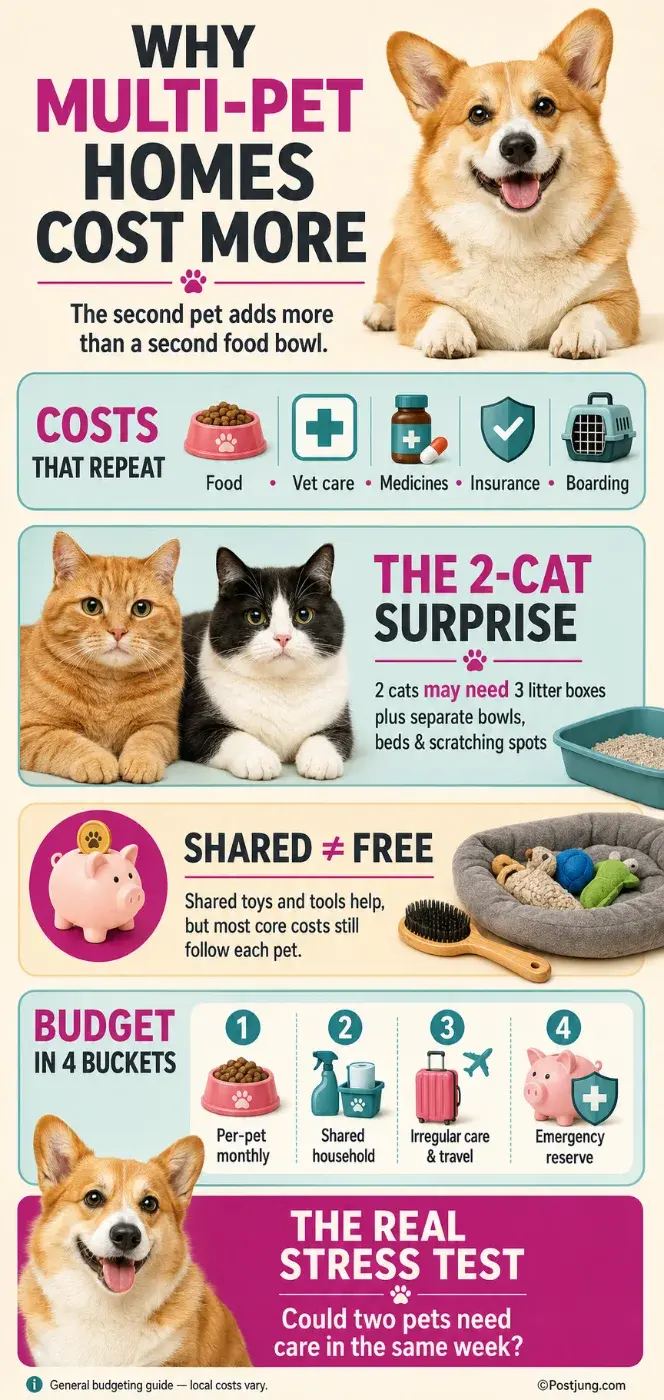
Food is only the beginning. Veterinary care, insurance, boarding, separate equipment, household space, and overlapping emergencies can make each additional pet more expensive than a simple head count suggests.
A second pet may share the sofa, toys, and affection, but it does not share most of its medical care, food allowance, medications, or emergency risk. That distinction is why the cost of a multi-pet home often rises faster than owners anticipate.
The mistake usually begins with simple multiplication. If one pet consumes a certain amount of food each month, an owner may assume that adding another will roughly double the grocery bill while leaving most other costs unchanged.
Some expenses do work that way. Many do not.
Most essential costs follow the individual pet
Every animal has its own health history, nutritional requirements, preventive care schedule, and age-related needs. Routine examinations, vaccinations, parasite prevention, dental care, prescriptions, licenses, microchips, grooming, and insurance generally need to be considered pet by pet.
The ASPCA’s pet-cost framework treats food, routine medical care, preventive medication, insurance, boarding, licensing, and several supplies as recurring expenses. Its published dollar estimates are dated 2021 and should not be treated as current prices, but the categories remain a useful reminder of how little of the core budget disappears when pets live together.
Differences among the animals can widen the gap. A young, healthy cat and a senior cat on prescription food do not create equal monthly expenses. Neither do a small dog and a large dog, even if they share the same home and veterinarian.
Owners should therefore estimate each animal separately instead of creating one generic “pet” line in the household budget.
Shared supplies offer only limited savings
Multi-pet homes can save money by sharing grooming tools, storage containers, some toys, cleaning equipment, and occasionally larger food packages. Veterinary clinics, insurers, trainers, or boarding providers may also offer multi-pet discounts.
Those savings should be verified before they are included in a budget. The American Veterinary Medical Association notes that some insurers offer discounts for multiple pets, but it also advises owners to examine deductibles, copayments, additional charges, exclusions, and other policy terms.
A discount on the second policy does not make the second animal free to insure. The same principle applies to boarding, grooming, training, and routine care: a percentage discount may reduce the bill without eliminating the repeated expense.
Some homes need more equipment than expected
Living together does not mean animals can safely or comfortably share every resource.
Guidance from the Feline Veterinary Medical Association recommends that multi-cat homes provide one litter box, food bowl, water bowl, bed, and scratching post for each cat, plus an extra set of resources where practical. These items should also be separated around the home to reduce competition and tension.
Under that guidance, a two-cat household may need three litter boxes rather than one oversized box. It may also need several feeding stations, resting areas, hiding places, and scratching surfaces.
Space becomes part of the budget, too. Introducing a new cat may require a separate transition room and temporary duplicate supplies. Dogs with different feeding behavior, training needs, or tolerance for one another may likewise need gates, crates, separate walking equipment, or professional behavioral support.
The household may consequently spend more on cleaning products, replacement furniture, air filtration, storage, utilities, or a larger rental property. These costs are easy to miss because they do not always appear on a receipt labeled “pet care.”
Travel and emergencies expose the real total
Daily expenses are predictable. Travel and medical problems are where a multi-pet budget can become strained quickly.
Boarding and pet-sitting charges commonly follow the number of animals, even when a provider offers a package rate. Transportation may require multiple secure carriers or a larger vehicle. International or long-distance travel can involve separate health documents, vaccinations, entry requirements, or transport arrangements for every pet.
Emergency planning also becomes more complicated. Two animals can require treatment during the same period, particularly after a household accident, toxic exposure, extreme-weather event, or contagious illness. An emergency reserve that would cover one animal may be inadequate when several are affected.
Insurance can transfer part of that financial risk, but coverage varies. Owners should confirm waiting periods, exclusions, reimbursement rules, annual limits, deductibles, and whether they must pay the veterinarian before submitting a claim.
A better way to build the budget
A realistic multi-pet budget can be divided into four parts:
- Individual recurring costs: Food, preventive medication, insurance, routine veterinary care, grooming, and prescriptions for each animal.
- Shared household costs: Cleaning equipment, common toys, storage, gates, furniture protection, and other genuinely reusable items.
- Irregular costs: Dental work, replacement carriers, training, boarding, pet sitting, travel documents, and age-related care.
- Emergency capacity: Savings, available credit, insurance, or another reliable plan that can handle more than one urgent case.
Owners can total the annual categories and divide them by 12 to create a monthly target. Local veterinary clinics, boarding facilities, insurers, landlords, and pet sitters can provide more useful figures than national averages because prices and requirements vary widely by location.
The most revealing test is not whether the household can buy food for another animal this month. It is whether it could continue providing appropriate care if that animal developed a chronic condition, needed boarding during an emergency, or required treatment at the same time as an existing pet.
Multi-pet life can be deeply rewarding, but companionship does not create a true economy of scale. The safest budget assumes that each animal remains an individual—with separate needs, separate risks, and a lifetime of care that cannot always be shared.
SOURCES USED:
- American Veterinary Medical Association — Do you need pet insurance?
- ASPCA — Cutting pet care costs
- Feline Veterinary Medical Association — How to introduce a new cat to other cats in your home
- North American Pet Health Insurance Association — Pet Insurance Buying Guide
- ASPCA — Making a plan for your pet

เขียนโดย Postjung Insights
 7 บทเพลงไวรัลยุคโบราณ! เพลงงานวัดที่เปิดเมื่อไหร่ คนก็ลุกขึ้นรำวงเมื่อนั้น
 7 คันเบ็ดตกปลาโบราณ สายเรโทรยอมทุ่มเงินซื้อ! ยิ่งเก่า ยิ่งหายาก ยิ่งมีเรื่องราว
 รู้หรือไม่? เปิดรายได้พนักงานส่งพัสดุของแต่ละแอป วันหนึ่งได้เท่าไร
 รู้หรือไม่? ความทรงจำวัยเด็กอาจไม่ได้เหมือนที่เราเคยจำ! สมองสามารถ “เติมเรื่อง” ให้เราได้
 5 ไอเทมป้องกันความร้อนให้บ้านแบบโบราณ! ภูมิปัญญาเก่าที่ช่วยบ้านเย็นลงได้ 3-5 องศา
 โรงเรียนที่มีนักเรียนมากที่สุดในไทย
 เปิด 5 โรงเรียนหญิงล้วนเก่าแก่ของไทย ที่มีประวัติยาวนานกว่าศตวรรษ
 แปลปกสลาก งวด 1 ต.ค. 69 ส่องตัวเลขจากภาพปกสลากกินแบ่งรัฐบาล
 อำเภอที่มีชื่ออำเภอสั้นที่สุด 3 อำเภอเท่านั้นในประเทศไทย
 เช็กด่วน ! ข่าวบัตรสวัสดิการแจก 10,000 บาท ก.ย. 69 จริงหรือ ? ก่อนเชื่อควรรู้อะไร
 ตาราง “เด่นเหนือเด่นใต้” งวด 1 ต.ค. 69 เปิดข้อมูลตามโพย เลขไหนอยู่ตรงไหน
 ส่องเลข 3 สำนักพิมพ์ งวด 1 ต.ค. 69 ตัวไหนมีข้อมูลตรงกันอำเภอที่มีชื่ออำเภอสั้นที่สุด 3 อำเภอเท่านั้นในประเทศไทย
 English Edition