Why your cat’s carrier should come out long before vet day
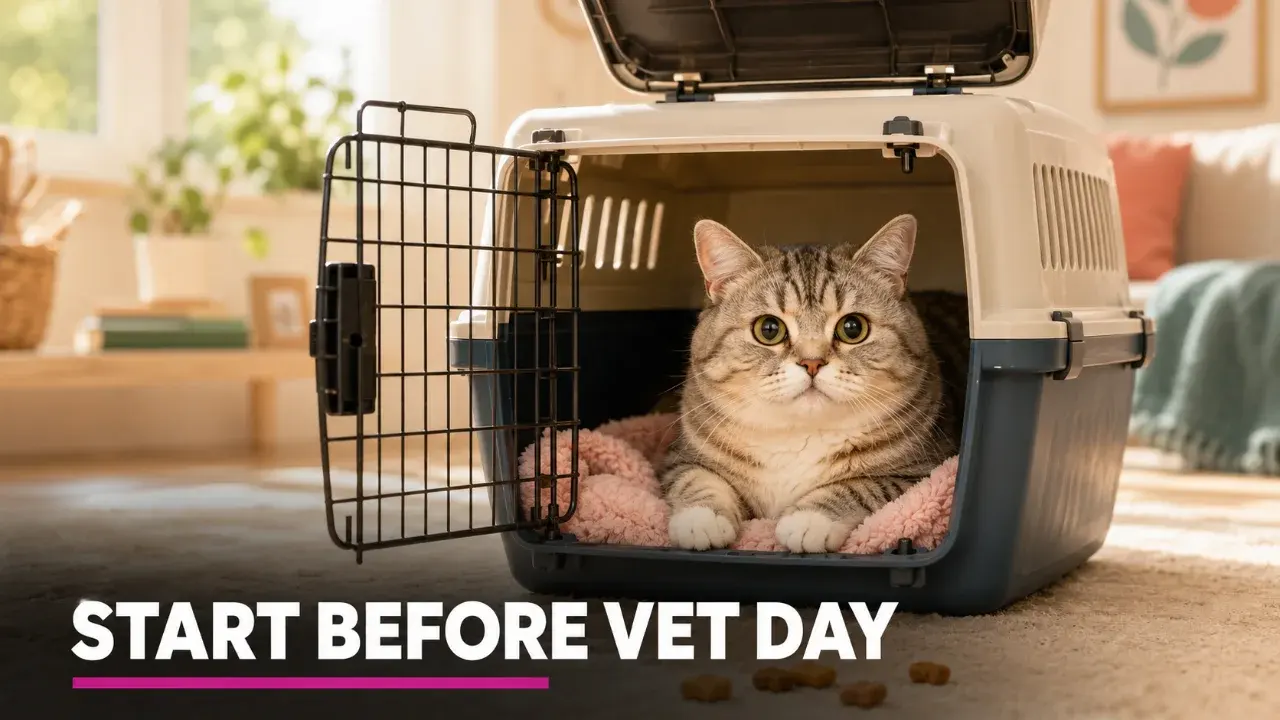
A carrier that appears only before an appointment can become a warning sign for your cat. Leaving it accessible and building positive associations may make travel and veterinary examinations less stressful.
For many cats, a veterinary visit begins with an unwelcome signal: a carrier suddenly appears from a closet or garage. By the time the door opens, the cat may already be hiding.
Introducing the carrier well before it is needed can change that response. Instead of treating it as equipment reserved for stressful trips, owners can make it a familiar resting place that the cat chooses to enter.
The goal is not to force a cat to tolerate confinement. It is to build a gradual association between the carrier and ordinary, rewarding experiences at home.
Why appointment-day introductions can backfire
Cats learn from associations. If the carrier consistently leads to being chased, confined, placed in a moving car, and handled by unfamiliar people, its appearance can predict a sequence of stressful events.
The Feline Veterinary Medical Association warns that chasing or forcing a cat into a carrier can intensify fear and future avoidance. It recommends positive reinforcement, allowing the cat to approach and enter voluntarily whenever possible.
This preparation matters beyond convenience. A frightened cat may be harder to transport and examine, while the struggle can be stressful for the owner and veterinary team as well.
A 2018 randomized controlled trial offers some evidence that training can help. Researchers compared 11 carrier-trained cats with 11 untrained cats during simulated veterinary visits. The trained cats completed 28 short training sessions over six weeks.
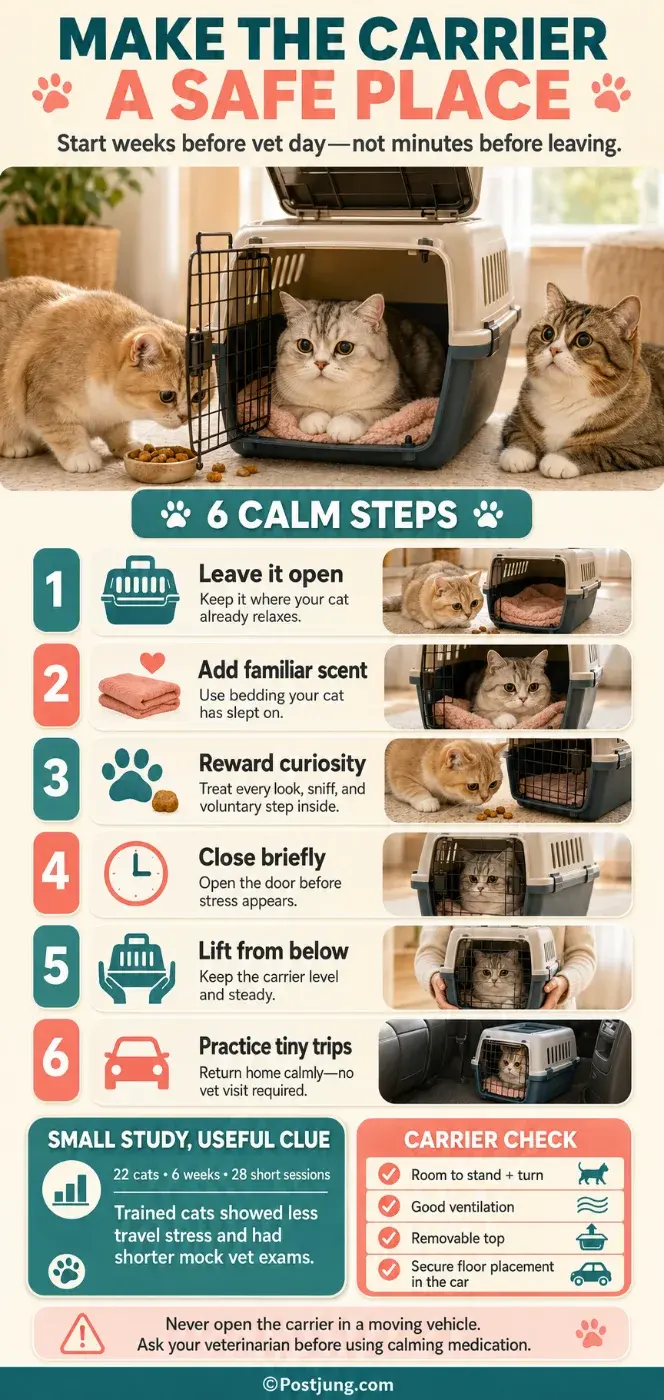
After training, those cats showed lower behavioral stress during a 10-minute car ride and required less time for the veterinary examination. The study was small and involved cats housed at a university, so it cannot predict how every household cat will respond. It does, however, support the use of gradual, reward-based carrier training.
Make the carrier part of the home
Start by leaving the carrier open in a quiet area your cat already uses. Avoid placing it in an exposed, noisy location or immediately attempting to put the cat inside.
Add familiar bedding, such as a blanket or mat on which the cat has already rested. Treats, meals, toys, or gentle attention can be offered near the entrance and then gradually farther inside.
Let the cat control the pace. Some will investigate within minutes, while others—particularly those with a history of frightening trips—may need considerably longer.
Once the cat enters comfortably, training can progress in small stages:
- Reward the cat for approaching or investigating the open carrier.
- Encourage voluntary entry with food, a toy, or familiar bedding.
- Reattach the top or door if it was initially removed.
- Close the door briefly, then open it before the cat becomes distressed.
- Gradually extend the time with the door closed.
- Lift the carrier from underneath for a few seconds while keeping it level.
- Practice brief, calm car rides that end back at home rather than at the clinic.
If the cat stops accepting treats, freezes, struggles to escape, or shows marked fear, return to an easier stage. Training should not become a test that the animal is forced to complete.
Choose a carrier that works at the clinic
A suitable carrier should allow the cat to stand, turn around, sit, and lie down comfortably. It must also be secure, well ventilated, and easy to clean.
A hard-sided model with a front entrance and removable top can be especially useful. If a nervous cat does not want to come out, veterinary staff may be able to remove the top and conduct part of the examination while the cat remains in the familiar bottom section.
Each cat should travel in a separate carrier, even when two cats normally get along. Stress during transportation can change how they react to one another.
When moving the carrier, support it from underneath rather than allowing it to swing from its handle. In the car, the Feline Veterinary Medical Association recommends securing it on the floor behind a front seat. A seat belt should be used only when the carrier is specifically crash-test certified for that arrangement.
A light blanket or towel over the carrier may reduce visual stimulation, provided airflow remains adequate. Never open the carrier while the vehicle is moving, even if the cat is vocalizing.
When training is not enough
Carrier practice can reduce one source of distress, but it cannot eliminate every stressful part of travel or veterinary care. Motion sickness, pain, unfamiliar sounds, earlier frightening experiences, and severe anxiety may still affect a cat.
Owners should contact the veterinary clinic before the appointment if their cat shows intense fear, aggression, repeated escape attempts, vomiting, or excessive drooling during travel. A veterinarian may recommend a tailored plan or prescribe medication to be given before the journey.
Owners should never give sedatives, supplements, or human medications without veterinary guidance. Any prescribed medicine should be tested and administered exactly as the veterinarian directs.
The most useful carrier is not the one hidden away until an appointment. It is the one that has become an ordinary, safe-looking part of the cat’s environment—ready for routine care and unexpected emergencies alike.
SOURCES USED:
- Feline Veterinary Medical Association — 2025 Transportation of Cats in Motor Vehicles Position Statement
- Feline Veterinary Medical Association — Visiting Your Veterinarian: Getting Your Cat to the Veterinary Practice
- American Animal Hospital Association — Preparing Your Pet for a Successful Veterinary Visit
- Applied Animal Behaviour Science — Carrier Training Cats Reduces Stress on Transport to a Veterinary Practice
- Feline Veterinary Medical Association — Positive Reinforcement Training Educational Toolkit

เขียนโดย Postjung Insights
 รู้หรือไม่? เปิดรายได้พนักงานส่งพัสดุของแต่ละแอป วันหนึ่งได้เท่าไร
 7 บทเพลงไวรัลยุคโบราณ! เพลงงานวัดที่เปิดเมื่อไหร่ คนก็ลุกขึ้นรำวงเมื่อนั้น
 5 ไอเทมป้องกันความร้อนให้บ้านแบบโบราณ! ภูมิปัญญาเก่าที่ช่วยบ้านเย็นลงได้ 3-5 องศา
 7 คันเบ็ดตกปลาโบราณ สายเรโทรยอมทุ่มเงินซื้อ! ยิ่งเก่า ยิ่งหายาก ยิ่งมีเรื่องราว
 ส่องเลข 3 สำนักพิมพ์ งวด 1 ต.ค. 69 ตัวไหนมีข้อมูลตรงกัน
 โรงเรียนที่มีนักเรียนมากที่สุดในไทย
 อำเภอที่มีชื่ออำเภอสั้นที่สุด 3 อำเภอเท่านั้นในประเทศไทย
 โรงเรียนชายล้วนแห่งแรกของไทยคือที่ไหน? ย้อนดูจุดเริ่มต้นโรงเรียนสวนกุหลาบวิทยาลัย
 โรงเรียนเพียงแห่งเดียวของประเทศไทย ที่อยู่มาตั้งแต่ยุครัชกาลที่ 4
 ตาราง “เด่นเหนือเด่นใต้” งวด 1 ต.ค. 69 เปิดข้อมูลตามโพย เลขไหนอยู่ตรงไหน
 รู้หรือไม่? ความทรงจำวัยเด็กอาจไม่ได้เหมือนที่เราเคยจำ! สมองสามารถ “เติมเรื่อง” ให้เราได้
 ทำไมหนังสือบางเล่มถึงมีหน้าว่างทั้งหน้า? มันอาจไม่ได้พิมพ์พลาดอำเภอที่มีชื่ออำเภอสั้นที่สุด 3 อำเภอเท่านั้นในประเทศไทย
 English Edition