Why dogs whine when you leave—and when it signals distress

Whining can be a brief request for attention, a response to frustration, or an early sign that a dog is struggling to be alone. The timing and accompanying behaviors reveal more than the sound itself.
A dog that whines as you reach for your keys is communicating something—but it is not necessarily saying the same thing as every other whining dog. The sound may express anticipation, frustration, uncertainty, or genuine fear about being left alone.
Whining is a normal form of canine communication. What makes departure whining significant is its context: when it begins, how long it continues, and what the dog does after the door closes.
Your departure routine has become a signal
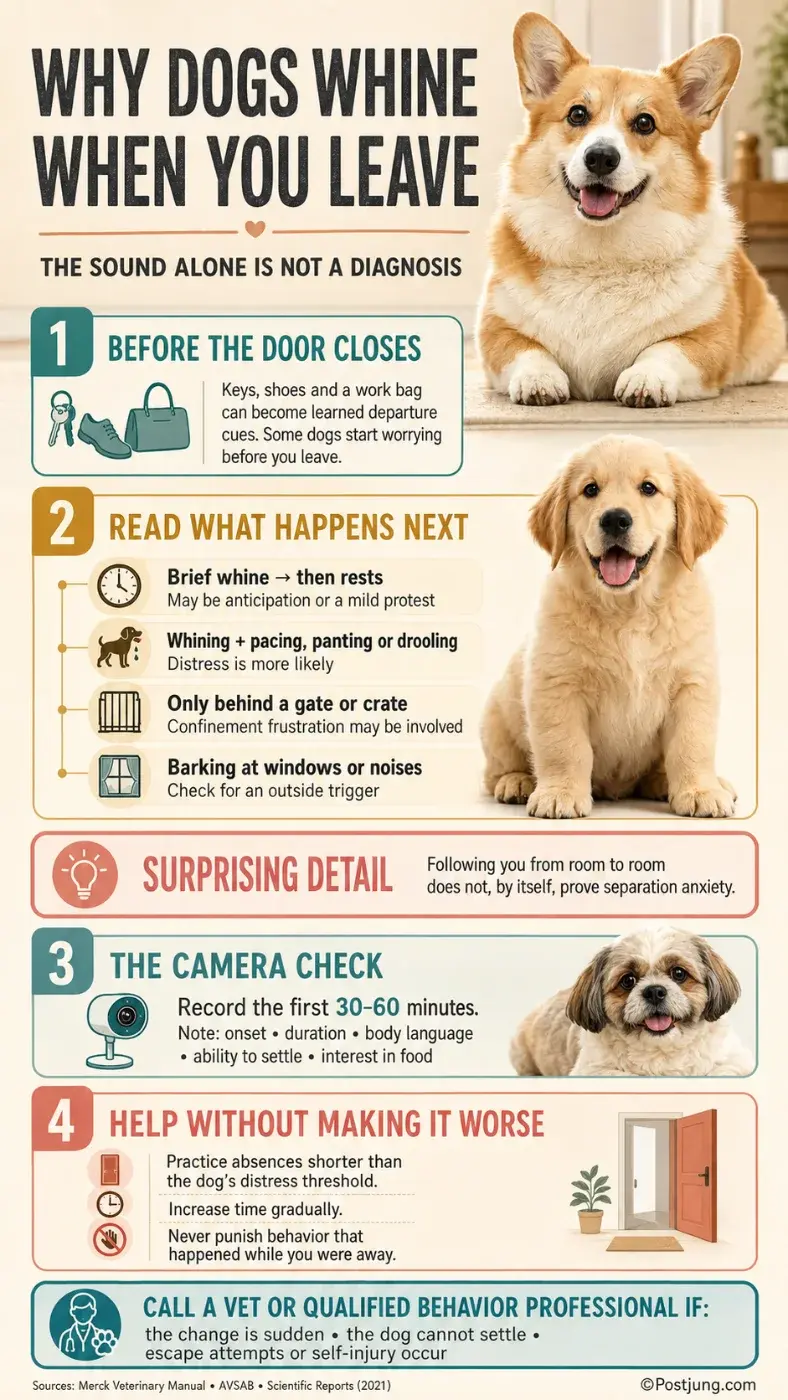
Dogs are quick to learn patterns. Shoes, work clothes, keys, a particular bag, or even the time of day can predict that their caregiver is about to disappear.
A dog may therefore begin whining before anyone reaches the door. This is known as a response to predeparture cues. For some dogs, it is little more than excited anticipation or an attempt to keep the person engaged. For others, those familiar signals trigger mounting anxiety because they predict an absence the dog finds difficult.
Attention can also reinforce the behavior. If whining consistently makes someone stop, speak, offer affection, or delay leaving, a dog may learn that vocalizing is an effective way to influence what happens next. That does not mean the dog is being manipulative; it means the behavior has produced a useful result before.
Whining does not always mean separation anxiety
Researchers increasingly use the broader term “separation-related problems” because similar outward behaviors can arise from different emotional states.
A 2021 study published in Scientific Reports found that separation responses were associated with both fear-related and frustration-related tendencies. Whining was more closely associated with fearful or phobic reactions in the study, while barking and scratching at the door were more strongly linked with frustration. These are group-level associations, however, and cannot diagnose an individual dog from one sound.
Other possible explanations include boredom, confinement frustration, outside noises, insufficient house training, discomfort, or a medical problem. A dog distressed by being shut behind a gate may be comfortable once the caregiver is fully out of sight. Another may bark at people passing a window whether anyone is home or not.
This is why whining by itself is not enough to confirm separation anxiety.
Look for a pattern of distress
Separation distress becomes more likely when whining is persistent and appears with other signs, including:
- Panting, trembling, drooling, or repeated lip licking
- Pacing or an inability to settle
- Scratching or chewing around doors and windows
- Urinating or defecating despite being house-trained
- Refusing food that the dog would normally value
- Repeated escape attempts
- An unusually intense greeting that takes time to calm
- Agitation that begins as soon as departure preparations start
The Merck Veterinary Manual notes that signs of separation distress commonly emerge within the first 15 to 30 minutes after departure. Some dogs react even earlier, while their caregiver is preparing to leave.
A dog that whines briefly, then settles down to sleep or play, presents a different picture from one that continues pacing, panting, vocalizing, or attempting to escape.
A camera provides the clearest evidence
Because the behavior occurs while no one is home, caregivers often see only the aftermath. A home camera, spare phone, tablet, or webcam can reveal what actually happens.
Record at least the first 30 to 60 minutes after leaving. Note when the whining starts, whether it stops, what seems to trigger it, and whether the dog can rest or engage with food.
A few short vocalizations followed by relaxed behavior may indicate a manageable protest. Sustained whining accompanied by physical signs of anxiety suggests a more serious welfare concern. Recording several routine and nonroutine departures can show whether the response is consistent.
Video can also uncover an entirely different trigger, such as construction noise, passing animals, delivery workers, or distress caused specifically by confinement.
Help the dog practice calm, manageable absences
Dogs learn to tolerate solitude most successfully through gradual departures that remain shorter than the point at which they become distressed. For one dog, that starting point might be several minutes. For another, it may be only a few seconds.
Begin with an absence the dog can handle calmly and increase it in small steps. If whining, pacing, or panting begins, the next practice session should be shorter rather than longer.
A safe resting area and a food-filled toy can help some mildly worried dogs form a positive association with alone time. A dog that is too anxious to touch favorite food, however, may need a more structured plan.
Avoid punishment after returning home. Dogs do not reliably connect a delayed reprimand with whining, chewing, or house-soiling that occurred earlier. Scolding can instead make departures and reunions more stressful.
Allowing a severely distressed dog to “cry it out” is also unlikely to teach calm independence. Repeatedly exposing the dog to an absence that causes panic can reinforce the negative response.
When professional help is warranted
Consult a veterinarian when the behavior appears suddenly, is becoming more intense, includes self-injury or escape attempts, or is accompanied by changes in mobility, appetite, elimination, sleep, or general behavior. Pain and other medical conditions can contribute to apparent separation problems.
Moderate or severe cases may require an individualized behavior-modification program designed with a veterinarian or qualified clinical animal behavior professional. Medication is sometimes used alongside training, but it should be selected and prescribed by a veterinarian.
The goal is not simply to silence the whining. It is to determine what the dog is experiencing and help it feel safe enough that calling for its person is no longer necessary.
SOURCES USED:
- Merck Veterinary Manual — Behavior Problems of Dogs
- American Veterinary Society of Animal Behavior — How to Tell if Your Dog Has Separation Anxiety
- Scientific Reports — Separation-Related Behavior of Dogs and Reactions to Frustration or Fear
- Frontiers in Veterinary Science — Disambiguating Separation-Related Problems in Dogs
- RSPCA — Recognising Separation-Related Behaviour and Anxiety in Dogs

เขียนโดย Postjung Insights
 รู้หรือไม่? เปิดรายได้พนักงานส่งพัสดุของแต่ละแอป วันหนึ่งได้เท่าไร
 7 บทเพลงไวรัลยุคโบราณ! เพลงงานวัดที่เปิดเมื่อไหร่ คนก็ลุกขึ้นรำวงเมื่อนั้น
 โรงเรียนที่มีนักเรียนมากที่สุดในไทย
 7 คันเบ็ดตกปลาโบราณ สายเรโทรยอมทุ่มเงินซื้อ! ยิ่งเก่า ยิ่งหายาก ยิ่งมีเรื่องราว
 รู้หรือไม่? ความทรงจำวัยเด็กอาจไม่ได้เหมือนที่เราเคยจำ! สมองสามารถ “เติมเรื่อง” ให้เราได้
 5 ไอเทมป้องกันความร้อนให้บ้านแบบโบราณ! ภูมิปัญญาเก่าที่ช่วยบ้านเย็นลงได้ 3-5 องศา
 อำเภอที่มีชื่ออำเภอสั้นที่สุด 3 อำเภอเท่านั้นในประเทศไทย
 เช็กด่วน ! ข่าวบัตรสวัสดิการแจก 10,000 บาท ก.ย. 69 จริงหรือ ? ก่อนเชื่อควรรู้อะไร
 เปิด 5 โรงเรียนหญิงล้วนเก่าแก่ของไทย ที่มีประวัติยาวนานกว่าศตวรรษ
 แปลปกสลาก งวด 1 ต.ค. 69 ส่องตัวเลขจากภาพปกสลากกินแบ่งรัฐบาล
 ทำไมหนังสือบางเล่มถึงมีหน้าว่างทั้งหน้า? มันอาจไม่ได้พิมพ์พลาด
 ตาราง “เด่นเหนือเด่นใต้” งวด 1 ต.ค. 69 เปิดข้อมูลตามโพย เลขไหนอยู่ตรงไหนอำเภอที่มีชื่ออำเภอสั้นที่สุด 3 อำเภอเท่านั้นในประเทศไทย
 English Edition