Why Cats Sometimes Look at Their Owners While Eating
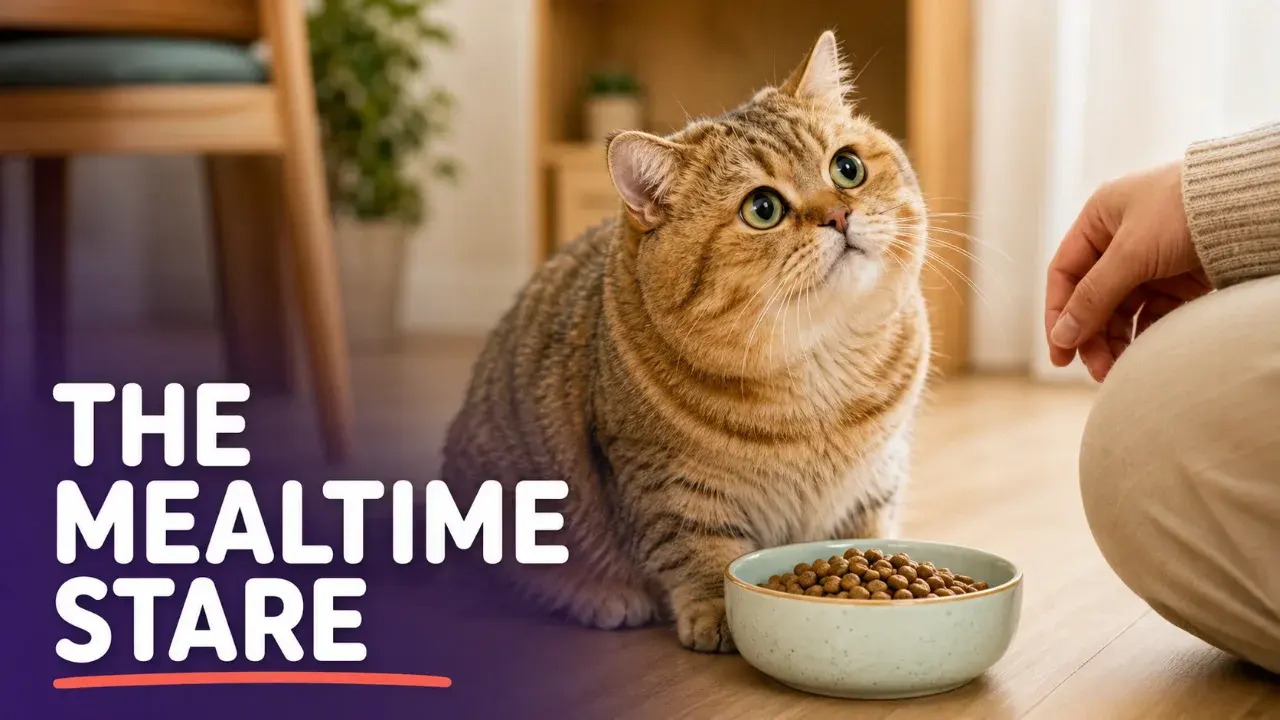
A glance across the food bowl may reflect reassurance, environmental awareness, or a habit your cat has learned. Body language—and whether the behavior is new—offers the most useful clues.
A cat that pauses between bites and fixes its eyes on its owner is not necessarily asking for protection or judging the menu. The look may be a quick environmental check, a request for company, or a behavior that has been rewarded during previous meals.
There is no single scientifically established translation for a cat staring at a person while eating. To understand it, owners need to consider what happens before and after the look, as well as the cat’s posture, appetite, and surroundings.
Your cat may be checking what is happening nearby
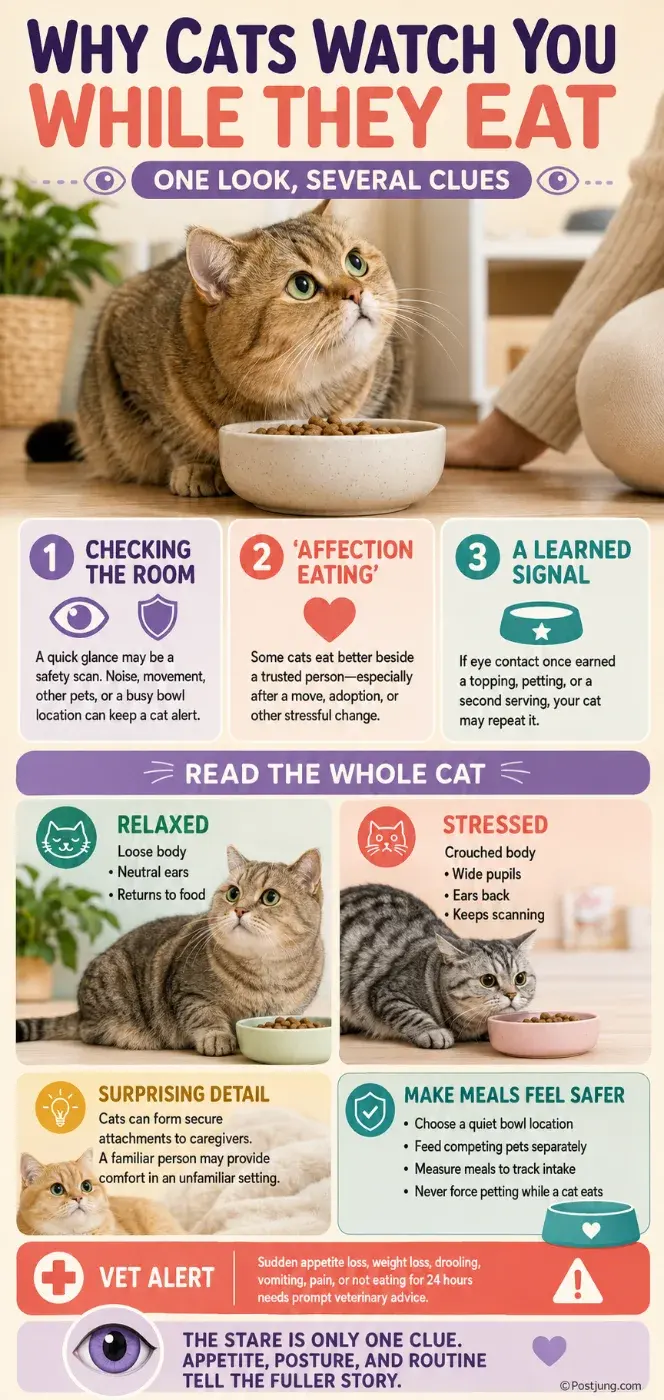
Eating temporarily directs a cat’s attention toward the bowl. Looking up allows the animal to check nearby movement, sounds, people, and other pets before returning to the meal.
This does not necessarily mean the cat believes its owner must “stand guard.” Cats are highly attentive to changes in their environment, and some simply interrupt eating to scan the room.
The feeding location can make a difference. A bowl placed in a busy hallway, beside a noisy appliance, near a window visited by outdoor cats, or where another pet can approach from behind may encourage more frequent checking.
A relaxed cat will usually look up briefly and then resume eating. Its body should remain loose, with neutral or forward-facing ears and no obvious attempt to retreat from the bowl.
Some cats eat more comfortably with human company
Animal shelters sometimes use the informal term “affection eater” for a cat that eats better when a familiar person sits nearby, speaks gently, or offers appropriate physical contact.
The San Francisco SPCA notes that this behavior is particularly common in cats coping with an unfamiliar or stressful environment, including the loss of a previous home or human companion. Some may want only a quiet human presence, while others respond to gentle petting or encouragement.
Research also shows that cats can form meaningful attachments to human caregivers. In a 2019 Oregon State University study, many cats used their caregivers as a source of comfort in an unfamiliar environment. That study did not examine mealtime staring specifically, but it supports the reasonable possibility that a trusted person’s presence helps some cats feel more secure.
This is not universal. Many cats naturally prefer to eat without humans or other animals watching them. The best response depends on the individual cat rather than a rule applied to every pet.
The behavior may have been learned
Cats quickly learn what produces a useful response.
If looking at an owner regularly results in extra food, a tastier topping, petting, conversation, or having the bowl moved, the gaze can become part of the feeding routine. The cat is not necessarily manipulating anyone in a human sense—it is repeating a behavior associated with a favorable outcome.
Watch what happens next. A cat that looks at its owner and then at the food container may be anticipating another serving. One that leaves the bowl and approaches the person may be requesting attention rather than help with eating.
Owners should also check whether the cat actually dislikes something about the meal. An unclean bowl, stale food, a recent recipe change, an uncomfortable bowl shape, or competition from another animal can all affect feeding behavior.
Read the whole cat, not just the eyes
Eye contact alone provides limited information. Posture and movement make the signal easier to interpret.
A comfortable cat may have relaxed whiskers, neutral ears, a loose body, and eyes that are partially closed between glances. It should continue eating normally after checking the room.
Possible signs of anxiety include a crouched or tense posture, flattened or sideways ears, enlarged pupils, repeated scanning, a tightly wrapped tail, or leaving the bowl whenever someone moves. Hiding, increased vigilance, aggression toward another pet, or eating only when the room is completely still can also point to environmental stress.
Owners can help by placing food in a quiet location where the cat has a clear view and cannot be cornered. In multi-cat homes, separate feeding stations can reduce competition. Regular meal times also make it easier to notice changes in how much each cat consumes.
Do not force interaction. A cat that accepts company may benefit from someone sitting calmly nearby, but petting during meals should stop if the cat stiffens, moves away, flicks its tail, or otherwise appears uncomfortable.
A sudden appetite change needs attention
A familiar mealtime glance is usually harmless when the cat is eating a normal amount and otherwise behaving as usual. A sudden change is different.
Contact a veterinarian if the cat begins refusing food unless someone is present, eats substantially less, loses weight, drools, struggles to chew, vomits, becomes lethargic, or develops other behavioral changes.
Cornell University’s Feline Health Center warns that sustained appetite loss can seriously affect an adult cat’s health in as little as 24 hours. Dental pain, kidney disease, gastrointestinal problems, fever, stress, and numerous other conditions can reduce appetite, so a newly dependent feeding pattern should not automatically be dismissed as affection.
The stare itself is rarely the important part. What matters is whether the cat looks relaxed, continues eating normally, and maintains its usual weight and behavior. Those details reveal far more than eye contact alone.
SOURCES USED:
- San Francisco SPCA — Affection Eaters
- Frontiers in Psychology — The Gaze Communications Between Dogs/Cats and Humans
- Oregon State University — Cats Develop Attachments to Their Caregivers, Study Shows
- Cats Protection — Spotting Signs of Cat Stress
- Cornell University College of Veterinary Medicine — Anorexia in Cats

เขียนโดย Postjung Insights
 5 ไอเทมป้องกันความร้อนให้บ้านแบบโบราณ! ภูมิปัญญาเก่าที่ช่วยบ้านเย็นลงได้ 3-5 องศา
 7 คันเบ็ดตกปลาโบราณ สายเรโทรยอมทุ่มเงินซื้อ! ยิ่งเก่า ยิ่งหายาก ยิ่งมีเรื่องราว
 รู้หรือไม่? เปิดรายได้พนักงานส่งพัสดุของแต่ละแอป วันหนึ่งได้เท่าไร
 ตาราง “เด่นเหนือเด่นใต้” งวด 1 ต.ค. 69 เปิดข้อมูลตามโพย เลขไหนอยู่ตรงไหน
 รู้หรือไม่? ความทรงจำวัยเด็กอาจไม่ได้เหมือนที่เราเคยจำ! สมองสามารถ “เติมเรื่อง” ให้เราได้
 อำเภอที่มีชื่ออำเภอสั้นที่สุด 3 อำเภอเท่านั้นในประเทศไทย
 แปลปกสลาก งวด 1 ต.ค. 69 ส่องตัวเลขจากภาพปกสลากกินแบ่งรัฐบาล
 7 บทเพลงไวรัลยุคโบราณ! เพลงงานวัดที่เปิดเมื่อไหร่ คนก็ลุกขึ้นรำวงเมื่อนั้น
 โรงเรียนที่มีนักเรียนมากที่สุดในไทย
 เช็กด่วน ! ข่าวบัตรสวัสดิการแจก 10,000 บาท ก.ย. 69 จริงหรือ ? ก่อนเชื่อควรรู้อะไร
 มารู้จัก“ชมพู่สีม่วงดำ”ผลไม้หน้าตาแปลก สีเข้มจนเกือบดำ
 เปิด 5 โรงเรียนหญิงล้วนเก่าแก่ของไทย ที่มีประวัติยาวนานกว่าศตวรรษอำเภอที่มีชื่ออำเภอสั้นที่สุด 3 อำเภอเท่านั้นในประเทศไทย
 English Edition