Why Your Indoor Cat or Dog Still Needs a Microchip
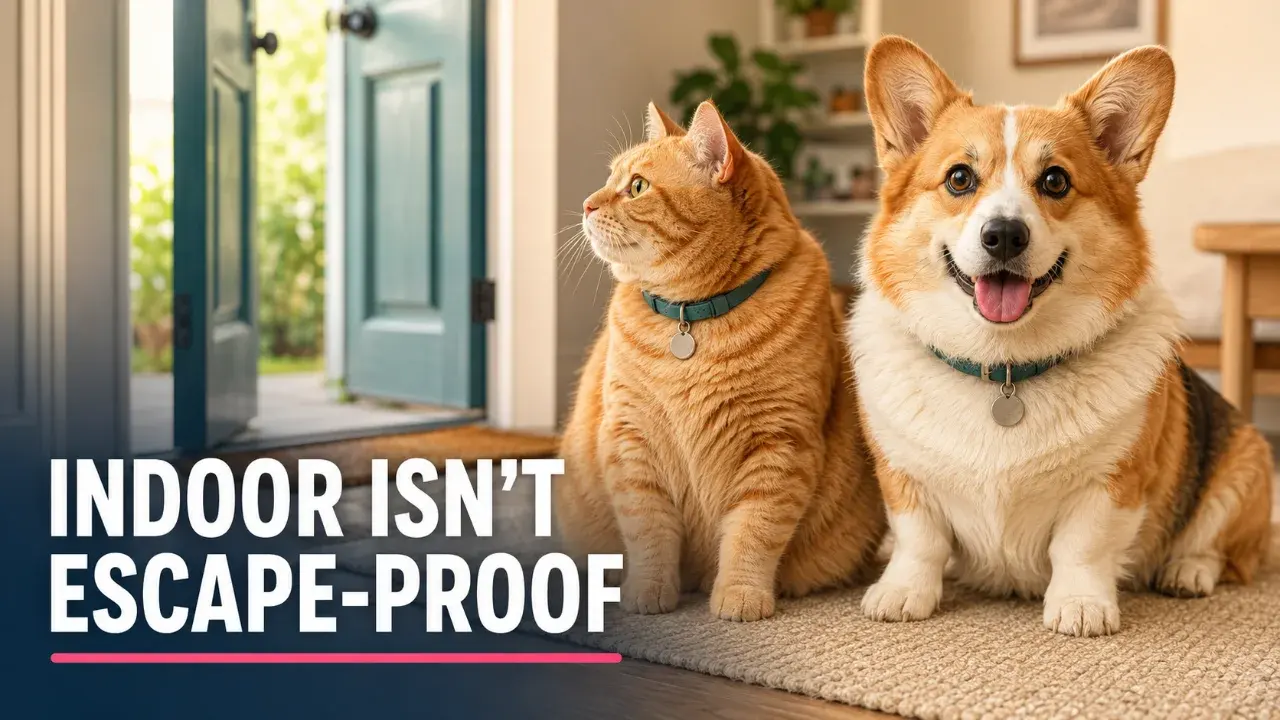
Indoor pets can slip through an open door, escape during a move, or become displaced in an emergency. A registered microchip gives shelters and veterinary clinics a durable way to identify them and contact their family.
Keeping a cat or dog indoors greatly reduces the opportunities for them to wander away. It does not, however, make getting lost impossible.
A visitor can leave a door open. A frightened pet can bolt during a move, storm, fire, or evacuation. Even an animal that has never shown interest in the outdoors may run when an unfamiliar noise or sudden disruption triggers panic.
A microchip provides permanent backup identification for precisely those rare moments when an indoor pet unexpectedly ends up outside.
Indoor does not mean escape-proof
Indoor pets generally live in a controlled environment, but that environment occasionally changes. Deliveries, maintenance work, visiting children, moving furniture, and trips to the veterinarian all create brief opportunities for escape.
Emergencies can overwhelm normal precautions. A damaged window, an evacuation, or a carrier that opens unexpectedly may separate a pet from its owner before anyone has time to attach a collar.
Indoor-only cats can be particularly difficult for strangers to identify. A cat found hiding beneath a porch may look like a community cat or an unowned stray, especially if it has lost its collar.
A microchip cannot prevent these situations, but it can preserve the connection between the animal and its family after other forms of identification are gone.
What a pet microchip actually does
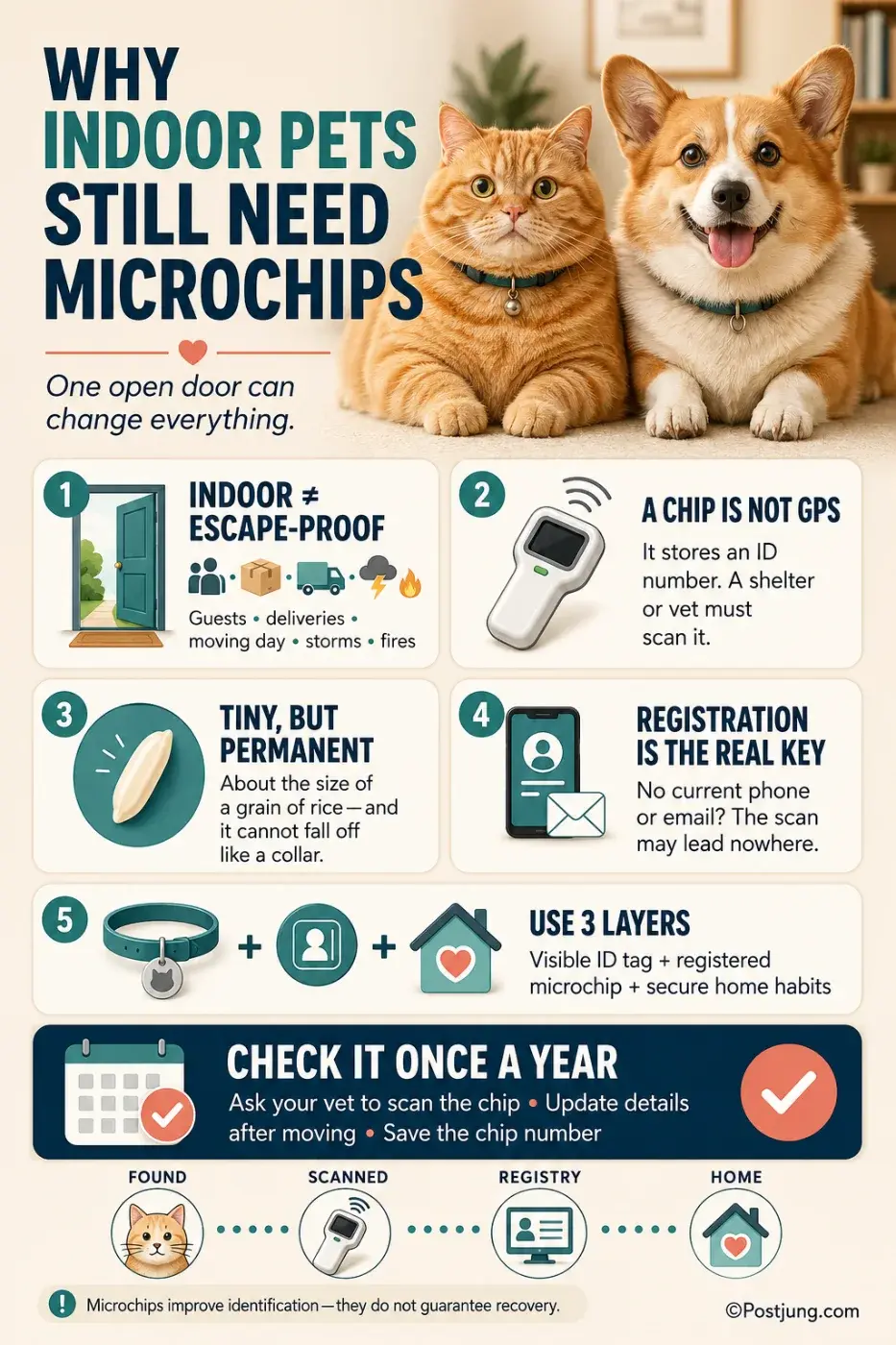
A pet microchip is a small radio-frequency identification device, usually about the size of a grain of rice. A veterinarian implants it beneath the skin using a syringe, commonly around the shoulder area in countries outside continental Europe. The precise standard location varies geographically.
When a shelter or veterinary clinic passes a compatible scanner over the animal, the chip returns a unique identification number. Staff can then use that number to identify the appropriate registry and request that the registered owner be contacted.
The chip itself does not normally contain the owner’s address, medical history, or live location. It stores an identification number linked to information maintained separately by a registry.
It is also not a GPS tracker. A microchip cannot show where a missing pet is or follow its movements. GPS collars and similar devices perform that function, although they depend on a wearable device remaining attached and usually require power, connectivity, or a subscription.
Research supports microchipping as a useful recovery tool. A 2023 retrospective study involving 5,960 dog and 3,489 cat admissions at a municipal shelter in Utah found that microchipped animals were more likely to be returned to their owners. The researchers cautioned that incomplete records and data from a single shelter limited how broadly the findings could be applied.
An earlier study covering 7,704 microchipped animals at 53 shelters also found substantially higher return-to-owner rates among microchipped dogs and cats. These studies do not mean a chip guarantees recovery: the animal must be found, scanned, and connected to usable registration information.
Registration is the step owners cannot skip
Implanting a microchip is only half the process. The identification number must be registered with current contact details.
An unregistered chip may lead only to its manufacturer or distributor. An outdated phone number can leave shelter staff unable to reach the owner even after successfully scanning the animal.
After implantation or adoption, owners should confirm:
- The chip was registered rather than merely implanted.
- The registry has the correct phone number and email address.
- An alternate trusted contact is listed when the service allows it.
- The chip number is saved with the pet’s veterinary and household records.
- The information is updated after a move or change of contact details.
Registry systems differ between countries. In the United States, the American Animal Hospital Association provides a lookup tool that identifies participating registries associated with a chip number; it does not reveal private owner information or update records itself. Pet owners elsewhere should ask their veterinarian which national or regional registry applies.
A chip works best as part of a layered safety plan
Microchips should complement collars and visible ID tags, not replace them. A readable tag lets a neighbor call immediately without traveling to a clinic or shelter. The microchip remains available if the collar slips off or is removed.
The implantation procedure is generally quick and does not usually require anesthesia, although owners should discuss individual medical concerns with their veterinarian. Complications are considered uncommon.
The World Small Animal Veterinary Association recommends that implanted animals be scanned annually to confirm the chip still functions and can be found in the expected area. A routine wellness visit is a convenient time to request this check.
Owners can also reduce escape risk by securing doors and windows, checking carriers and fences, and placing nervous pets in a closed, comfortable room when workers, movers, or guests are entering the home.
For an animal that may spend an entire lifetime safely indoors, a microchip might never need to be used. That is the ideal outcome. Its value lies in remaining with the pet when an ordinary day suddenly stops going according to plan.
SOURCES USED:
- American Animal Hospital Association — Frequently Asked Questions About Pet Microchipping
- American Animal Hospital Association — Microchip Registry Lookup
- World Small Animal Veterinary Association — Microchip Identification Guidelines
- Journal of Shelter Medicine and Community Animal Health — Factors Affecting the Likelihood of Dogs and Cats Returning to Their Owners
- PubMed — Characterization of Animals With Microchips Entering Animal Shelters

เขียนโดย Postjung Insights
 ลาภเด็ด...เช็คให้รวย เปิดเลขเด่นวงกลม 2-9 จัดคู่เลข 6 ชุด งวด 16 พ.ย. 69
 4 โรงงานใหญ่ในไทย ที่มีพนักงานหลักพันคน
 10 นามสกุลที่มีผู้ใช้มากที่สุดในประเทศไทย
 เปิดพิกัดทางหลวง 117 ถนนสายยาวผ่านพิจิตร กับปริศนาทางตรงเกือบ 100 กิโลเมตร
 พลังเต่าหับ ชูเลขเด่นวงกลม 5-1 จัด 8 คู่สองตัว แบ่งชัดสองกลุ่ม งวด 16 พ.ย. 69
 มหาวิทยาลัยไหนมีบัณฑิตตกงานน้อยที่สุดในไทย
 นางฟ้าให้โชค งวด 16 พ.ย. 69 แยกฟ้า-ดิน เลข 2 นำบน เลข 4 คุมล่าง พร้อมคู่เลขน่าจับตา
 5 ชาราคาแพงที่สุดในโลก แพงเพราะอะไรและมีที่มาอย่างไร
 5 มหาวิทยาลัยไทย ที่เรียนจบยากมากที่สุด ต้องผ่านกี่ด่านกว่าจะได้ปริญญา?
 เปิด 10 อำเภอที่ดินถูกที่สุดในไทย บางพื้นที่ราคาประเมินเริ่มเพียง 10,000 บาทต่อไร่
 กันดั้มมีเป็นร้อยตอน ต้องเริ่มดูจากภาคไหนถึงจะดูรู้เรื่อง?
 รู้หรือไม่ว่า "กระเป๋า 4 มิติของ "โดราเอมอน" ใส่สิ่งมีชีวิตได้นะ!!"
 รถไฟสายแรกของไทยเปิดตั้งแต่ พ.ศ. 2436 แต่ทำไมคนส่วนใหญ่จึงจำปี 2439
 มนุษย์เป็นสัตว์ชนิดเดียวที่มีคางจริงหรือ
 คนเราฟังเพลงกี่เพลงตลอดชีวิต
 คนเรากินอาหารกี่มื้อตลอดชีวิต
 ร่างกายสร้างเม็ดเลือดแดงใหม่ได้เร็วแค่ไหนลาภเด็ด...เช็คให้รวย เปิดเลขเด่นวงกลม 2-9 จัดคู่เลข 6 ชุด งวด 16 พ.ย. 69
 English Edition
 Examining the Structure of Thailand’s Amulet Market: When Certification Power, Pricing, and Belief Become a Self-Perpetuating Cycle By C.T. Suwan
 EP1 — What Does It Take to Turn a Book into a Real Product? Behind the Creation of Cosmic Mind: From Manuscript to Four Published Formats
 Why Cats Quiver Their Tails When They Greet You
 Is It Jealousy or Resource Competition Between Pets?