What to Check Before Paying for Dog Daycare

A polished lobby and busy playroom do not tell you how safely a daycare operates. Check its screening, supervision, rest, health, emergency, and payment policies before booking a package.
Dog daycare can provide exercise, stimulation, and companionship, but a lively room full of dogs is not automatically a well-managed one. Before paying a deposit or signing up for multiple days, find out how the facility prevents problems, responds when something goes wrong, and decides whether daycare suits your dog at all.
The strongest providers should be able to explain their procedures clearly. Vague assurances such as “someone is always watching” are less useful than specific answers about staffing, playgroups, rest periods, illness, and emergencies.
Visit the facility before committing
Ask to see the areas where dogs play, rest, drink, and enter or leave the building. If an in-person tour during operating hours would disturb the dogs, the provider may offer an after-hours tour, current video, or another way to observe normal operations.
Look for secure fencing and gates, non-slip floors, adequate ventilation, comfortable temperatures, fresh water, and spaces free of damaged toys, exposed wires, sharp edges, or accumulated waste. An escape-prevention system with more than one barrier between the dogs and an exterior exit is especially valuable.
Observe the dogs as well as the building. Staff should notice when a dog repeatedly tries to escape an interaction, hides, becomes overly excited, or begins pestering another dog.
Ask how dogs are screened and grouped
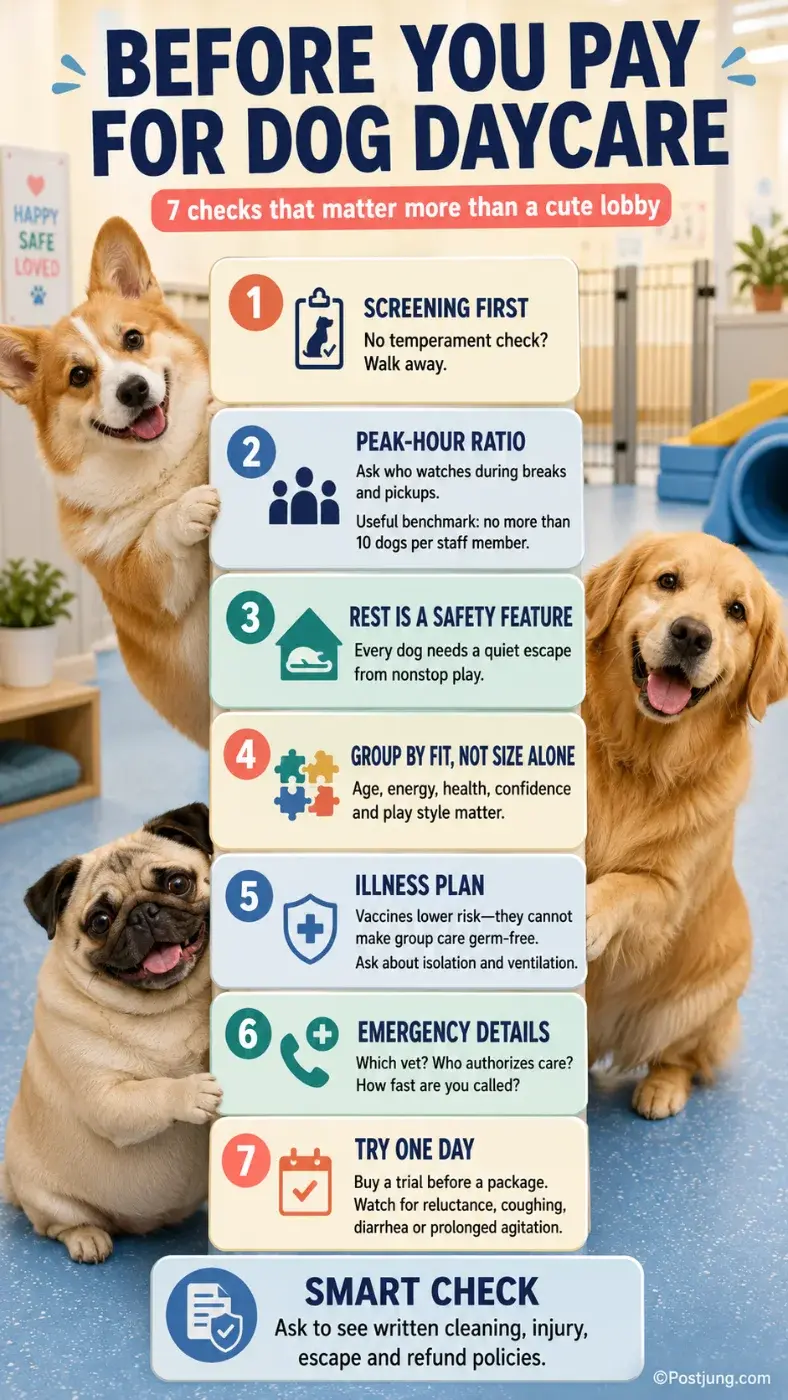
A responsible daycare should collect your dog’s medical and behavioral history and assess the dog before placing them in a group. The American Kennel Club’s daycare guidance recommends asking whether the provider conducts a temperament assessment and whether care can be adjusted to the individual dog.
Automatic acceptance without meaningful questions is not necessarily a benefit. Screening helps identify dogs that may be fearful, uncomfortable around unfamiliar people, prone to guarding resources, or poorly suited to energetic group play.
Ask how groups are formed. Size matters, but it should not be the only consideration. Age, health, energy, confidence, behavior, and play style can all affect compatibility. The facility must also have a practical way to separate a dog promptly without treating isolation as punishment.
Get a specific answer about supervision
Ask how many dogs each employee supervises during active play—and whether that number changes during peak hours, staff breaks, drop-off, or pickup.
There is no single worldwide ratio that guarantees safety. Local regulations differ, and the experience of the handler, group composition, building layout, and dogs’ needs all matter. As one useful regulatory benchmark, current dog-daycare guidance for England says each staff member should generally care for no more than 10 dogs, with one full-time employee per eight dogs listed as a higher standard.
A number alone is not enough. Ask where supervisors stand, whether they can see the entire play area, and what training they receive in canine body language, humane handling, first aid, disease control, and conflict prevention.
Check the schedule for rest—not just play
Continuous activity may sound appealing, but dogs need opportunities to disengage and sleep. Ask how often rest periods occur, where dogs rest, and whether your dog can move away from noise, people, and other animals.
Find out whether crates are used, why they are used, and for how long. A suitable daycare should be able to offer quiet space without forcing every dog into the same all-day routine.
Also ask how staff handle food, toys, and water. Shared resources can create competition, so the center should monitor their use and separate dogs for meals when necessary.
Review health and cleaning policies
Ask which vaccinations and parasite-prevention measures are required, how records are verified, and what happens when a dog arrives coughing, vomiting, experiencing diarrhea, or showing another possible sign of illness.
The American Veterinary Medical Association notes that vaccines such as Bordetella and canine influenza may be recommended for dogs that spend time in daycare, boarding, or other group settings. The appropriate vaccines depend on the dog, location, and current disease risk, so confirm the plan with your veterinarian rather than relying solely on a daycare’s standard list.
No facility can eliminate infection risk completely. What matters is whether it has documented cleaning procedures, good ventilation, prompt waste removal, an isolation area, and a clear rule against mixing potentially infectious dogs with the group.
Know what happens in an emergency
Ask for a step-by-step explanation of what staff do if a dog is injured, escapes, becomes ill, or is involved in a serious conflict. The answer should cover:
- Who provides first aid
- Which veterinarian or emergency clinic is contacted
- How and when the owner is notified
- Who can authorize treatment if the owner cannot be reached
- How sick or injured dogs are separated
- How fires, power failures, extreme heat, flooding, or evacuations are handled
Written plans are stronger than improvised assurances. England’s statutory guidance, for example, requires licensed facilities to maintain emergency procedures, suitable first-aid supplies, veterinary arrangements, and a plan for relocating dogs if the premises become unusable.
Read the financial terms before buying a package
Clarify the full daily rate and any charges for late pickup, medication, feeding, transportation, assessment days, cancellations, holidays, or unused package credits.
Read the liability and veterinary-consent forms carefully. Check what the contract says about injuries, emergency treatment, refunds, package expiration, and suspension from group play. Also verify any license, registration, or insurance required in your jurisdiction.
Professional certification can provide another useful signal, although it does not replace your own inspection. The Professional Animal Care Certification Council offers an independent certification directory and a checklist for comparing pet-care providers.
Begin with a trial, then watch your dog
Choose a short trial before purchasing a long package. Ask staff for candid feedback about your dog’s behavior rather than accepting a generic “great day” report.
Afterward, watch for reluctance to enter, prolonged agitation, unusual withdrawal, appetite changes, diarrhea, coughing, injuries, or behavior that becomes noticeably worse after visits. A dog being tired after active play can be normal; appearing distressed or repeatedly resisting the facility deserves closer attention.
Daycare is optional, not a requirement for a happy dog. A dog walker, small home-based provider, individual sitter, or quieter enrichment routine may be a better investment if group care consistently overwhelms your dog.
SOURCES USED:
- American Kennel Club — How to Choose a Daycare for Your Dog
- American Veterinary Medical Association — Vaccinating Your Pet
- UK Department for Environment, Food & Rural Affairs — Dog Day Care Licensing: Statutory Guidance for Local Authorities
- Professional Animal Care Certification Council — Choosing a Pet Care Provider

เขียนโดย Postjung Insights
 รู้หรือไม่? เปิดรายได้พนักงานส่งพัสดุของแต่ละแอป วันหนึ่งได้เท่าไร
 5 ไอเทมป้องกันความร้อนให้บ้านแบบโบราณ! ภูมิปัญญาเก่าที่ช่วยบ้านเย็นลงได้ 3-5 องศา
 7 บทเพลงไวรัลยุคโบราณ! เพลงงานวัดที่เปิดเมื่อไหร่ คนก็ลุกขึ้นรำวงเมื่อนั้น
 7 คันเบ็ดตกปลาโบราณ สายเรโทรยอมทุ่มเงินซื้อ! ยิ่งเก่า ยิ่งหายาก ยิ่งมีเรื่องราว
 อำเภอที่มีชื่ออำเภอสั้นที่สุด 3 อำเภอเท่านั้นในประเทศไทย
 โรงเรียนที่มีนักเรียนมากที่สุดในไทย
 รู้หรือไม่? ความทรงจำวัยเด็กอาจไม่ได้เหมือนที่เราเคยจำ! สมองสามารถ “เติมเรื่อง” ให้เราได้
 เปิด 5 โรงเรียนหญิงล้วนเก่าแก่ของไทย ที่มีประวัติยาวนานกว่าศตวรรษ
 ตาราง “เด่นเหนือเด่นใต้” งวด 1 ต.ค. 69 เปิดข้อมูลตามโพย เลขไหนอยู่ตรงไหน
 โรงเรียนชายล้วนแห่งแรกของไทยคือที่ไหน? ย้อนดูจุดเริ่มต้นโรงเรียนสวนกุหลาบวิทยาลัย
 เช็กด่วน ! ข่าวบัตรสวัสดิการแจก 10,000 บาท ก.ย. 69 จริงหรือ ? ก่อนเชื่อควรรู้อะไร
 ส่องเลข 3 สำนักพิมพ์ งวด 1 ต.ค. 69 ตัวไหนมีข้อมูลตรงกันอำเภอที่มีชื่ออำเภอสั้นที่สุด 3 อำเภอเท่านั้นในประเทศไทย
 English Edition