Why cats groom themselves right after you pet them
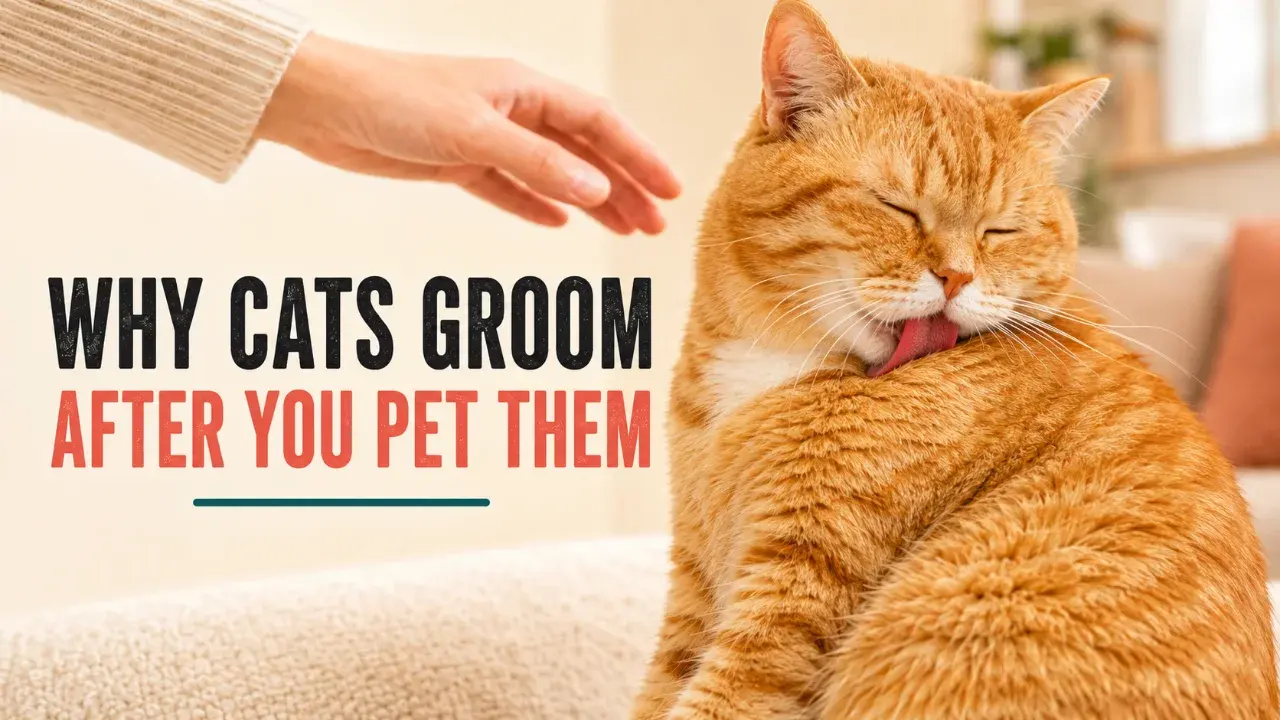
A quick lick after petting does not necessarily mean your cat is rejecting you. It may be routine coat care, a response to physical stimulation, or a subtle request for a break.
A cat that begins licking its fur seconds after being petted can appear to be deliberately undoing your affection. The behavior is usually far less personal—and its meaning depends on what the cat does before, during, and after that first lick.
There is no single experimentally proven reason that explains every instance of post-petting grooming. In some situations, touching the coat may simply trigger an ordinary grooming sequence. In others, a brief burst of licking can be a displacement behavior or a sign that the cat has had enough physical contact.
Grooming is already a major part of a cat’s routine
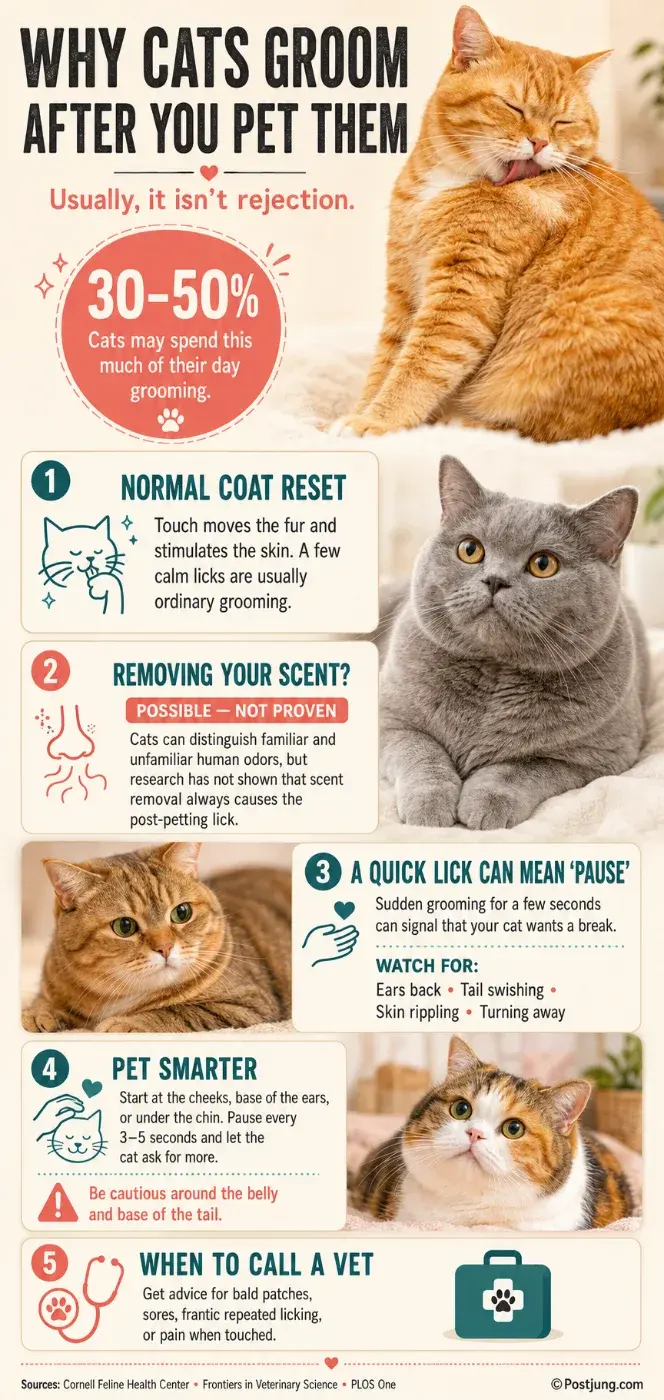
Cats do not need a special reason to begin washing themselves. Cornell University’s Feline Health Center notes that cats may spend 30% to 50% of their day grooming, although the amount varies between individuals.
Normal grooming helps maintain the coat, remove loose material and deal with parasites. Research published in Applied Animal Behaviour Science also found that cats exposed to fleas groomed more frequently and that grooming helped reduce their flea burden.
Petting moves individual hairs and stimulates the skin, so it is plausible that the physical sensation can prompt a cat to lick or reposition its coat. However, that explanation has not been directly established as the cause of every post-petting grooming episode.
A relaxed cat that gives the touched area a few unhurried licks, settles down and displays no other signs of discomfort is probably performing ordinary maintenance.
Is your cat trying to remove your smell?
The claim that cats groom after petting specifically to “remove the human scent” is repeated frequently online, but direct evidence for that conclusion is limited.
Scent certainly matters to cats. A 2025 study involving 30 domestic cats found that they sniffed an unfamiliar person’s odor longer than their owner’s odor, suggesting that cats can distinguish between familiar and unfamiliar human smells. Cats also exchange and deposit odors through rubbing behavior.
The study did not test grooming after petting, however, and it did not show that cats lick themselves because they dislike or want to erase an owner’s scent. Scent management remains a possible contributor, not a universal or proven answer.
In fact, cats often rub their cheeks and bodies against trusted people. That behavior would make little sense if every trace of human odor were automatically unwelcome.
A sudden lick can mean “pause”
The timing and intensity of the grooming matter.
In a 2021 study of human-cat interactions, researchers taught participants to give cats more choice, monitor their body language and concentrate touch around commonly preferred areas such as the cheeks and base of the ears. The cats subsequently displayed more friendly behavior and fewer signs of conflict or aggression.
The researchers’ handling guidelines listed suddenly grooming for a few seconds as one possible sign that a cat needs a break. Other signals included:
- Turning the head away
- Flattening or rotating the ears backward
- Becoming unusually still
- Rippling skin along the back
- Twitching or vigorously swishing the tail
- Sharply turning toward the person’s hand
- Moving away
In this context, grooming may act as a displacement behavior—a familiar action performed during mild conflict, uncertainty or arousal. It does not necessarily mean the cat is severely distressed, but it is a good reason to stop touching and observe what happens next.
Where you pet the cat makes a difference
Cats have individual preferences, but research suggests that body location affects their response.
One study found the strongest negative reactions when cats were stroked around the caudal region, including the area near the base of the tail. Other research-based handling guidance recommends beginning around the cheeks, base of the ears and, for some cats, under the chin.
A simple way to ask for consent is to pause after three to five seconds of petting. If the cat rubs against your hand or moves closer, it may want the interaction to continue. If it turns away, starts flicking its tail or begins a tense grooming burst, give it space.
This method is more reliable than assuming that purring alone means unlimited touching is welcome.
When grooming deserves a veterinary check
Occasional grooming after petting is generally not concerning. A sudden change in frequency or intensity is different.
Cornell University advises paying attention when licking causes bald patches, broken hair, skin damage or unusually frequent hairballs. Concentrated licking can occur when an area is itchy or painful, while more widespread grooming may be associated with parasites, allergies or other skin problems.
Contact a veterinarian if your cat:
- Repeatedly attacks the same area after it is touched
- Develops thinning hair, bald patches, sores or scabs
- Shows skin rippling or extreme sensitivity along the back
- Bites or cries when a particular area is handled
- Grooms much more frequently than usual
- Cannot be interrupted from prolonged licking
The most useful interpretation comes from the whole sequence. Calm licking followed by resting is different from frantic grooming accompanied by flattened ears, tail lashing or skin twitching.
Your cat is probably not issuing a verdict on your cleanliness. It may simply be tidying its coat—or quietly telling you that the petting session is over.
SOURCES USED:
- Frontiers in Veterinary Science — Providing Humans With Practical, Best Practice Handling Guidelines During Human-Cat Interactions
- University of Lincoln — The Influence of Body Region and Handler Familiarity on Cats’ Responses to Stroking
- Cornell Feline Health Center — Cats That Lick Too Much
- PLOS One — Behavioral Responses of Domestic Cats to Human Odor
- Merck Veterinary Manual — Structure of the Skin in Cats

เขียนโดย Postjung Insights
 รู้หรือไม่? เปิดรายได้พนักงานส่งพัสดุของแต่ละแอป วันหนึ่งได้เท่าไร
 7 บทเพลงไวรัลยุคโบราณ! เพลงงานวัดที่เปิดเมื่อไหร่ คนก็ลุกขึ้นรำวงเมื่อนั้น
 7 คันเบ็ดตกปลาโบราณ สายเรโทรยอมทุ่มเงินซื้อ! ยิ่งเก่า ยิ่งหายาก ยิ่งมีเรื่องราว
 รู้หรือไม่? ความทรงจำวัยเด็กอาจไม่ได้เหมือนที่เราเคยจำ! สมองสามารถ “เติมเรื่อง” ให้เราได้
 เปิด 5 โรงเรียนหญิงล้วนเก่าแก่ของไทย ที่มีประวัติยาวนานกว่าศตวรรษ
 ตาราง “เด่นเหนือเด่นใต้” งวด 1 ต.ค. 69 เปิดข้อมูลตามโพย เลขไหนอยู่ตรงไหน
 อำเภอที่มีชื่ออำเภอสั้นที่สุด 3 อำเภอเท่านั้นในประเทศไทย
 ส่องเลข 3 สำนักพิมพ์ งวด 1 ต.ค. 69 ตัวไหนมีข้อมูลตรงกัน
 5 ไอเทมป้องกันความร้อนให้บ้านแบบโบราณ! ภูมิปัญญาเก่าที่ช่วยบ้านเย็นลงได้ 3-5 องศา
 โรงเรียนที่มีนักเรียนมากที่สุดในไทย
 AI วิเคราะห์สถิติ 20 ปีหวยงวด 1 ตุลาคม 69 ให้เลขท้าย 2 ตัวเน้นๆ!
 เช็กด่วน ! ข่าวบัตรสวัสดิการแจก 10,000 บาท ก.ย. 69 จริงหรือ ? ก่อนเชื่อควรรู้อะไรอำเภอที่มีชื่ออำเภอสั้นที่สุด 3 อำเภอเท่านั้นในประเทศไทย
 English Edition