Why pet food allergies are so hard to identify

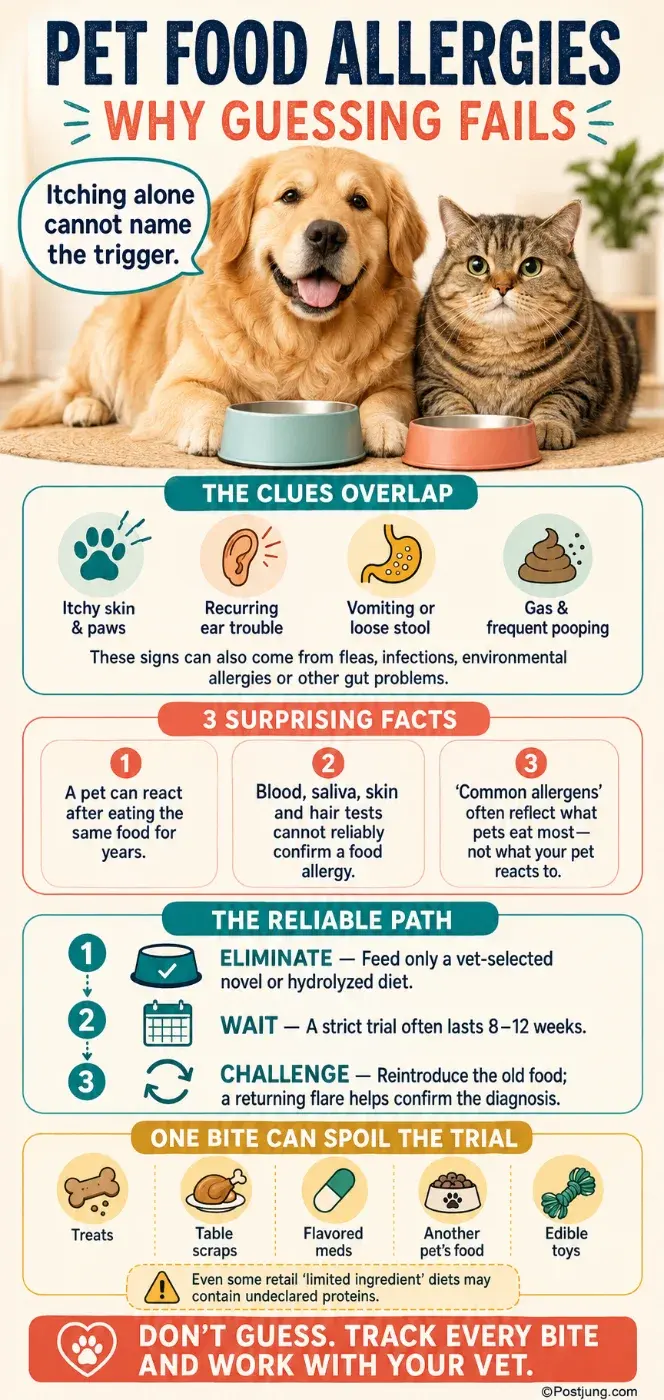
Itching, ear infections, vomiting, and loose stools can have many causes—and popular allergy tests may not provide a dependable answer. Confirming a food allergy usually requires a carefully controlled diet trial followed by a deliberate food challenge.
A dog that constantly licks its paws or a cat that scratches around its face may appear to be reacting to food. Yet those signs alone cannot identify either a food allergy or the ingredient responsible.
Food allergies can resemble environmental allergies, flea allergy, parasites, skin infections, and several digestive disorders. Even when food is involved, finding the trigger requires more than choosing a new flavor or avoiding whichever ingredient has the worst reputation.
The symptoms do not point to one ingredient
In dogs and cats, persistent itching is the most common skin sign linked to food allergy. Dogs may develop itchy feet, ears, bellies, or other areas, while affected cats often scratch or overgroom around the head and neck.
Recurring ear inflammation and secondary bacterial or yeast infections can also occur. Some animals have digestive signs such as vomiting, diarrhea, soft stools, increased bowel movements, gas, or abdominal discomfort.
The problem is that none of these patterns is unique to food allergy. The American Animal Hospital Association’s guidelines state that medical history and physical examination generally cannot distinguish food allergy from atopic dermatitis, an allergic skin condition commonly associated with environmental triggers.
The old assumption that itching around a dog’s ears and rear reliably indicates a food allergy is also considered inaccurate. A veterinarian may first need to investigate fleas, mites, infections, environmental allergies, and other possible causes.
A familiar food can still become a problem
Owners sometimes rule out an ingredient because their pet has eaten it safely for years. That reasoning is unreliable: an allergy can develop after repeated exposure, and animals of many ages can be affected.
The Merck Veterinary Manual lists beef, dairy products, chicken, wheat, and lamb among the most frequently reported allergens in dogs. In cats, beef, fish, and chicken are commonly reported.
Those lists cannot predict an individual animal’s trigger. Frequently reported allergens tend to be ingredients that pets are frequently fed, and feeding patterns vary by location and over time. A pet may also react to more than one food source.
A true food allergy involves an abnormal immune response. The broader category of adverse food reactions can also include nonimmune problems, such as intolerance. Similar digestive symptoms therefore do not necessarily share the same biological cause.
Popular tests cannot provide a firm diagnosis
Blood, saliva, skin, patch, and hair tests have all been investigated or marketed for pet food allergies. None has consistently matched the reactions animals experience when they actually eat the suspected food.
Merck concludes that a strict elimination diet followed by a food challenge remains the only reliable method of confirming a food allergy. The AAHA guidelines likewise say serum, saliva, and hair tests have no diagnostic value for identifying the condition.
This distinction matters because an inaccurate result can lead owners to remove ingredients unnecessarily while overlooking the real cause of a pet’s symptoms.
An elimination trial is stricter than changing brands
During an elimination trial, a veterinarian selects a nutritionally complete diet containing either a protein the animal has not previously eaten or hydrolyzed protein. Hydrolyzed proteins have been broken into smaller fragments that are less likely to be recognized by the immune system.
The diet must be chosen from the pet’s complete feeding history—not just the main food currently in its bowl. Previous treats, table scraps, supplements, chews, and flavored medications can affect which ingredients are suitable.
Trials commonly continue for eight weeks, although some animals may need longer. The AAHA guidelines note that eight weeks may identify more than 90% of food-allergic dogs that respond to a strict prescription diet trial, while a smaller group may require up to 12 weeks.
During that period, the test diet must be the only food the animal consumes. Possible sources of accidental exposure include:
- Treats and table scraps
- Flavored medications or pill pockets
- Edible or flavored toys
- Another pet’s food
- Shared bowls
- Food found outdoors
- In some dogs, access to cat feces
Even an occasional bite can make the result difficult to interpret.
Over-the-counter “limited ingredient” food may also be unsuitable for a diagnostic trial. The AAHA guidelines warn that undeclared protein sources have been detected in some retail diets. Veterinary prescription diets are generally preferred when a controlled commercial elimination trial is needed.
A home-cooked diet may be an option in selected cases, but it should be formulated with veterinary guidance so that it remains nutritionally appropriate, particularly if it will be fed beyond a short diagnostic period.
Improvement is only half the test
If the pet improves, that does not immediately prove which ingredient caused the original problem. Symptoms can change for other reasons, including treatment of an infection, seasonal variation, or differences in the new diet.
Confirmation requires a challenge: the original food is reintroduced under veterinary direction to see whether the signs return. If symptoms recur and then resolve again after returning to the elimination diet, the evidence for a food-related reaction becomes much stronger.
Individual ingredients may subsequently be challenged one at a time to identify what the animal can and cannot tolerate. Cornell University’s Feline Health Center describes the same elimination-and-reintroduction process for cats.
The difficulty is not simply that pets cannot describe what they feel. Their symptoms overlap with other diseases, their feeding histories are often complicated, and reliable diagnosis depends on weeks of unusually strict control.
Owners who suspect a food allergy should consult a veterinarian before repeatedly switching foods. A structured investigation can prevent unnecessary restrictions while ensuring that infections, parasites, and other medical causes are not missed.
SOURCES USED:
- Merck Veterinary Manual — Cutaneous Food Allergy in Animals
- American Animal Hospital Association — 2023 AAHA Management of Allergic Skin Diseases in Dogs and Cats Guidelines
- Cornell University College of Veterinary Medicine — Food Allergies
- VCA Animal Hospitals — Implementing an Elimination-Challenge Diet Trial in Dogs

เขียนโดย Postjung Insights
 7 บทเพลงไวรัลยุคโบราณ! เพลงงานวัดที่เปิดเมื่อไหร่ คนก็ลุกขึ้นรำวงเมื่อนั้น
 รู้หรือไม่? เปิดรายได้พนักงานส่งพัสดุของแต่ละแอป วันหนึ่งได้เท่าไร
 5 ไอเทมป้องกันความร้อนให้บ้านแบบโบราณ! ภูมิปัญญาเก่าที่ช่วยบ้านเย็นลงได้ 3-5 องศา
 ตาราง “เด่นเหนือเด่นใต้” งวด 1 ต.ค. 69 เปิดข้อมูลตามโพย เลขไหนอยู่ตรงไหน
 รู้หรือไม่? ความทรงจำวัยเด็กอาจไม่ได้เหมือนที่เราเคยจำ! สมองสามารถ “เติมเรื่อง” ให้เราได้
 อำเภอที่มีชื่ออำเภอสั้นที่สุด 3 อำเภอเท่านั้นในประเทศไทย
 ส่องเลข 3 สำนักพิมพ์ งวด 1 ต.ค. 69 ตัวไหนมีข้อมูลตรงกัน
 โรงเรียนที่มีนักเรียนมากที่สุดในไทย
 เช็กด่วน ! ข่าวบัตรสวัสดิการแจก 10,000 บาท ก.ย. 69 จริงหรือ ? ก่อนเชื่อควรรู้อะไร
 7 คันเบ็ดตกปลาโบราณ สายเรโทรยอมทุ่มเงินซื้อ! ยิ่งเก่า ยิ่งหายาก ยิ่งมีเรื่องราว
 แปลปกสลาก งวด 1 ต.ค. 69 ส่องตัวเลขจากภาพปกสลากกินแบ่งรัฐบาล
 ทำไมบ้านเลขที่ 23–24 Leinster Gardens จึงไม่มีห้องอยู่ด้านหลังอำเภอที่มีชื่ออำเภอสั้นที่สุด 3 อำเภอเท่านั้นในประเทศไทย
 English Edition