How to Build a Budget for an Aging Pet

Older pets may need more frequent exams, diagnostic testing, medication, dental treatment, and mobility support. A workable budget separates those predictable costs from true emergencies—and starts with your veterinarian, not a generic online estimate.
Aging does not automatically mean that a pet is ill, but it often changes the kind and frequency of care they need. The most useful financial plan anticipates routine monitoring, prepares for chronic conditions, and preserves cash for decisions that cannot wait.
There is no universal “senior pet budget.” Costs vary by species, breed, body size, medical history, location, and the veterinary services available nearby. Instead of choosing an arbitrary savings target, build a plan around your pet’s health and actual local prices.
Start with a senior-care forecast
Ask your veterinarian when your pet should be considered senior. The answer is not based on one birthday for every animal: the American Animal Hospital Association defines the senior stage for dogs as roughly the final quarter of their expected lifespan, while cats older than 10 are generally classified as senior.
AAHA advises twice-yearly veterinary examinations for senior dogs and cats, including animals that appear healthy. Depending on the individual pet, a visit may include a physical and dental assessment, blood work, urinalysis, thyroid testing, blood-pressure measurement, or other screening.
At the next appointment, ask the clinic for an estimate covering the coming 12 months. It should distinguish recommended routine care from tests or treatments that would be needed only if a problem appears.
Divide the predictable annual total by 12. If planned care would cost 1,200 in your local currency over the year, for example, setting aside 100 each month turns a large future bill into a regular expense.
Review the estimate after every major diagnosis and at least once a year, since a senior pet’s needs can change quickly.
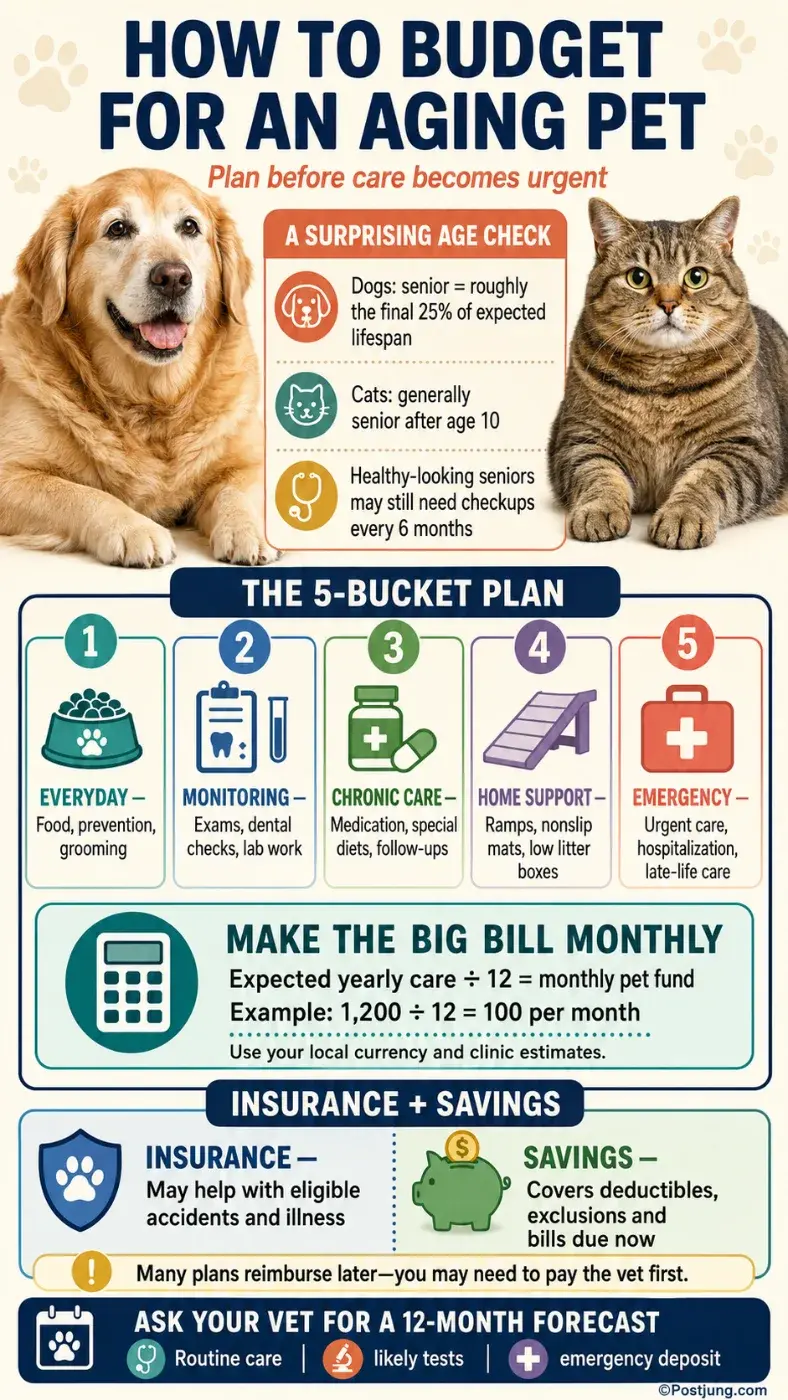
Divide the budget into five parts
A useful senior-pet budget has separate categories:
- Everyday care: Food, parasite prevention, grooming, litter, routine medication, and other recurring supplies.
- Preventive and monitoring care: Examinations, vaccinations selected for the pet’s lifestyle, dental assessments, and veterinarian-recommended screening tests.
- Chronic-condition care: Prescription diets, repeat laboratory tests, medication, rehabilitation, specialist consultations, and follow-up appointments. Once a condition is diagnosed, request both a monthly estimate and a likely annual range.
- Home and mobility support: Nonslip mats, ramps, orthopedic bedding, low-sided litter boxes, harnesses, slings, absorbent pads, or changes to feeding stations. These purchases may be occasional, but they should not be treated as surprises.
- Emergency and late-life care: Urgent examinations, imaging, hospitalization, surgery, palliative or hospice support, euthanasia, and aftercare where available.
Keep emergency savings separate from the account used for routine expenses. Otherwise, a dental procedure or prescription refill may quietly consume the money intended for an urgent event.
Set the emergency target using local evidence
Generic cost figures found online may reflect another country, clinic system, or level of care. Call your regular clinic and the nearest emergency hospital to ask about consultation fees, deposits, payment policies, and the approximate cost of evaluating common emergencies.
Use those figures, your pet’s medical history, and the amount you could pay from current income to set an initial savings target. Build it gradually through an automatic transfer after each payday.
The Consumer Financial Protection Bureau notes that even a small dedicated reserve can provide protection from unexpected bills. The account should be safe, accessible, and separate enough that it is not routinely spent on non-emergencies.
If the full target feels unreachable, start with the likely cost of an emergency examination and basic diagnostic work. Reaching a modest first milestone is more useful than abandoning an unrealistic goal.
Understand what insurance will—and will not—do
Pet insurance can reduce the financial impact of eligible accidents or illnesses, but it is not identical to a savings account. Coverage, age limits, deductibles, reimbursement percentages, benefit caps, and exclusions vary by insurer and country.
Many policies operate through reimbursement: the owner pays the veterinary bill first and submits a claim afterward. That means insured households may still need cash or available credit at the time of treatment.
Pre-existing conditions are commonly excluded, and some providers restrict enrollment for older pets. Waiting periods may also apply. Before buying or renewing a policy, confirm:
- Which existing conditions are excluded
- Whether hereditary, congenital, dental, or chronic conditions are covered
- How the deductible and reimbursement are calculated
- Whether examination fees, prescriptions, rehabilitation, and specialist care qualify
- Whether there is an annual, per-condition, or lifetime limit
- Whether you must pay the clinic before reimbursement
- How premiums and coverage may change as the pet ages
Compare the policy with the care your pet is most likely to need—not simply with the lowest advertised premium. Insurance may protect against eligible large losses, while savings cover exclusions, deductibles, routine care, and bills due before a claim is paid.
Include comfort and end-of-life decisions
Financial planning is also part of preserving an older animal’s comfort. AAHA’s senior-care guidelines include pain management, palliative care, hospice, and end-of-life decision-making as legitimate parts of care—not signs that treatment has failed.
Ask your veterinarian about available options before a crisis. Understanding the likely services, prices, and payment arrangements allows the family to focus more clearly on the pet’s quality of life when difficult decisions arise.
A budget cannot predict every diagnosis. It can, however, reduce the risk that an avoidable financial delay limits the choices available to an aging pet. Start with a veterinary care forecast, save monthly for predictable expenses, maintain a separate emergency reserve, and reassess the plan whenever the pet’s health changes.
SOURCES USED:
- American Animal Hospital Association — Supporting Your Senior Pet: Veterinary Care Recommendations
- American Animal Hospital Association — 2023 AAHA Senior Care Guidelines for Dogs and Cats
- American Veterinary Medical Association — Do You Need Pet Insurance?
- National Association of Insurance Commissioners — Pet Insurance
- Consumer Financial Protection Bureau — An Essential Guide to Building an Emergency Fund
- ASPCA — End of Life Care

เขียนโดย Postjung Insights
 อำเภอที่มีชื่ออำเภอสั้นที่สุด 3 อำเภอเท่านั้นในประเทศไทย
 5 ไอเทมป้องกันความร้อนให้บ้านแบบโบราณ! ภูมิปัญญาเก่าที่ช่วยบ้านเย็นลงได้ 3-5 องศา
 รู้หรือไม่? เปิดรายได้พนักงานส่งพัสดุของแต่ละแอป วันหนึ่งได้เท่าไร
 เปิด 5 โรงเรียนหญิงล้วนเก่าแก่ของไทย ที่มีประวัติยาวนานกว่าศตวรรษ
 ส่องเลข 3 สำนักพิมพ์ งวด 1 ต.ค. 69 ตัวไหนมีข้อมูลตรงกัน
 7 คันเบ็ดตกปลาโบราณ สายเรโทรยอมทุ่มเงินซื้อ! ยิ่งเก่า ยิ่งหายาก ยิ่งมีเรื่องราว
 โรงเรียนที่มีนักเรียนมากที่สุดในไทย
 7 บทเพลงไวรัลยุคโบราณ! เพลงงานวัดที่เปิดเมื่อไหร่ คนก็ลุกขึ้นรำวงเมื่อนั้น
 ตาราง “เด่นเหนือเด่นใต้” งวด 1 ต.ค. 69 เปิดข้อมูลตามโพย เลขไหนอยู่ตรงไหน
 รู้หรือไม่? ความทรงจำวัยเด็กอาจไม่ได้เหมือนที่เราเคยจำ! สมองสามารถ “เติมเรื่อง” ให้เราได้
 เช็กด่วน ! ข่าวบัตรสวัสดิการแจก 10,000 บาท ก.ย. 69 จริงหรือ ? ก่อนเชื่อควรรู้อะไร
 โรงเรียนเพียงแห่งเดียวของประเทศไทย ที่อยู่มาตั้งแต่ยุครัชกาลที่ 4อำเภอที่มีชื่ออำเภอสั้นที่สุด 3 อำเภอเท่านั้นในประเทศไทย
 English Edition