What to know before buying a dog stroller
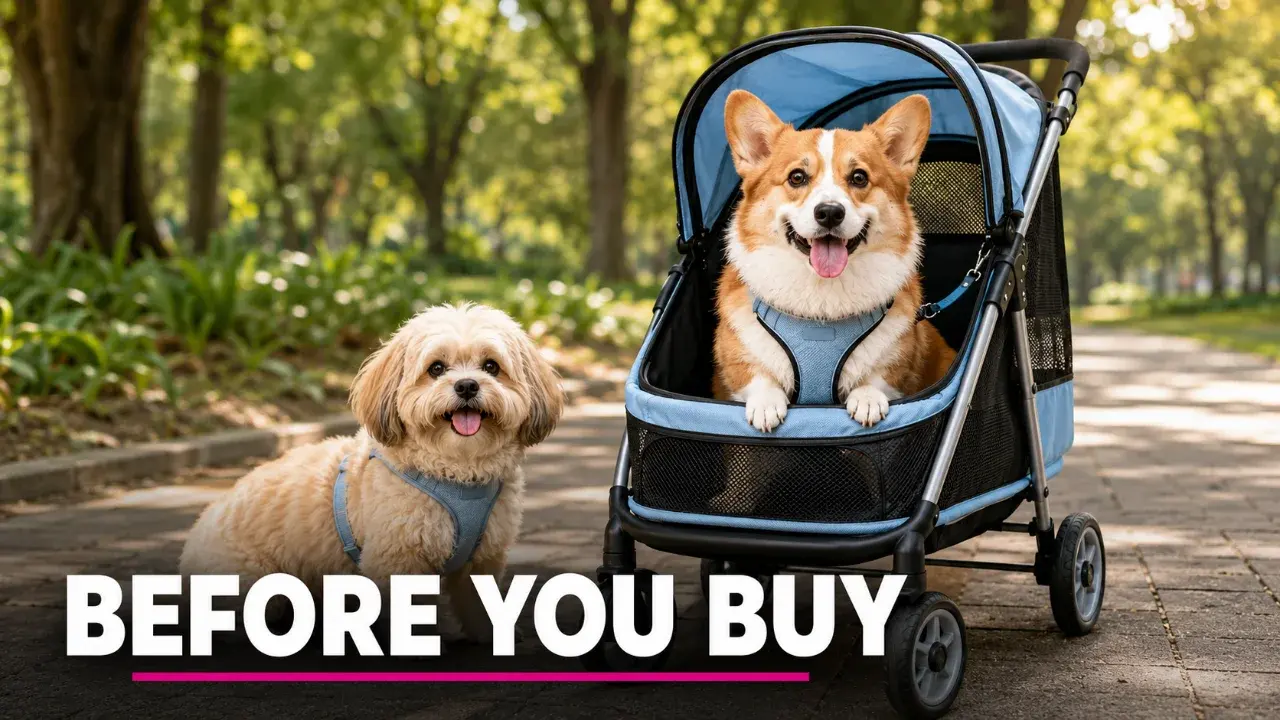
The best dog stroller is not necessarily the lightest or most expensive. Start with your dog’s measurements, then examine the cabin, restraints, brakes, wheels, ventilation, and folded size.
A dog stroller can give an older, injured, small, or easily fatigued dog more time outdoors without requiring them to walk the entire distance. The wrong model, however, may feel cramped, overheat in the sun, tip too easily, or become so inconvenient that it rarely leaves storage.
Before comparing colors and accessories, decide exactly who will ride in it, where it will go, and how you will transport it.
First, decide whether a stroller solves the right problem
Strollers can be particularly useful for senior dogs, dogs with limited mobility, and smaller dogs that cannot comfortably cover the same distance as their owners. They may also provide a resting place during longer family outings.
The American Animal Hospital Association notes that a stroller or large garden cart can help dogs that no longer manage long distances continue enjoying outdoor experiences without overexertion. Stroller rides still expose a dog to scents, sounds, people, and changing surroundings, providing sensory enrichment even when walking is limited.
A stroller should not automatically replace every walk. Dogs that can move safely still benefit from activity adapted to their health and abilities. The American Kennel Club recommends discussing pain, fatigue, limping, or declining mobility with a veterinarian and using a stroller as a break during longer outings when appropriate.
Measure the dog—not just their weight
Every model should state a maximum load, but weight capacity does not tell you whether the cabin is comfortable.
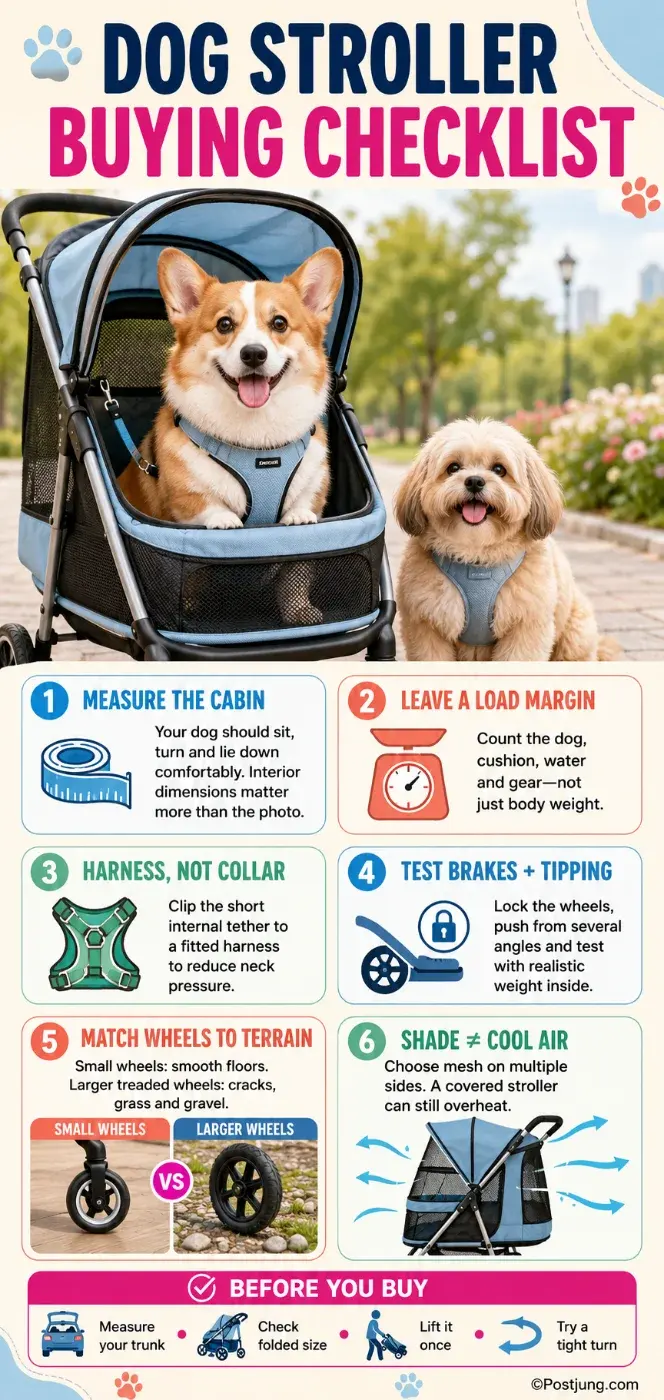
Measure your dog while standing, sitting, and lying in their usual resting position. Compare those measurements with the stroller’s internal cabin dimensions rather than its overall exterior size. Your dog should be able to sit naturally, lie down without being tightly curled, and turn around comfortably.
For two dogs, check their combined weight and confirm that both can rest without climbing over each other. Leave capacity for any cushion, water, or other items placed inside the cabin.
Avoid choosing a model that places your dog close to its stated maximum load. Real-world use includes movement, bumps, slopes, and shifting weight—not just a motionless dog on a flat showroom floor.
Treat restraint, brakes, and stability as essentials
Look for at least one strong internal tether attached to the stroller’s frame or another reinforced point. Clip it to a correctly fitted harness, not solely to a collar. A harness distributes pressure around the chest and shoulders and places less force on the neck than a collar, according to AKC veterinary guidance.
The tether should be short enough to prevent the dog from jumping over the side, but not so short that it forces an unnatural posture. If the cabin includes two tethers, confirm that they cannot twist together or wrap around the dogs.
Test the wheel brakes before buying if possible. Apply them, push the stroller gently from different directions, and check whether the wheels remain locked. Always engage the brakes before putting a dog in, taking them out, or stopping on any incline.
Stability deserves equal attention. With the stroller loaded to approximate normal use, turn it slowly, press lightly on different edges, and watch for excessive rocking. Avoid hanging heavy shopping bags from the handle because the added leverage can make a stroller easier to tip.
Inspect the folding lock, canopy fasteners, zippers, wheel attachments, seams, and frame joints. A convenient one-hand fold is useful only if the stroller locks securely when open and cannot collapse unexpectedly.
Match the wheels to the ground
Small, hard wheels may work inside shopping centers or on smooth sidewalks, but they can rattle or stop abruptly on cracks, gravel, grass, and uneven paths. Larger wheels with tread generally handle rougher ground more comfortably.
Check whether the front wheels swivel for tight urban turns and whether they can be locked straight when greater stability is needed. Suspension may improve comfort on uneven routes, particularly for dogs with painful joints.
A model intended for ordinary walking should not be assumed safe for running. Anyone planning to jog should choose a stroller specifically designed for that activity and follow its speed, terrain, and weight instructions.
Also consider the person pushing it. Handle height, steering resistance, stroller width, and total loaded weight can affect control. A heavy-duty model may support a large dog but still be impractical for someone who must lift it into a vehicle or carry it upstairs.
A canopy does not eliminate heat risk
A shaded cabin can reduce direct sunlight, but enclosing a dog may also restrict airflow. Look for generous mesh panels on more than one side so air can move through the cabin even when the canopy is closed.
This is especially important in hot and humid climates. The American Animal Hospital Association warns that pets can develop heatstroke when they lack shade, water, ventilation, or adequate rest. Short-muzzled dogs, senior dogs, puppies, overweight dogs, and animals with heart or lung disease are more vulnerable.
A stroller does not make a dangerously hot outing safe. Choose cooler times of day, bring water, take breaks, and monitor the cabin rather than judging conditions only from the temperature felt at handle height.
Excessive panting, heavy drooling, difficulty breathing, weakness, stumbling, vomiting, collapse, or seizures can signal dangerous overheating. Move the dog to a cool area and contact a veterinarian immediately if these signs appear.
Check whether it fits your actual routine
Measure the car trunk, elevator, doorway, and storage space the stroller must pass through. Compare these with both the open and folded dimensions. Confirm the folded model can stand or lie securely without rolling.
Try lifting it before purchasing. The listed stroller weight can feel very different when the frame is bulky or lacks a useful carrying handle. Removable, washable padding is also valuable because dirt, urine, shed hair, and motion sickness can turn a difficult-to-clean cabin into a long-term problem.
Storage baskets, cup holders, rain covers, and reversible handles can be helpful, but they come after fit, stability, braking, airflow, and secure restraint.
Finally, introduce the stroller gradually. Let the dog investigate it while it is stationary, reward calm behavior, and begin with short rides in a quiet area. A dog that pants, scratches at the enclosure, repeatedly tries to escape, or freezes in fear may need slower training—or may simply be uncomfortable riding in one.
The right stroller should expand a dog’s access to the world without compromising safety or replacing movement they can still enjoy. A careful fit test and a short trial push reveal far more than a long accessories list.
SOURCES USED:
- American Kennel Club — Strollers for Dogs: Everything You Need to Know
- American Animal Hospital Association — Optimizing the Golden Years
- American Animal Hospital Association — How to Prevent Heatstroke in Dogs and Cats
- American Kennel Club — How Many Walks Does Your Dog Need Each Day?
- American Kennel Club — Choosing the Right Harness for Your Dog

เขียนโดย Postjung Insights
 รู้หรือไม่? เปิดรายได้พนักงานส่งพัสดุของแต่ละแอป วันหนึ่งได้เท่าไร
 5 ไอเทมป้องกันความร้อนให้บ้านแบบโบราณ! ภูมิปัญญาเก่าที่ช่วยบ้านเย็นลงได้ 3-5 องศา
 อำเภอที่มีชื่ออำเภอสั้นที่สุด 3 อำเภอเท่านั้นในประเทศไทย
 ตาราง “เด่นเหนือเด่นใต้” งวด 1 ต.ค. 69 เปิดข้อมูลตามโพย เลขไหนอยู่ตรงไหน
 รู้หรือไม่? ความทรงจำวัยเด็กอาจไม่ได้เหมือนที่เราเคยจำ! สมองสามารถ “เติมเรื่อง” ให้เราได้
 เปิด 5 โรงเรียนหญิงล้วนเก่าแก่ของไทย ที่มีประวัติยาวนานกว่าศตวรรษ
 โรงเรียนที่มีนักเรียนมากที่สุดในไทย
 โรงเรียนชายล้วนแห่งแรกของไทยคือที่ไหน? ย้อนดูจุดเริ่มต้นโรงเรียนสวนกุหลาบวิทยาลัย
 7 บทเพลงไวรัลยุคโบราณ! เพลงงานวัดที่เปิดเมื่อไหร่ คนก็ลุกขึ้นรำวงเมื่อนั้น
 7 คันเบ็ดตกปลาโบราณ สายเรโทรยอมทุ่มเงินซื้อ! ยิ่งเก่า ยิ่งหายาก ยิ่งมีเรื่องราว
 โรงเรียนเพียงแห่งเดียวของประเทศไทย ที่อยู่มาตั้งแต่ยุครัชกาลที่ 4
 แปลปกสลาก งวด 1 ต.ค. 69 ส่องตัวเลขจากภาพปกสลากกินแบ่งรัฐบาลอำเภอที่มีชื่ออำเภอสั้นที่สุด 3 อำเภอเท่านั้นในประเทศไทย
 English Edition