Why predictable routines can help anxious pets feel safer

Regular meals, rest, play, and quiet time give dogs and cats useful clues about what will happen next. The schedule need not be rigid—but it should be consistent enough to reduce uncertainty.
An anxious pet does not necessarily need every meal or walk to happen at the exact same minute. What often helps is a day with recognizable patterns: waking, eating, activity, rest, and time alone occurring in a dependable sequence.
That predictability can make the environment feel less uncertain. Veterinary behavior guidance supports consistent routines as one part of managing fear and anxiety in both dogs and cats, while emphasizing that routines should still meet each animal’s physical, social, and behavioral needs.
Predictability gives pets useful information
Anxiety involves anticipating a possible future threat. For a pet that already feels uneasy, not knowing when food, attention, exercise, visitors, or alone time will occur can add another layer of uncertainty.
A routine provides signals. A dog may learn that a morning walk is followed by breakfast and a period of rest. A cat may recognize that the evening household activity settles down before feeding and play.
These patterns do not tell pets that nothing unexpected will ever happen. They simply make much of the ordinary day easier to anticipate.
The Merck Veterinary Manual notes that structured interactions with consistent owner responses can decrease anxiety in dogs while improving communication and self-control. Its guidance for feline behavior problems similarly recommends establishing routines and introducing changes gradually when possible.
Consistency also applies to human responses. If jumping, barking, or pawing sometimes produces attention and sometimes leads to scolding, the outcome remains unpredictable. Calm, reinforcement-based responses make it easier for a pet to understand which behaviors work.
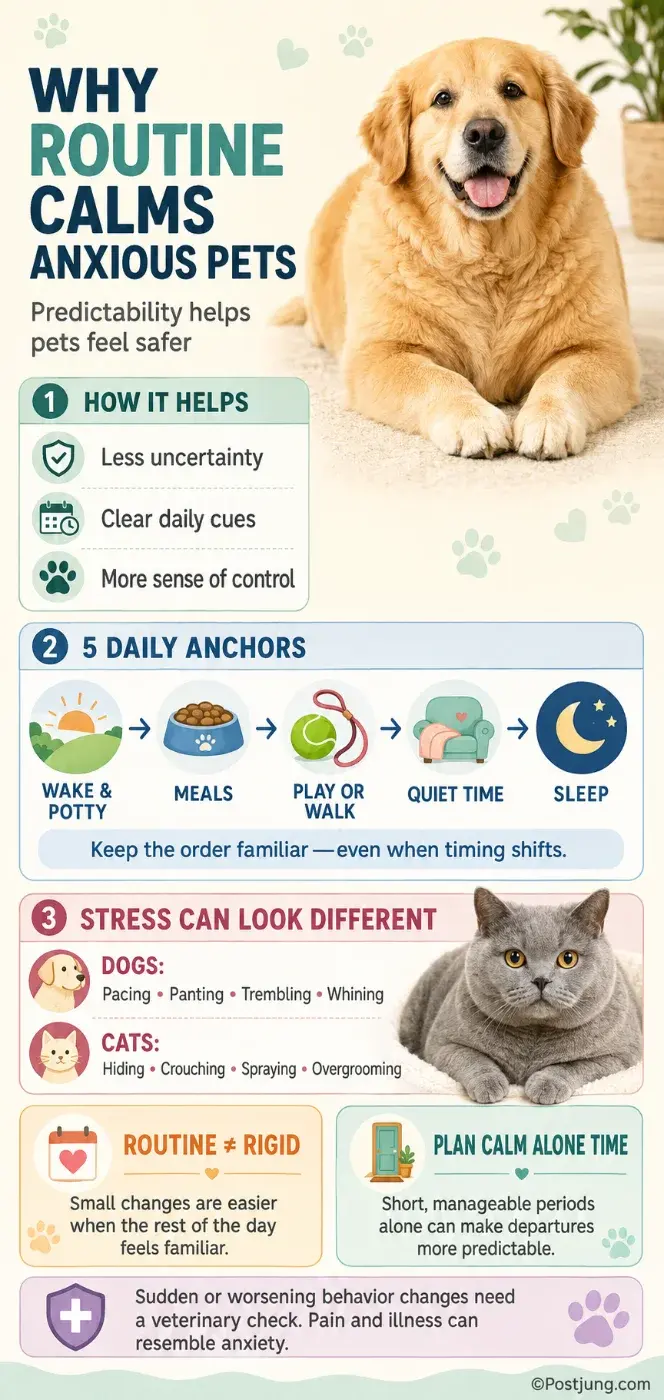
A helpful routine is structured, not rigid
A useful schedule should act as a set of daily anchors rather than a clock that controls the household.
VCA Animal Hospitals advises that a predictable routine does not need to be rigid. It should instead reserve regular time for the different activities a pet needs.
Those anchors may include:
- Meals and access to fresh water
- Toilet breaks or litter-box care
- Age-appropriate exercise
- Play, training, or food-based enrichment
- Quiet rest without interruption
- Social contact on the pet’s terms
- Short, manageable periods alone
The sequence may be more important than exact timing. If breakfast is occasionally served at 7:30 rather than 7:00, familiar cues and the surrounding pattern can still provide reassurance.
Some flexibility is beneficial. A pet that can cope only when everything occurs at one precise time may become distressed by unavoidable changes. Small, manageable variations—such as shifting a walk slightly or rotating safe enrichment activities—can preserve predictability without making the animal dependent on perfect timing.
Match the routine to the species and the individual
Dogs often benefit from planned walks, toilet opportunities, training, social contact, play, and uninterrupted sleep. Dogs Trust includes all of these when advising owners to build a dependable daily pattern.
For cats, routine should not mean forcing interaction. Predictable feeding and play sessions can help, but cats also need control over whether they approach people. Accessible hiding places, elevated resting areas, scratching surfaces, clean litter boxes, and separation from unwanted attention are equally important.
Age and health matter, too. Puppies and kittens may need more frequent meals, toilet opportunities, and short activity sessions. Older animals may need easier access to resources and a gentler pace. A routine designed for a healthy young animal may be uncomfortable or unrealistic for a senior pet with pain or reduced mobility.
Household changes are best introduced gradually when circumstances allow. Before a work-schedule change, for example, owners can begin adjusting walks, feeding, attention, and alone time in small steps rather than changing the entire day at once.
Routine supports treatment, but it is not a cure
A predictable day can reduce background stress, but it cannot by itself resolve every fear, phobia, or separation-related problem. It also cannot remove pain or illness that appears as a behavior change.
Dogs showing stress may pace, pant when they are not hot, tremble, refuse food, vocalize, or repeatedly seek attention. Cats may hide, crouch, avoid interaction, become aggressive, spray urine, or groom excessively. These behaviors have multiple possible causes and should not automatically be labeled anxiety.
Arrange a veterinary assessment when a behavior begins suddenly, is worsening, disrupts eating or toileting, causes injury, involves aggression, or makes it difficult for the pet to function normally. Medical problems should be ruled out before assuming that a new behavior is purely emotional.
Routine works best as a foundation: familiar daily anchors, gradual change, consistent communication, adequate enrichment, and professional support when anxiety exceeds what thoughtful home management can address.
SOURCES USED:

โพสท์โดย Postjung Insights
 โรงเรียนที่มีนักเรียนมากที่สุดในไทย
 ใบมีดโกน ของถูกที่ผลิตยาก เบื้องหลังเหล็กพิเศษ–ความร้อน–เจียร–เคลือบผิว
 ตาราง “เด่นเหนือเด่นใต้” งวด 1 ต.ค. 69 เปิดข้อมูลตามโพย เลขไหนอยู่ตรงไหน
 หญิงไทยถูกแฟนหนุ่มรัดคอดับในไต้หวัน โดยศพถูกซ่อนไว้ในตู้แช่แข็งของบริษัท
 รู้หรือไม่? เปิดรายได้พนักงานส่งพัสดุของแต่ละแอป วันหนึ่งได้เท่าไร
 แปลปกสลาก งวด 1 ต.ค. 69 ส่องตัวเลขจากภาพปกสลากกินแบ่งรัฐบาล
 อำเภอที่มีชื่ออำเภอสั้นที่สุด 3 อำเภอเท่านั้นในประเทศไทย
 5 ไอเทมป้องกันความร้อนให้บ้านแบบโบราณ! ภูมิปัญญาเก่าที่ช่วยบ้านเย็นลงได้ 3-5 องศา
 สถิติย้อนหลัง 10 ปี ออกเลขไหนบ้างมาดูกัน
 7 บทเพลงไวรัลยุคโบราณ! เพลงงานวัดที่เปิดเมื่อไหร่ คนก็ลุกขึ้นรำวงเมื่อนั้น
 โรงเรียนชายล้วนแห่งแรกของไทยคือที่ไหน? ย้อนดูจุดเริ่มต้นโรงเรียนสวนกุหลาบวิทยาลัย
 เปิด 5 โรงเรียนหญิงล้วนเก่าแก่ของไทย ที่มีประวัติยาวนานกว่าศตวรรษอำเภอที่มีชื่ออำเภอสั้นที่สุด 3 อำเภอเท่านั้นในประเทศไทย
 English Edition