Why some cats cry when left alone—and when to worry
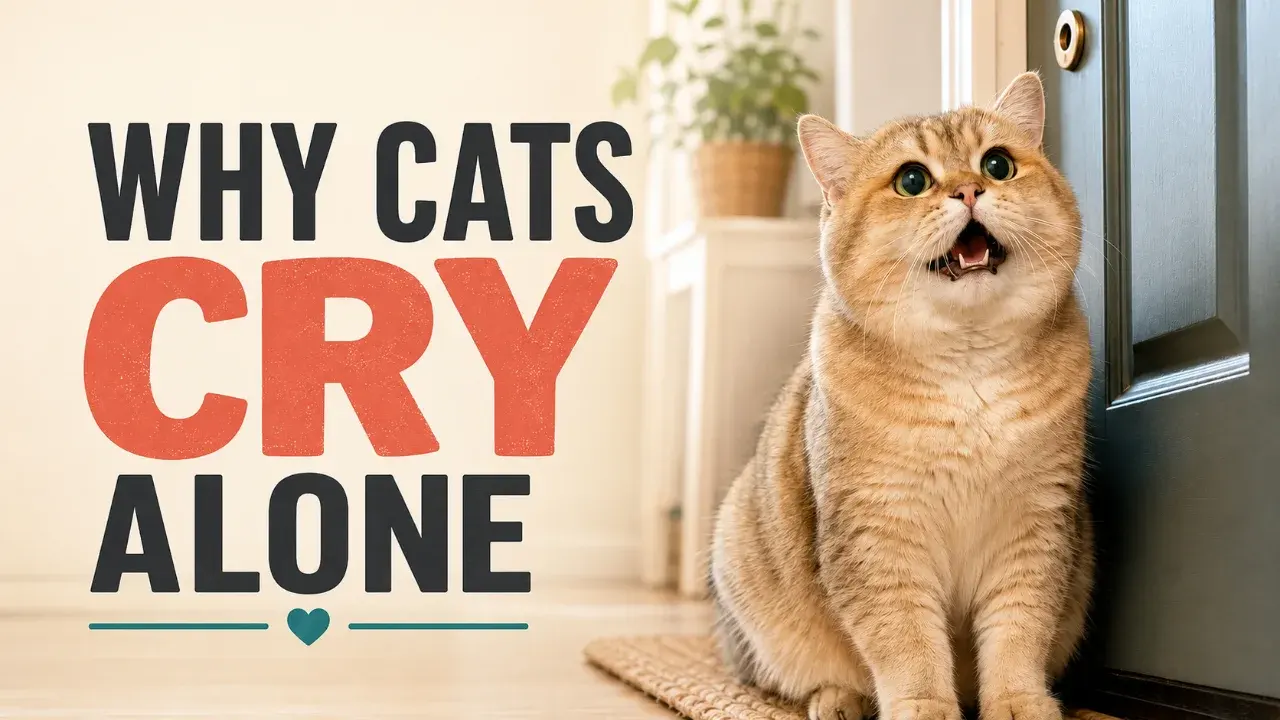
A cat that meows after its person leaves may be seeking contact, reacting to a disrupted routine, or experiencing separation-related distress. The surrounding behavior—not the sound alone—offers the most useful clues.
Cats have a reputation for independence, but that does not mean they are emotionally indifferent to their people. Some form strong attachment bonds with human caregivers, and a departure can trigger anything from a brief contact call to a sustained pattern of distress.
The important distinction is that crying—or, more accurately, meowing and yowling—does not automatically mean a cat has separation anxiety. Owners need to consider when the vocalization begins, how long it lasts, what else the cat does, and whether the behavior is new.
Cats can form meaningful attachments to people
Researchers have found that many cats use a familiar caregiver as a source of security in an unfamiliar environment. In a 2019 study published in Current Biology, cats displayed distinct attachment patterns during a test involving a short separation and reunion.
That finding helps challenge the idea that cats simply do not care when people leave. It does not mean every attached cat becomes distressed during an ordinary absence, however. Attachment is normal; separation-related difficulty is a potential behavioral problem.
A cat may call after someone leaves because it wants to restore contact. Others may vocalize in anticipation of food, play, or another familiar event that normally involves that person. If meowing reliably brings someone back into the room or produces attention, the behavior can also become learned and repeated.
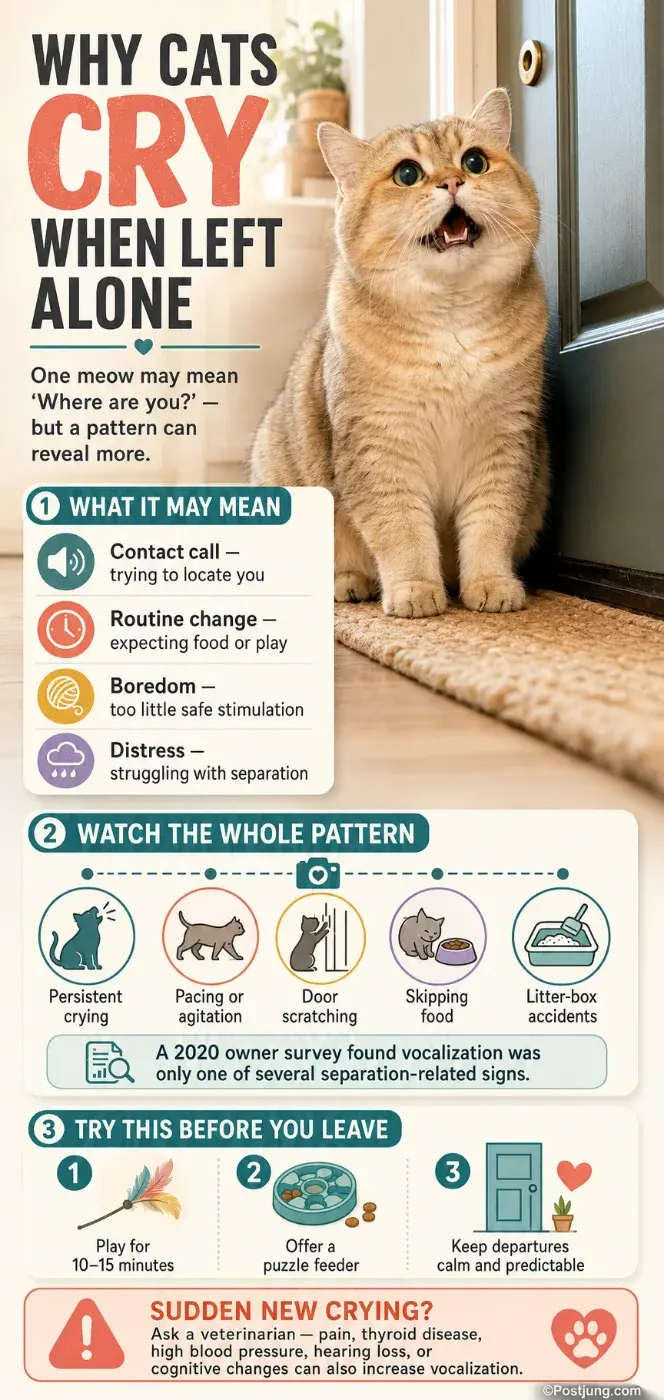
Look beyond the meowing
Research into feline separation-related problems remains limited compared with research involving dogs. One frequently cited 2020 questionnaire study examined 223 cats and found that 30 met at least one of the researchers’ behavioral criteria for a potential separation-related problem.
Among those 30 cats, excessive vocalization was common—but so were destructive behavior, urination outside the litter box, apparent apathy, agitation, and aggression. Because the study relied on owner reports and associations, it could not prove that separation caused every behavior or establish how common the condition is among all cats.
That limitation matters. A cat that calls briefly and then settles, eats, plays, or sleeps is presenting a different picture from one that cries persistently, paces, refuses food, scratches around exits, urinates outside the litter box, or remains highly agitated.
A home camera can reveal what happens after the door closes. Record several typical departures and note:
- How soon the behavior begins
- Whether it stops after a few minutes
- Whether the cat eats, rests, grooms, or plays normally
- Whether distress appears only during certain departures
- Whether there is destructive behavior or inappropriate elimination
These observations can help a veterinarian or qualified feline behavior professional identify a pattern. They are more informative than judging the cat solely by an excited reunion.
Medical problems can sound like emotional distress
Sudden or excessive vocalization should not automatically be treated as a training issue. Pain, high blood pressure, endocrine disorders, declining hearing, cognitive dysfunction, and other medical problems can make cats unusually restless or vocal.
A veterinary examination is particularly important when the behavior is new, worsening, or accompanied by weight loss, changes in appetite or thirst, altered litter-box habits, disorientation, reduced mobility, vomiting, hiding, or other changes.
Middle-aged and senior cats deserve special attention. Age-related cognitive and sensory changes can produce confusion and increased calling, including when the cat can no longer locate a person easily.
Make alone time easier, not frightening
Punishment does not address the cause of distress and can make a cat feel less secure. Instead, improve the environment and build a routine that gives the cat appropriate activities before and during an absence.
The Feline Veterinary Medical Association recommends providing safe resting places, separated resources, opportunities for play and predatory behavior, and positive, predictable human interaction. Useful options include elevated perches, hiding boxes, scratching surfaces, window views, food puzzles, and toys that can be used safely without supervision.
Schedule interactive play before leaving, then offer part of the cat’s normal food allowance through a puzzle feeder or timed feeder. Rotate toys instead of leaving every toy available continuously.
Keep departures and returns calm and predictable. If the cat becomes distressed during even very short separations, a veterinarian or credentialed behavior professional can design a gradual plan that begins below the cat’s distress threshold. Severe cases may require a broader treatment plan, but medication should only be considered with veterinary guidance.
Getting another cat is not a guaranteed solution. Some cats enjoy feline companionship, while others merely tolerate it or find shared territory stressful. Compatibility, social history, space, and access to separate resources all matter.
A few calls after the door closes may simply be a cat checking where its person went. Persistent vocalization accompanied by agitation, elimination changes, destruction, or withdrawal deserves closer investigation. The goal is not merely to silence the cat, but to understand what the cat is communicating.
SOURCES USED:
- PLOS ONE — Identification of separation-related problems in domestic cats: A questionnaire survey — https://journals.plos.org/plosone/article?id=10.1371/journal.pone.0230999
- Current Biology — Attachment bonds between domestic cats and humans — https://www.cell.com/current-biology/fulltext/S0960-9822(19)31086-3
- Feline Veterinary Medical Association — 2013 AAFP/ISFM Environmental Needs Guidelines — https://catvets.com/resource/aafp-isfm-environmental-needs-guidelines/
- VCA Animal Hospitals — Cat Behavior Problems: Vocalization — https://vcahospitals.com/know-your-pet/cat-behavior-problems---vocalization
- ASPCA — Meowing and Yowling — https://www.aspca.org/pet-care/cat-care/common-cat-behavior-issues/meowing-and-yowling

เขียนโดย Postjung Insights
 อำเภอที่มีชื่ออำเภอสั้นที่สุด 3 อำเภอเท่านั้นในประเทศไทย
 5 ไอเทมป้องกันความร้อนให้บ้านแบบโบราณ! ภูมิปัญญาเก่าที่ช่วยบ้านเย็นลงได้ 3-5 องศา
 7 บทเพลงไวรัลยุคโบราณ! เพลงงานวัดที่เปิดเมื่อไหร่ คนก็ลุกขึ้นรำวงเมื่อนั้น
 7 คันเบ็ดตกปลาโบราณ สายเรโทรยอมทุ่มเงินซื้อ! ยิ่งเก่า ยิ่งหายาก ยิ่งมีเรื่องราว
 รู้หรือไม่? เปิดรายได้พนักงานส่งพัสดุของแต่ละแอป วันหนึ่งได้เท่าไร
 โรงเรียนที่มีนักเรียนมากที่สุดในไทย
 ตาราง “เด่นเหนือเด่นใต้” งวด 1 ต.ค. 69 เปิดข้อมูลตามโพย เลขไหนอยู่ตรงไหน
 5 เมนูอาหารไทยโบราณที่หาทานยาก ชื่อคุ้นหู แต่คนรุ่นใหม่อาจไม่เคยชิม
 รู้หรือไม่? ความทรงจำวัยเด็กอาจไม่ได้เหมือนที่เราเคยจำ! สมองสามารถ “เติมเรื่อง” ให้เราได้
 เช็กด่วน ! ข่าวบัตรสวัสดิการแจก 10,000 บาท ก.ย. 69 จริงหรือ ? ก่อนเชื่อควรรู้อะไร
 ทำไมหนังสือบางเล่มถึงมีหน้าว่างทั้งหน้า? มันอาจไม่ได้พิมพ์พลาด
 เปิด 5 โรงเรียนหญิงล้วนเก่าแก่ของไทย ที่มีประวัติยาวนานกว่าศตวรรษอำเภอที่มีชื่ออำเภอสั้นที่สุด 3 อำเภอเท่านั้นในประเทศไทย
 English Edition