Why Dog Daycare Is Not Right for Every Dog

Group play can give some dogs exercise and companionship, but others experience fear, exhaustion, conflict, or overstimulation. The clearest answer comes from watching the dog—not following a one-size-fits-all rule.
Dog daycare can be a welcome outlet for a sociable dog that enjoys energetic group play. For another dog, the same room may feel crowded, unpredictable, and impossible to escape.
The difference is not simply breed, size, or age. Temperament, health, play style, previous experiences, the quality of supervision, and the facility’s daily routine all influence whether daycare is enriching or stressful.
Socialization does not mean constant group play
A common reason for enrolling a dog in daycare is “socialization.” But good socialization is not measured by the number of dogs an animal meets.
It involves safe, positive exposure to different animals, people, places, sounds, and situations without overwhelming the dog. The American Veterinary Society of Animal Behavior says puppies should encounter varied experiences without being pushed into excessive fear, withdrawal, or avoidance.
That distinction matters. A dog can be socially well-adjusted while preferring a few familiar companions—or even choosing human company over a large playgroup.
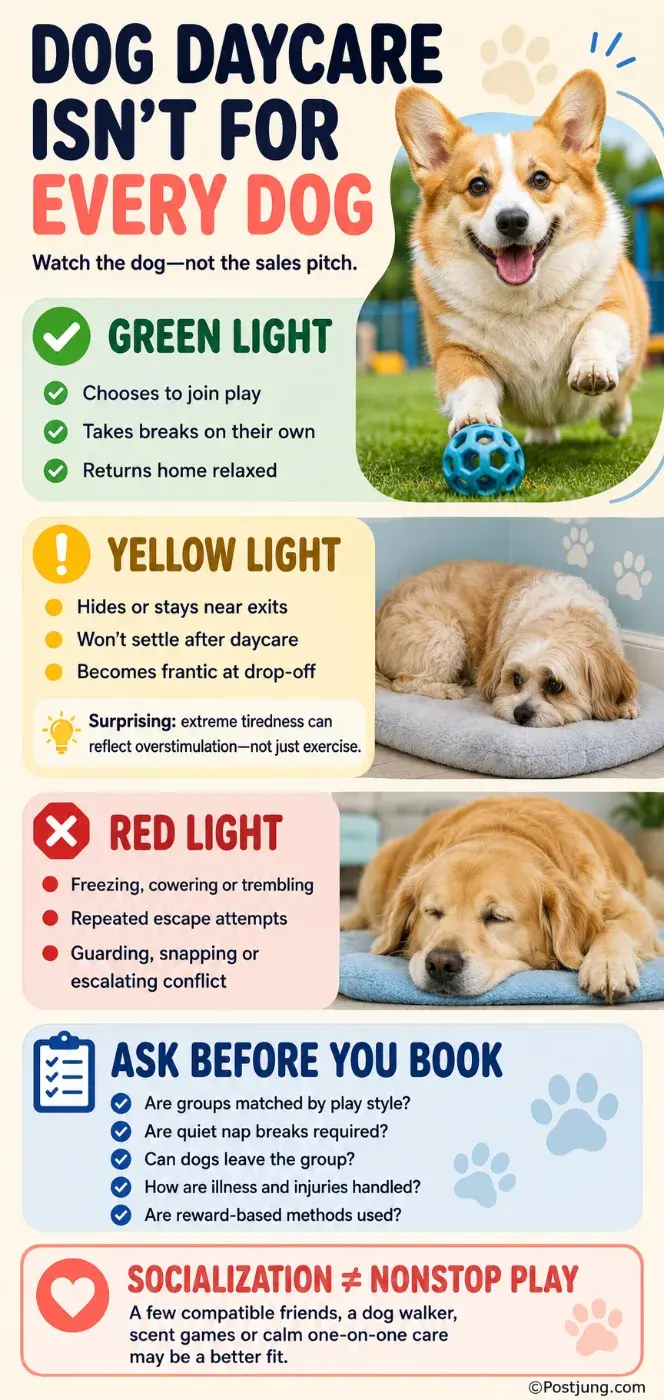
Daycare may suit dogs that voluntarily approach other dogs, respond appropriately when play partners need space, take breaks, and remain comfortable in a busy environment. It is less likely to help a dog that hides, repeatedly tries to escape, freezes, guards resources, becomes intensely overaroused, or reacts aggressively when crowded.
Dogs with significant fear or aggression need an individual assessment. Placing them in a group and hoping repeated exposure will “fix” the problem can increase distress and create safety risks.
Exhaustion is not always proof of a good day
Owners may assume that a dog sleeping for hours after daycare must have enjoyed an excellent workout. Sometimes that is true. But extreme fatigue can also follow prolonged vigilance, poor-quality rest, or overstimulation.
The more useful question is how the dog behaves before, during, and after attendance.
Possible signs of stress include excessive panting when heat and exercise do not explain it, repeated lip licking, cowering, hiding, withdrawal, aggression, or a noticeable change in normal behavior. The RSPCA advises consulting a veterinarian when these patterns recur because pain or illness can produce similar changes.
Owners should also notice whether their dog willingly enters the facility. Stopping at the entrance, pulling toward the car, trembling, refusing treats, or becoming unusually subdued after repeated visits deserves attention. One hesitant morning does not establish a pattern, but consistent reluctance should not be dismissed.
At the other extreme, frantic barking, lunging, spinning, or dragging the handler toward the door may signal uncontrolled arousal rather than relaxed enthusiasm.
The facility matters as much as the dog
A well-managed daycare should assess dogs before placing them in a group. Staff should understand canine body language, interrupt unsafe play early, and separate dogs by compatible size, energy, and play style rather than relying on one large mixed group.
Dogs also need genuine downtime. Quiet rest areas help prevent a full day from becoming hours of nonstop stimulation.
Before enrolling, ask:
- How are new dogs evaluated and introduced?
- How large are the groups, and how many staff members supervise them?
- Are dogs matched by play style as well as size?
- Can a dog leave the group or rest without being disturbed?
- How are mounting, bullying, guarding, and escalating play handled?
- Are punishment, intimidation, or force-based corrections used?
- What happens if a dog appears frightened or unwell?
- Will staff provide honest behavioral feedback after each visit?
- What are the vaccination, parasite-control, sanitation, and illness-exclusion policies?
Reward-based handling is an important standard. The American Veterinary Society of Animal Behavior recommends reward-based methods for dog training and warns that aversive methods can harm welfare and the human-animal bond.
Owners should be cautious if a facility will not allow a tour, cannot explain its emergency procedures, keeps dogs playing continuously, or describes fear and conflict as something dogs must simply “work out.”
Group care also changes health risks
Any setting where dogs gather closely increases exposure to contagious illness. Canine infectious respiratory disease complex—often called kennel cough—can spread in boarding facilities, daycares, shelters, dog parks, and other group environments.
Vaccination reduces important risks but does not make group care infection-proof. The American Animal Hospital Association identifies daycare attendance as a lifestyle factor veterinarians should consider when recommending vaccines, including Bordetella and canine influenza vaccination where appropriate.
Requirements differ among countries, regions, and facilities. A veterinarian who knows the dog’s health, age, vaccination history, travel, and local disease conditions can recommend an appropriate plan.
A dog that is coughing, sneezing, vomiting, experiencing diarrhea, or otherwise unwell should not attend. Facilities should have a clear policy for isolating a dog that develops symptoms during the day and contacting the owner promptly.
A quieter alternative may be the better choice
Skipping daycare does not mean leaving a dog bored or isolated. Depending on the individual, better options may include a dog walker, an in-home sitter, short training sessions, scent games, food puzzles, controlled play with one compatible dog, or calm walks where the dog can explore at its own pace.
Some dogs enjoy daycare occasionally but struggle with daily attendance. A shorter session, smaller group, or more recovery days may make a substantial difference.
The right arrangement is the one that leaves the dog behaviorally comfortable, physically safe, and able to rest—not simply the one that produces the most activity. If a dog repeatedly shows fear, aggression, or an unexplained behavioral change, pause group care and consult a veterinarian or qualified behavior professional before trying again.
SOURCES USED:
- American Veterinary Society of Animal Behavior — Puppy Socialization Position Statement
- American Veterinary Society of Animal Behavior — Humane Dog Training Position Statement
- RSPCA — Understanding Your Dog’s Behaviour
- American Animal Hospital Association — Canine Vaccination Guidelines FAQs
- American Veterinary Medical Association — Canine Infectious Respiratory Disease Complex

เขียนโดย Postjung Insights
 วงแหวนแฟร์รี่ (Fairy Circles): ปริศนาวงกลมกลางทะเลทราย ที่เรายังต้องหาคำตอบกันต่อไป...
 รู้หรือไม่? เปิดรายได้พนักงานส่งพัสดุของแต่ละแอป วันหนึ่งได้เท่าไร
 เปิดหลักฐานเก่า 120 ปี ปมภาพหญิงเมืองกำแพงเพชร โผล่เวที Miss Universe Cambodia 2026
 อำเภอที่มีชื่ออำเภอสั้นที่สุด 3 อำเภอเท่านั้นในประเทศไทย
 5 คณะที่เรียนจบมาแล้ว มีอาชีพรองรับมากกว่าที่คิด
 ตาราง “เด่นเหนือเด่นใต้” งวด 1 ต.ค. 69 เปิดข้อมูลตามโพย เลขไหนอยู่ตรงไหน
 โรงเรียนที่มีนักเรียนมากที่สุดในไทย
 เปิดรายชื่อโรงเรียนในไทยที่ “ว่ายน้ำ” อยู่ในหลักสูตร เรียนจริงตั้งแต่อนุบาลถึงมัธยม
 เปิด 5 โรงเรียนหญิงล้วนเก่าแก่ของไทย ที่มีประวัติยาวนานกว่าศตวรรษ
 เปิด 5 สินค้าเกษตรจากลาวที่เข้าสู่ตลาดไทย สินค้าไหนมีบทบาทสำคัญที่สุด
 จุฬาฯ มหาวิทยาลัยแห่งแรกของไทย มีจุดเริ่มต้นในสมัยรัชกาลที่ 5
 แปลปกสลาก งวด 1 ต.ค. 69 ส่องตัวเลขจากภาพปกสลากกินแบ่งรัฐบาลเปิดหลักฐานเก่า 120 ปี ปมภาพหญิงเมืองกำแพงเพชร โผล่เวที Miss Universe Cambodia 2026เปิด 5 สินค้าเกษตรจากลาวที่เข้าสู่ตลาดไทย สินค้าไหนมีบทบาทสำคัญที่สุดวงแหวนแฟร์รี่ (Fairy Circles): ปริศนาวงกลมกลางทะเลทราย ที่เรายังต้องหาคำตอบกันต่อไป...
 😃 ชวนเข้ามาดูกันอีกกับคนที่มีร่างกายพิเศษจนเหมือนมีกล่องสมบัติที่หายาก 😯5 คณะที่เรียนจบมาแล้ว มีอาชีพรองรับมากกว่าที่คิดเปิดรายชื่อโรงเรียนในไทยที่ “ว่ายน้ำ” อยู่ในหลักสูตร เรียนจริงตั้งแต่อนุบาลถึงมัธยม
 English Edition