Why senior pet care often costs more than owners expect

Older pets may need more appointments, diagnostic testing, medication, dental treatment, and home support—sometimes for several conditions at once. Understanding how those costs accumulate can make them easier to plan and prioritize.
Aging does not automatically make a dog or cat sick. It does, however, increase the likelihood that veterinary care will involve more frequent monitoring, more diagnostic decisions, and longer-term treatment.
That is why the cost of senior pet care can climb even when there is no single medical emergency. A routine visit may uncover several smaller needs—bloodwork, dental treatment, pain management, dietary changes, or follow-up testing—that collectively reshape a household’s pet-care budget.
“Senior” is not one universal age
Cats are generally classified as senior after age 10, according to the American Animal Hospital Association, or AAHA. For dogs, size and expected lifespan matter; AAHA defines the senior stage as roughly the final 25% of a dog’s estimated lifespan.
A large dog may therefore enter this life stage earlier than a small dog. Health history, breed, body condition, mobility, and existing disease can also matter more than the number of birthdays alone.
This variation is one reason there is no universal price for senior care. Two pets of the same age may require completely different levels of medical support.
Routine care becomes more detailed
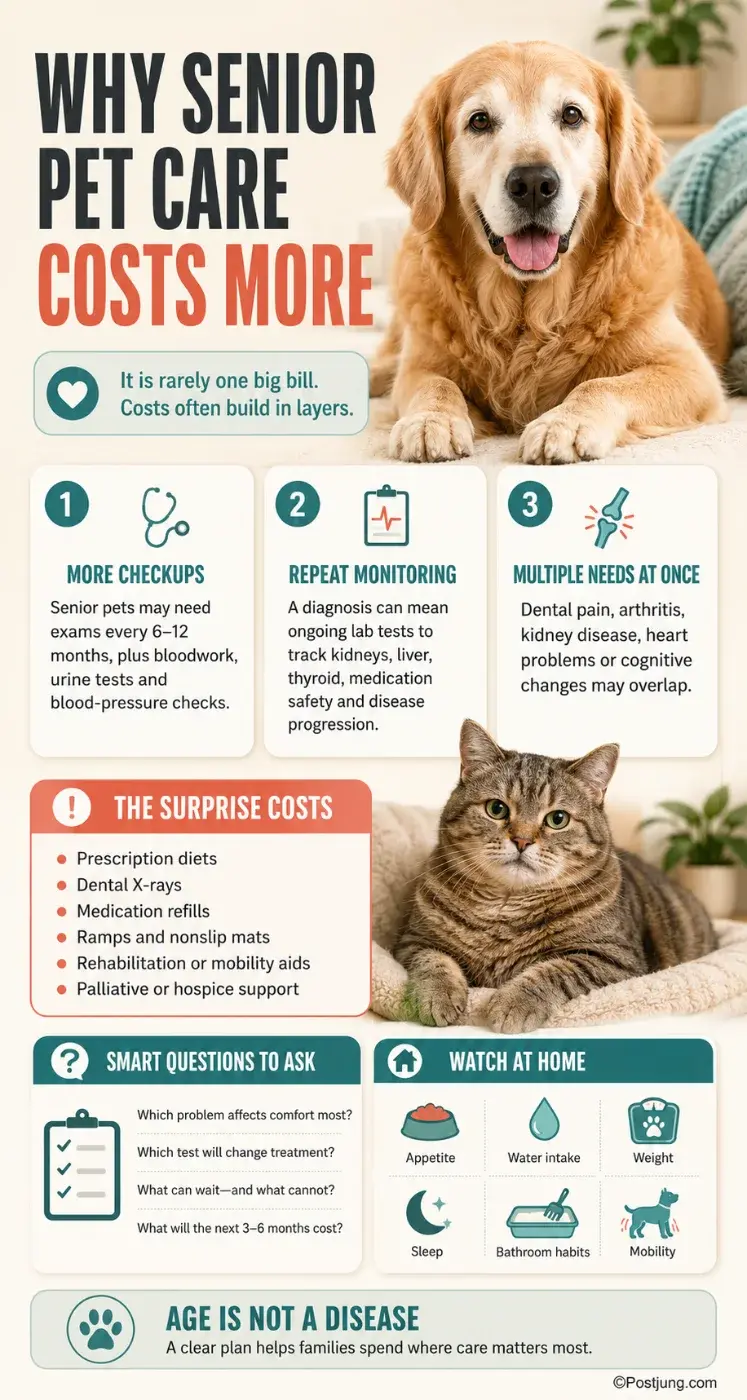
The American Veterinary Medical Association advises that senior pets may need veterinary examinations twice a year or more. These appointments can be more extensive than a younger animal’s routine checkup and may include bloodwork, urine testing, dental evaluation, or screening for age-related conditions.
AAHA’s senior-care guidelines recommend that complete blood counts, blood chemistry panels, and urinalysis generally be considered every six to 12 months. Depending on the animal, veterinarians may also recommend blood-pressure measurement, thyroid testing, parasite screening, heart testing, or diagnostic imaging.
Not every pet needs every test. The appropriate schedule depends on species, breed, lifestyle, symptoms, medical history, medication use, and previous results. Still, the shift from a simple annual examination to regular examinations plus laboratory monitoring creates a higher baseline cost.
These tests are not only about finding new disease. Once an abnormality is discovered, repeated testing may be needed to track whether it is stable, progressing, or responding to treatment.
Chronic conditions create recurring expenses
Senior pets are more likely to develop kidney or urinary disease, heart disease, diabetes, arthritis, dental problems, vision or hearing changes, cancer, and cognitive decline. An individual pet may have more than one condition at the same time.
This is where expenses can become less predictable. The cost is no longer limited to diagnosing one problem. It may include daily medication, prescription food, monitoring tests, follow-up appointments, rehabilitation, mobility aids, or consultations with specialists.
Medication itself may also require additional monitoring. A veterinarian may need to check kidney or liver function, adjust a dose, or confirm that multiple drugs and supplements can be used safely together.
The total can grow through repetition: one prescription every month, laboratory work several times a year, and periodic reassessment of pain, weight, appetite, or mobility.
Dental and mobility needs are easy to underestimate
Dental disease is especially common in older animals. Cornell University’s Feline Health Center notes that it can cause significant pain and make eating difficult in senior cats.
A visible dental examination may be only the beginning. Proper diagnosis and treatment can involve anesthesia, dental X-rays, blood testing before the procedure, cleaning, extractions, pain relief, and follow-up care.
Mobility problems can add another layer. Arthritis may require medication or rehabilitation, but expenses can also appear outside the clinic: nonslip flooring, low-entry litter boxes, orthopedic bedding, ramps, raised bowls, or changes to the home.
Some of these purchases are modest individually. Together, they can become a meaningful part of the cost of helping an older pet remain comfortable and independent.
Advanced care is not the only responsible choice
When a pet has several medical problems, owners may be presented with a long list of tests and treatments. That does not mean every option carries the same urgency or benefit.
AAHA’s guidance recognizes that senior-pet care requires time, money, patience, and physical and emotional stamina. It recommends that veterinary teams and families develop plans that fit the caregiver’s practical limitations and, when necessary, focus treatment on what is essential.
Useful questions to ask include:
- Which problem is causing the most pain or affecting quality of life now?
- Which test is most likely to change the treatment plan?
- What must be done immediately, and what can be monitored?
- Are there lower-cost ways to reach the same clinical goal?
- What ongoing expenses should be expected over the next three to six months?
- Which changes would mean the pet needs an earlier recheck?
Ask for an itemized estimate when a major diagnostic workup or procedure is proposed. If the plan contains several stages, request separate estimates for the initial investigation, treatment, and likely follow-up care.
Keeping a simple record of appetite, water intake, weight, bathroom habits, sleep, medication, and mobility can also make appointments more productive. Photos or short videos may help a veterinarian assess changes that are difficult to reproduce in the clinic.
Planning should begin before a crisis
A practical senior-pet budget can include three categories: predictable preventive care, recurring management of known conditions, and a reserve for unexpected illness.
Owners can also discuss treatment priorities before an emergency. For a chronic, progressive, or terminal condition, palliative care may be provided alongside treatment to manage pain and other symptoms. Hospice is a later stage of that approach and includes planning for decline, possible crises, and end-of-life decisions.
The goal is not to pursue every available intervention. It is to understand the options early enough to make deliberate choices centered on comfort, likely benefit, affordability, and the pet’s quality of life.
Senior care may cost more because it often becomes more frequent, interconnected, and continuous. A clear plan cannot eliminate every unexpected bill, but it can reduce surprises and help families direct their resources toward the care that matters most.
SOURCES USED:
- American Animal Hospital Association — 2023 AAHA Senior Care Guidelines for Dogs and Cats
- American Veterinary Medical Association — Senior Pets
- Cornell University College of Veterinary Medicine — The Special Needs of the Senior Cat
- American Animal Hospital Association — Managing the Caregiver Burden
- American Animal Hospital Association — Palliative Care or Hospice?

เขียนโดย Postjung Insights
 4 โรงงานใหญ่ในไทย ที่มีพนักงานหลักพันคน
 10 นามสกุลที่มีผู้ใช้มากที่สุดในประเทศไทย
 5 มหาวิทยาลัยไทย ที่เรียนจบยากมากที่สุด ต้องผ่านกี่ด่านกว่าจะได้ปริญญา?
 รวมเลขปฏิทินจีน งวด 16 พ.ย 69
 มหาวิทยาลัยไหนมีบัณฑิตตกงานน้อยที่สุดในไทย
 พลังเต่าหับ ชูเลขเด่นวงกลม 5-1 จัด 8 คู่สองตัว แบ่งชัดสองกลุ่ม งวด 16 พ.ย. 69
 มังกรหยก วางเลขเด่นคนละหลัก! ชูหลักสิบ 1 หลักหน่วย 8 จัดคู่สองตัว 10 ชุด งวด 16 พ.ย. 69
 รู้หรือไม่ว่า "กระเป๋า 4 มิติของ "โดราเอมอน" ใส่สิ่งมีชีวิตได้นะ!!"
 กันดั้มมีเป็นร้อยตอน ต้องเริ่มดูจากภาคไหนถึงจะดูรู้เรื่อง?
 คนเราฟังเพลงกี่เพลงตลอดชีวิต
 ลาภเด็ด...เช็คให้รวย เปิดเลขเด่นวงกลม 2-9 จัดคู่เลข 6 ชุด งวด 16 พ.ย. 69
 เปิดพิกัดทางหลวง 117 ถนนสายยาวผ่านพิจิตร กับปริศนาทางตรงเกือบ 100 กิโลเมตร
 รถไฟสายแรกของไทยเปิดตั้งแต่ พ.ศ. 2436 แต่ทำไมคนส่วนใหญ่จึงจำปี 2439
 มนุษย์เป็นสัตว์ชนิดเดียวที่มีคางจริงหรือคนเราฟังเพลงกี่เพลงตลอดชีวิต
 คนเรากินอาหารกี่มื้อตลอดชีวิต
 ร่างกายสร้างเม็ดเลือดแดงใหม่ได้เร็วแค่ไหนลาภเด็ด...เช็คให้รวย เปิดเลขเด่นวงกลม 2-9 จัดคู่เลข 6 ชุด งวด 16 พ.ย. 69
 English Edition
 Examining the Structure of Thailand’s Amulet Market: When Certification Power, Pricing, and Belief Become a Self-Perpetuating Cycle By C.T. Suwan
 EP1 — What Does It Take to Turn a Book into a Real Product? Behind the Creation of Cosmic Mind: From Manuscript to Four Published Formats
 Why Cats Quiver Their Tails When They Greet You
 Is It Jealousy or Resource Competition Between Pets?