Why orthopedic pet beds are not just for senior pets

Supportive bedding is commonly marketed to aging animals, but younger, larger, recovering, and thin pets may appreciate it too. The important question is not whether a bed says “orthopedic,” but whether it supports the individual animal without creating new problems.
Orthopedic pet beds are closely associated with gray muzzles, arthritis, and stiff morning walks. Yet age is only one reason an animal may benefit from a supportive sleeping surface.
A healthy adult dog that spends hours resting, a large dog whose weight compresses thin padding, or a pet recovering from an injury may also be more comfortable on a bed that cushions pressure points without collapsing to the floor. That does not make the bed a medical treatment—and it does not mean every young animal needs one.
What “orthopedic” should mean in practice
In pet-product marketing, “orthopedic” may describe beds made from memory foam, egg-crate foam, layered foam, or other supportive materials. The word alone does not tell an owner how firm, durable, or suitable the bed will be.
A useful bed should distribute the pet’s weight, provide enough cushioning around bony areas, and remain supportive after repeated use. If a heavy dog sinks through the foam and can effectively feel the floor, a thick-looking bed may provide little real support.
The bed should also be large enough for the animal to lie on its side with its legs extended. Raised bolsters can offer a comfortable headrest, but they should not leave too little usable sleeping space.
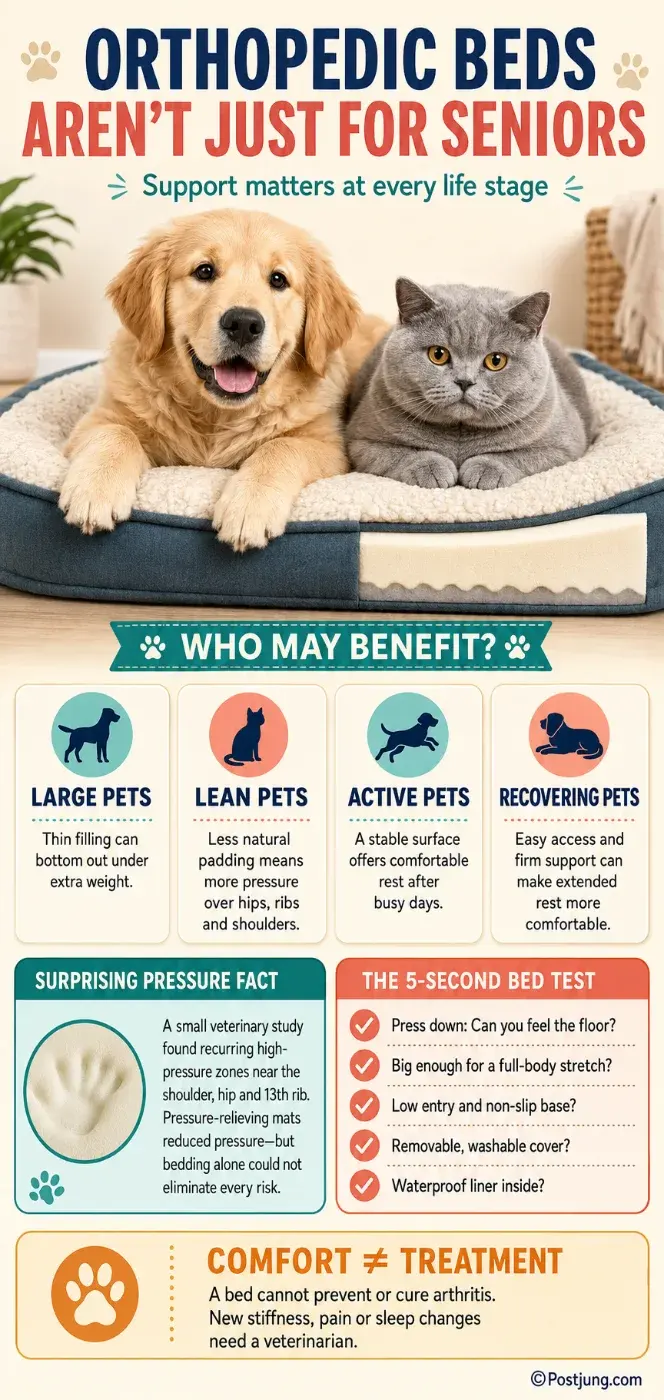
Younger pets may have different reasons for using one
For a healthy young pet, an orthopedic bed is mainly a comfort and environmental choice. Evidence does not show that buying a memory-foam bed will prevent arthritis or correct an orthopedic condition.
It may still be useful in several situations:
- Large or heavy dogs: Greater body weight can compress loose fiber filling quickly. Dense, resilient foam may provide a more stable surface.
- Thin pets: Animals with little natural padding over the ribs, hips, or shoulders can place more pressure on bony areas when lying down.
- Highly active animals: A supportive resting place may be comfortable after running, training, hiking, or working, although it should not be presented as a substitute for veterinary care.
- Pets recovering from illness or surgery: Animals resting for extended periods may need thicker bedding, easy access, and closer monitoring.
- Puppies and accident-prone pets: A waterproof liner and washable cover can make a supportive bed more practical, provided the puppy is not likely to chew and swallow the foam.
One small veterinary study compared blankets, a standard mattress, a veterinary memory-foam mattress, and a human medical memory-foam mattress using three dog cadavers. Pressure-relieving surfaces produced lower pressure than blankets or standard bedding around recurrent risk areas, including the shoulder, hip, and thirteenth rib.
The study’s limitations matter: it involved only three cadavers, examined pressure-sore prevention rather than ordinary sleep comfort, and did not establish that a particular retail bed prevents disease. It also found that thin dogs experienced high pressure and that a static mattress alone could not always keep vulnerable areas within the researchers’ target range. Position changes remained important.
Support matters most when mobility is limited
The case for specialized bedding becomes stronger when an animal has osteoarthritis, paralysis, chronic pain, or restricted mobility.
The American Animal Hospital Association’s pain-management guidelines include optimizing sleeping surfaces among the environmental changes that can help animals living with chronic pain.
For paralyzed pets, thick bedding has an additional purpose. Animals that cannot reposition themselves normally are vulnerable to pressure sores over areas such as the hips and elbows. Veterinary guidance recommends combining soft, supportive bedding with regular repositioning and skin checks; the mattress cannot do the entire job by itself.
A sudden change in sleeping behavior should not simply trigger a bed upgrade. Restlessness, repeatedly changing position, difficulty settling, reluctance to rise, or avoiding a previously favored bed can be signs of discomfort that warrant a veterinary assessment.
Cats need support in the right location
Cats with sore joints may benefit from orthopedic or memory-foam beds, but accessibility can be as important as the material.
A supportive bed will not help much if a cat must make a painful jump to reach it. Placing beds near favorite resting areas and providing stable steps or ramps can make them more useful. Some cats also prefer warmth, a covered space, or a particular texture, so the technically firmest bed is not automatically the one they will choose.
How to judge a bed before buying
Rather than relying on the product name, consider these practical details:
- Press firmly into the bed and check whether your hand immediately reaches the hard surface beneath it.
- Match foam depth and density to the animal’s weight.
- Choose a size that accommodates the pet’s normal sleeping positions.
- Look for a low or open entry if the animal has short legs, pain, weakness, or poor balance.
- Use a nonslip base on tile or polished floors.
- Select a removable, machine-washable cover and, ideally, a waterproof inner liner.
- Avoid exposed zippers or accessible foam if the pet chews bedding.
- Check the bed regularly for flattened foam, dampness, odor, tears, or loss of support.
An orthopedic bed can be a worthwhile comfort upgrade before a pet reaches old age. Its value, however, comes from suitable support, safe access, proper maintenance, and the animal’s willingness to use it—not from the label printed on the packaging.
For pets with pain, weakness, paralysis, skin sores, or a sudden change in mobility or sleep, bedding should be discussed as one part of a broader veterinary care plan.
SOURCES USED:
- American Animal Hospital Association — 2022 AAHA Pain Management Guidelines for Dogs and Cats
- Journal of Small Animal Practice — Comparison of the different supports used in veterinary medicine for pressure sore prevention
- VCA Animal Hospitals — Homecare for Paralyzed Pets
- VCA Animal Hospitals — Helping Your Cat with Osteoarthritis
- American Kennel Club — The Importance of a Good Dog Bed

เขียนโดย Postjung Insights
 เปิดรายชื่อ 5 โรงเรียนเป้าหมาย เด็กสอบเข้าต้องเตรียมตัวให้พร้อม
 ซาบีดา” เรียกถกด่วน ปมภาพ “ชุดไทย” ถูกนำไปอ้างเป็นชุดกัมพูชา
 รู้หรือไม่? เปิดรายได้พนักงานส่งพัสดุของแต่ละแอป วันหนึ่งได้เท่าไร
 อำเภอที่มีชื่ออำเภอสั้นที่สุด 3 อำเภอเท่านั้นในประเทศไทย
 โรงเรียนที่มีนักเรียนมากที่สุดในไทย
 หนุ่มขับ Porsche ใจหล่อสุดๆ ติดประกาศเด็กหายไว้รอบคัน..หวังช่วยเผยแพร่ข้อมูลให้ตามหาได้เร็วขึ้น
 'สควีชชี่'ของเล่นที่กำลังเป็นไวรัลอาจถูกเจ้าหน้าที่ของสนามบินยึดได้ ตรวจสอบให้ดีก่อนนำขึ้นเครื่อง
 ส่องเลข 3 สำนักพิมพ์ งวด 1 ต.ค. 69 ตัวไหนมีข้อมูลตรงกัน
 แปลปกสลาก งวด 1 ต.ค. 69 ส่องตัวเลขจากภาพปกสลากกินแบ่งรัฐบาล
 ตาราง “เด่นเหนือเด่นใต้” งวด 1 ต.ค. 69 เปิดข้อมูลตามโพย เลขไหนอยู่ตรงไหน
 Ctrip แพลตฟอร์มการท่องเที่ยวของจีน เปิดขายตั๋วสำหรับทริปท่องเที่ยวอวกาศ ของ Virgin Galactic 6 วัน ในราคาประมาณ 24 ล้านบาท
 เปิด 5 โรงเรียนหญิงล้วนเก่าแก่ของไทย ที่มีประวัติยาวนานกว่าศตวรรษซาบีดา” เรียกถกด่วน ปมภาพ “ชุดไทย” ถูกนำไปอ้างเป็นชุดกัมพูชาเปิดรายชื่อ 5 โรงเรียนเป้าหมาย เด็กสอบเข้าต้องเตรียมตัวให้พร้อมหนุ่มขับ Porsche ใจหล่อสุดๆ ติดประกาศเด็กหายไว้รอบคัน..หวังช่วยเผยแพร่ข้อมูลให้ตามหาได้เร็วขึ้น
 วาบิ-ซาบิ (Wabi-Sabi) ปรัชญาญี่ปุ่นที่สอนให้เราโอบกอดความไม่สมบูรณ์แบบ
 English Edition