Why every pet needs a disaster go-bag
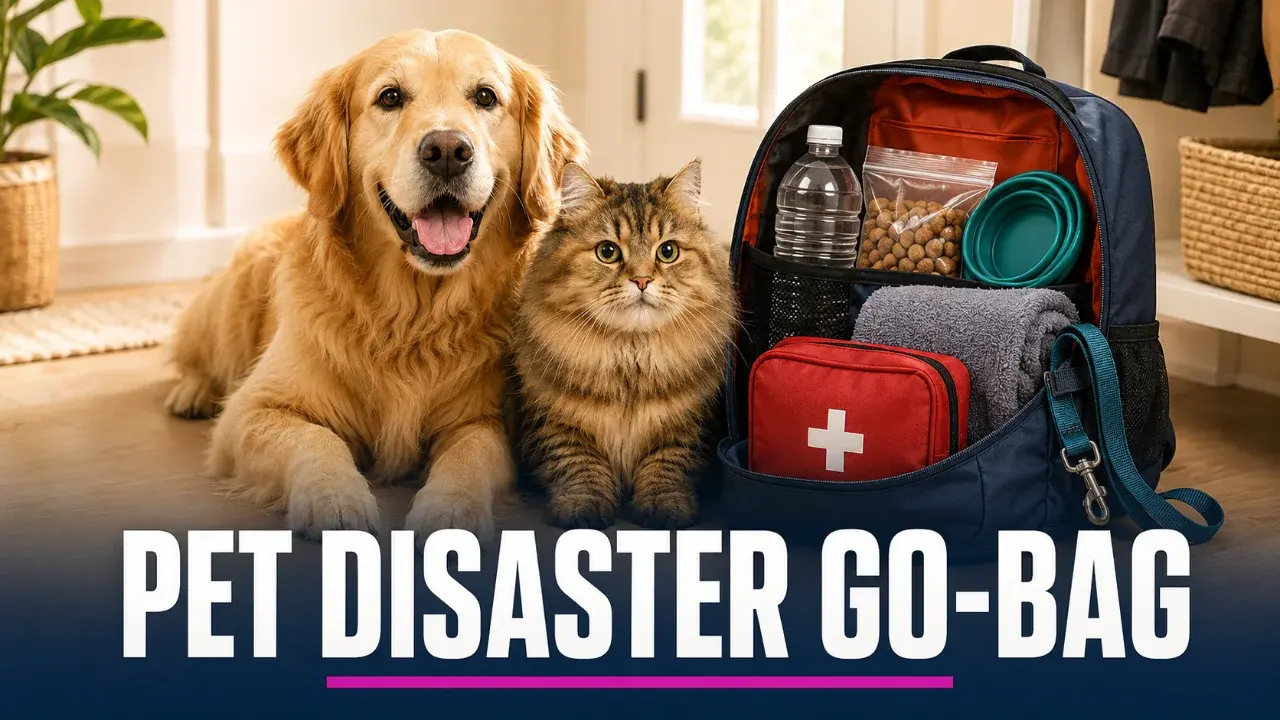
Food and water are only the beginning. A useful pet go-bag also contains the documents, medication, restraint equipment, and care instructions needed to move an animal safely when there is little time to prepare.
A disaster go-bag gives a pet owner one portable place for the supplies needed during a sudden evacuation. Without it, finding medication, vaccination records, a carrier, and several days of food can consume time that may not be available during a flood, wildfire, earthquake, severe storm, or building emergency.
The bag is not simply luggage for an animal. It is the practical link between deciding to evacuate and being able to leave safely with the pet.
The US Centers for Disease Control and Prevention warns that excluding animals from an evacuation plan can endanger pets, owners, and first responders. Pets left behind may be injured or lost, even when owners try to create a seemingly safe place for them.
Pack for movement, not just survival
A pet go-bag must be portable enough for one person to carry while also handling an animal. Start with the supplies that would be difficult or unsafe to improvise:
- Food your pet already eats
- Drinking water and collapsible or non-spill bowls
- Essential medication and written dosing instructions
- A leash, harness, collar, and current identification tag
- A secure carrier appropriate for the animal
- Waste bags, cat litter, a compact litter pan, and cleaning supplies
- A towel or small blanket
- A basic pet first-aid kit
- A familiar toy or comfort item, if space permits
The CDC’s full preparedness checklist recommends a two-week supply of food, water, and necessary medication for each animal. New Zealand Civil Defence advises households to hold supplies for pets for at least three days.
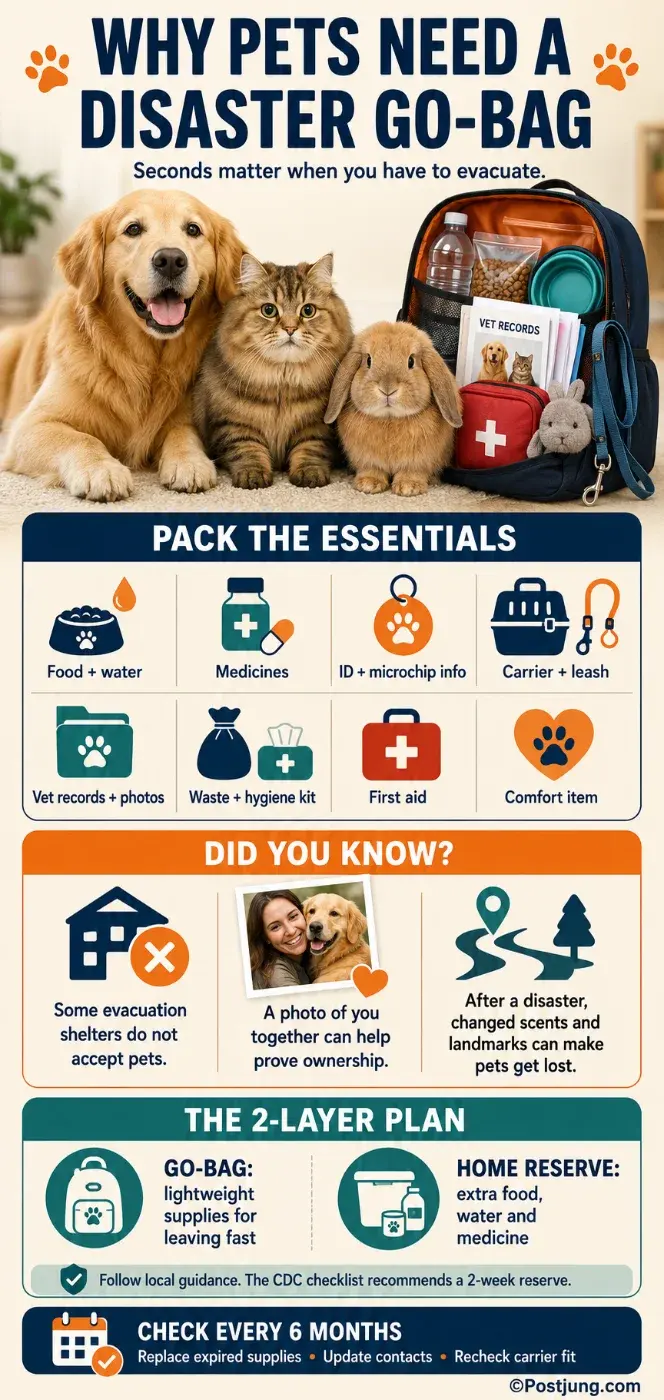
These recommendations do not mean an owner must carry an unmanageable amount of water on foot. A practical approach is to divide supplies into two layers: a lightweight evacuation bag containing immediate essentials and a larger reserve stored beside it for loading into a vehicle or sheltering at home.
Owners should adapt the quantity to local hazards, climate, evacuation routes, animal size, and official guidance. A large dog in hot weather, for example, will require considerably more water than a small indoor cat.
The paperwork may be as important as the food
Keep copies of vaccination records, prescriptions, medical history, proof of ownership, boarding instructions, and microchip details in a waterproof pouch. Include your veterinarian’s contact information and an emergency contact who can care for the animal if you cannot.
Add recent photographs of the pet and at least one clear image showing you together. The American Red Cross notes that a photo of owner and pet can help resolve mistaken identity when animals look similar or become separated from their families.
A short care sheet is also valuable. Record the animal’s feeding schedule, medication, medical conditions, hiding behavior, handling warnings, and any triggers that could cause fear or aggression. Someone unfamiliar with the pet may need to provide care.
Digital copies stored securely on a phone or cloud account provide a backup, but paper copies remain useful when batteries, cellular networks, or internet access fail.
Identification must extend beyond the bag. Keep collar details current, register the pet’s microchip, and update the microchip database whenever your phone number or address changes. A microchip without current registration information may be much less useful during reunification.
A packed bag cannot solve a missing destination
Many emergency shelters do not routinely accept household pets, although policies vary by country, location, facility, and type of animal. Service animals may be treated differently under local law.
Before an emergency, identify several possible destinations: pet-friendly shelters, hotels, boarding facilities, veterinary clinics, rescue organizations, or friends outside the affected area. Confirm their rules rather than assuming a “pet-friendly” label applies during a disaster.
Arrange a backup person who can collect the animal if roads close while you are away from home. That person should know where the carrier and go-bag are stored and have lawful access to the property.
Practice before the carrier becomes frightening
A carrier beside the door is useful only if the pet can be placed inside it. The CDC recommends helping animals become comfortable with their carriers and practicing the process of catching, loading, and transporting them.
Leave the carrier open during ordinary days, place familiar bedding inside, and reward calm entry. Run occasional evacuation drills without creating panic. Owners of multiple animals should confirm that every pet has a suitable restraint or carrier and that the household can move them all at once.
Stress may change even a gentle animal’s behavior. During evacuation and after returning home, keep pets secured because unfamiliar noise, lost landmarks, floodwater, wildlife, exposed wiring, and broken materials can create new dangers. The CDC notes that pets may become confused when familiar scents and surroundings change after a disaster.
Check the bag before it quietly becomes obsolete
Review the kit at least every six months and after any change in medication, diet, address, veterinarian, or emergency contact. Replace expired food and medicine, refresh stored water, confirm that batteries work, and check that collars, harnesses, and carriers still fit.
Ask a veterinarian which medical and first-aid supplies are appropriate for the individual animal. Human medicines should never be added or given to a pet unless a veterinarian specifically directs their use.
The best go-bag is not the biggest. It is the one that is current, portable, easy to find, and paired with a destination and a practiced evacuation plan.
SOURCES USED:
- Centers for Disease Control and Prevention — Build a Pet Disaster Preparedness Kit
- Centers for Disease Control and Prevention — Be Prepared: Pet Safety in Emergencies
- Centers for Disease Control and Prevention — Pets in Evacuation Centers
- American Red Cross — Pet Disaster Preparedness & Recovery
- New Zealand Civil Defence — Make a Household Emergency Plan

เขียนโดย Postjung Insights
 รู้หรือไม่? เปิดรายได้พนักงานส่งพัสดุของแต่ละแอป วันหนึ่งได้เท่าไร
 เปิดรายชื่อ 5 โรงเรียนเป้าหมาย เด็กสอบเข้าต้องเตรียมตัวให้พร้อม
 'สควีชชี่'ของเล่นที่กำลังเป็นไวรัลอาจถูกเจ้าหน้าที่ของสนามบินยึดได้ ตรวจสอบให้ดีก่อนนำขึ้นเครื่อง
 ซาบีดา” เรียกถกด่วน ปมภาพ “ชุดไทย” ถูกนำไปอ้างเป็นชุดกัมพูชา
 อำเภอที่มีชื่ออำเภอสั้นที่สุด 3 อำเภอเท่านั้นในประเทศไทย
 โรงเรียนที่มีนักเรียนมากที่สุดในไทย
 หนุ่มขับ Porsche ใจหล่อสุดๆ ติดประกาศเด็กหายไว้รอบคัน..หวังช่วยเผยแพร่ข้อมูลให้ตามหาได้เร็วขึ้น
 แปลปกสลาก งวด 1 ต.ค. 69 ส่องตัวเลขจากภาพปกสลากกินแบ่งรัฐบาล
 เปิด 5 โรงเรียนหญิงล้วนเก่าแก่ของไทย ที่มีประวัติยาวนานกว่าศตวรรษ
 6 วิธีรักษาชีวิตของคนโบราณ! ก่อนมียา โรงพยาบาล และเทคโนโลยี พวกเขาเอาตัวรอดกันแบบนี้
 ตาราง “เด่นเหนือเด่นใต้” งวด 1 ต.ค. 69 เปิดข้อมูลตามโพย เลขไหนอยู่ตรงไหน
 Ctrip แพลตฟอร์มการท่องเที่ยวของจีน เปิดขายตั๋วสำหรับทริปท่องเที่ยวอวกาศ ของ Virgin Galactic 6 วัน ในราคาประมาณ 24 ล้านบาทซาบีดา” เรียกถกด่วน ปมภาพ “ชุดไทย” ถูกนำไปอ้างเป็นชุดกัมพูชาเปิดรายชื่อ 5 โรงเรียนเป้าหมาย เด็กสอบเข้าต้องเตรียมตัวให้พร้อมหนุ่มขับ Porsche ใจหล่อสุดๆ ติดประกาศเด็กหายไว้รอบคัน..หวังช่วยเผยแพร่ข้อมูลให้ตามหาได้เร็วขึ้น
 วาบิ-ซาบิ (Wabi-Sabi) ปรัชญาญี่ปุ่นที่สอนให้เราโอบกอดความไม่สมบูรณ์แบบ
 English Edition