Why dogs lick your face—and what they may be telling you

A lick can be a warm greeting, a request for attention, an investigation of an interesting taste, or even a response to tension. The surrounding body language is the best clue to what a dog means.
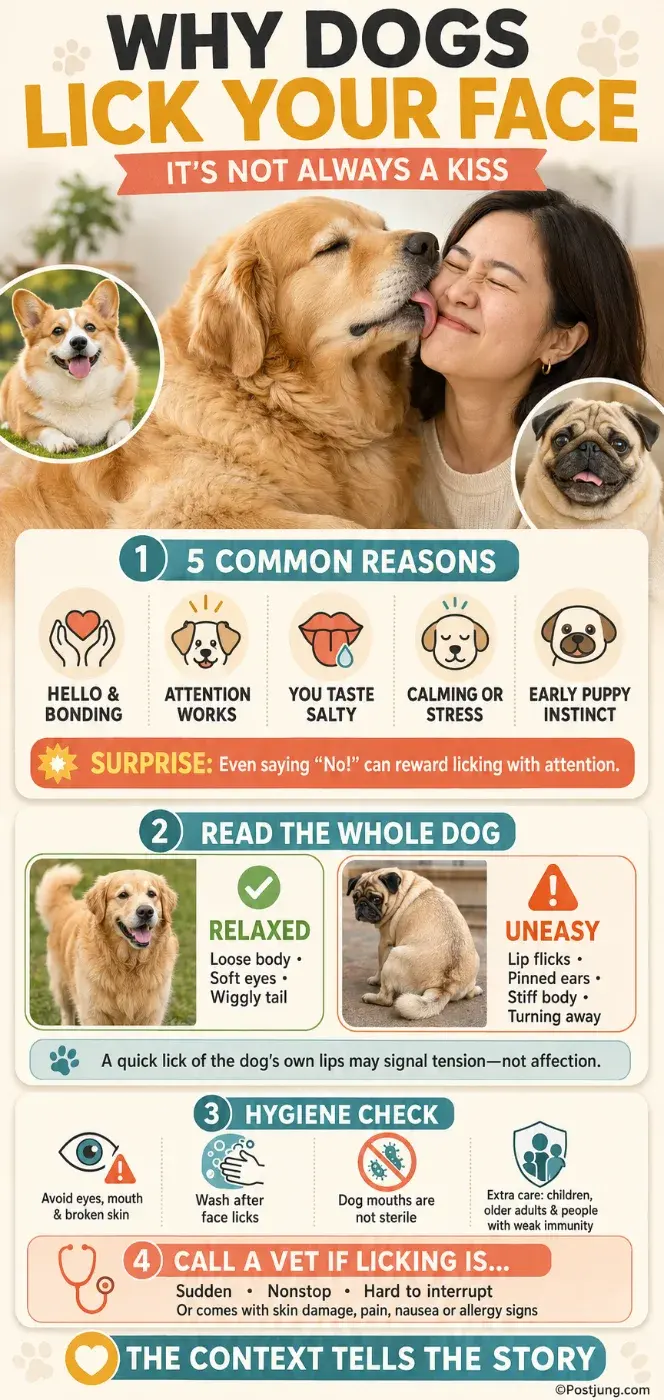
A dog licking your face may be showing affection, but that is only one possible explanation. Dogs also lick to greet people, collect scents and tastes, seek attention, calm themselves, or respond to an uncomfortable interaction.
There is no reliable one-lick translation. To understand the behavior, look at what happened immediately before it—and at the rest of the dog’s body.
Licking begins early in a dog’s life
Licking is one of the first sensations a puppy experiences. Mother dogs lick newborn puppies to clean them, stimulate bodily functions, and provide contact. Puppies later lick themselves, their littermates, and adult dogs during social interactions.
Young puppies may also lick around their mother’s mouth. In wild canids, similar behavior can prompt an adult returning from a hunt to regurgitate food. Domestic dogs do not all retain or display this feeding-related behavior, but mouth-directed licking has deep roots in canine development.
As dogs mature, licking can remain part of greeting, grooming, and social bonding. That helps explain why some dogs immediately aim for a familiar person’s hands or face during a reunion. VCA Animal Hospitals and the veterinary charity Blue Cross both identify affection and social interaction among several possible motivations.
Your face is interesting—and licking gets a reaction
Human skin carries salt, traces of food, skin-care products, and many different scents. A dog may investigate those cues with its nose and tongue, especially after a person has eaten, exercised, or returned from somewhere new.
The face is also socially important. People speak, make expressions, and direct their attention from it. For a dog seeking interaction, getting close to someone’s face is an efficient way to be noticed.
What happens next can turn occasional licking into a habit. Laughing, speaking, petting the dog, or even pushing it away may provide the attention it wanted. If licking consistently produces an exciting response, the dog can learn to repeat it.
That does not mean affection is absent. A dog can be happy to see someone while also seeking attention and enjoying an interesting taste. Behavior often has more than one reward.
Read the whole dog, not just the tongue
A relaxed, affectionate greeting usually comes with loose movement, a soft facial expression, and an easy approach. The dog may wag broadly, lean in, lick briefly, and then move on.
Licking accompanied by a lowered body, pinned-back ears, a tucked tail, stiffness, repeated yawning, avoidance, or attempts to move away may mean something different. Dogs can lick or flick their tongues when nervous, and forcing further contact can increase their discomfort.
A 2020 review of research into canine emotional signals noted that lip and nose licking has appeared in both stressful and positive social situations. It therefore should not be interpreted in isolation. The review also discussed evidence that dogs respond differently to positive and negative human facial expressions. Frontiers in Psychology
There is also an important distinction: a dog quickly licking its own lips or nose is not necessarily offering a “kiss.” It may be processing a smell, anticipating food, feeling conflicted, or trying to cope with tension.
Should dogs be allowed to lick faces?
A brief lick on healthy, intact skin is unlikely to make most people ill, but a dog’s mouth is not sterile. Dogs explore objects, animals, food, and waste with their mouths, and their saliva can carry microorganisms.
The U.S. Centers for Disease Control and Prevention says Capnocytophaga bacteria are commonly found in dogs’ and cats’ mouths. Most people who have contact with pets do not become sick, but saliva entering an open wound can cause infection. Risk is greater for people with weakened immune systems, those without a spleen, and people with certain other health conditions. CDC
A sensible approach is to keep dog saliva away from the eyes, mouth, open wounds, and broken skin, then wash the area if needed. The CDC also advises against letting a pet lick someone’s mouth or face immediately after eating, particularly when raw pet food is involved. CDC pet-food safety guidance
Children should be supervised around dogs and discouraged from placing their faces directly in front of them, regardless of how friendly the animal usually appears.
How to reduce face-licking without frightening the dog
If face-licking is unwanted, respond consistently and calmly. Turn away or pause the interaction, then reward a behavior you prefer, such as sitting, keeping four paws on the floor, or touching your hand with the dog’s nose.
A toy, food puzzle, lick mat, or short training exercise can redirect a dog that simply wants activity. Avoid shouting or physical punishment, which may create confusion or anxiety without teaching an alternative.
Sudden, persistent, or compulsive licking deserves closer attention. Excessive licking of people, objects, or the dog’s own body can sometimes accompany anxiety, pain, allergies, nausea, or another medical issue. A veterinarian should assess the dog if the behavior is new, difficult to interrupt, or associated with skin damage or other symptoms.
A face lick may indeed be affectionate, but its meaning depends on the moment. The clearest interpretation comes from the dog’s posture, expression, recent experience, and what the licking has achieved in the past.
SOURCES USED:
- VCA Animal Hospitals — Why do dogs lick humans?
- Blue Cross — Why do dogs lick?
- Frontiers in Psychology — Where Do We Stand in Domestic Dog Positive-Emotion Assessment?
- U.S. Centers for Disease Control and Prevention — About Capnocytophaga
- U.S. Centers for Disease Control and Prevention — About Pet Food Safety

เขียนโดย Postjung Insights
 ซาบีดา” เรียกถกด่วน ปมภาพ “ชุดไทย” ถูกนำไปอ้างเป็นชุดกัมพูชา
 เปิดรายชื่อ 5 โรงเรียนเป้าหมาย เด็กสอบเข้าต้องเตรียมตัวให้พร้อม
 โรงเรียนที่มีนักเรียนมากที่สุดในไทย
 'สควีชชี่'ของเล่นที่กำลังเป็นไวรัลอาจถูกเจ้าหน้าที่ของสนามบินยึดได้ ตรวจสอบให้ดีก่อนนำขึ้นเครื่อง
 Ctrip แพลตฟอร์มการท่องเที่ยวของจีน เปิดขายตั๋วสำหรับทริปท่องเที่ยวอวกาศ ของ Virgin Galactic 6 วัน ในราคาประมาณ 24 ล้านบาท
 ตาราง “เด่นเหนือเด่นใต้” งวด 1 ต.ค. 69 เปิดข้อมูลตามโพย เลขไหนอยู่ตรงไหน
 โรสแมรี่ แฮร์ริส ‘ป้าเมย์’ แห่ง Spider-Man ฉบับโทบีย์ แม็คไกวร์ อายุครบ 99 ปี
 รู้หรือไม่? เปิดรายได้พนักงานส่งพัสดุของแต่ละแอป วันหนึ่งได้เท่าไร
 แปลปกสลาก งวด 1 ต.ค. 69 ส่องตัวเลขจากภาพปกสลากกินแบ่งรัฐบาล
 อำเภอที่มีชื่ออำเภอสั้นที่สุด 3 อำเภอเท่านั้นในประเทศไทย
 หนุ่มขับ Porsche ใจหล่อสุดๆ ติดประกาศเด็กหายไว้รอบคัน..หวังช่วยเผยแพร่ข้อมูลให้ตามหาได้เร็วขึ้น
 จากอินเดียสู่เส้นทางสายไหม! เจาะลึก “การเผยแผ่พระพุทธศาสนา” ปรากฏการณ์เปลี่ยนโลกเมื่อกว่า 2,500 ปีก่อนซาบีดา” เรียกถกด่วน ปมภาพ “ชุดไทย” ถูกนำไปอ้างเป็นชุดกัมพูชาเปิดรายชื่อ 5 โรงเรียนเป้าหมาย เด็กสอบเข้าต้องเตรียมตัวให้พร้อมหนุ่มขับ Porsche ใจหล่อสุดๆ ติดประกาศเด็กหายไว้รอบคัน..หวังช่วยเผยแพร่ข้อมูลให้ตามหาได้เร็วขึ้น
 วาบิ-ซาบิ (Wabi-Sabi) ปรัชญาญี่ปุ่นที่สอนให้เราโอบกอดความไม่สมบูรณ์แบบ
 English Edition