Why pet-friendly cities can still be unaffordable

Dog parks, walkable neighborhoods, and pet-friendly businesses can make a city look ideal for animal lovers. But high rents, restrictive leases, pet surcharges, and rising veterinary costs may tell a very different story.
A city can have excellent dog parks, outdoor cafés, grooming salons, and veterinary clinics—and still be financially out of reach for many pet owners. The problem is that “pet-friendly” usually describes what a city offers, while affordability describes what a household can actually pay.
That distinction matters most to renters. A city may welcome dogs in public spaces, yet offer few reasonably priced homes that accept a renter’s particular animal.
Pet-friendly is not the same as pet-inclusive
Rental advertisements often use “pet-friendly” as a broad label. It may mean that one cat is allowed, dogs under a certain weight are accepted, or selected breeds are permitted after additional approval.
“Pet-inclusive” is a more demanding standard. It generally refers to housing without major breed or size restrictions and without excessive pet-related charges.
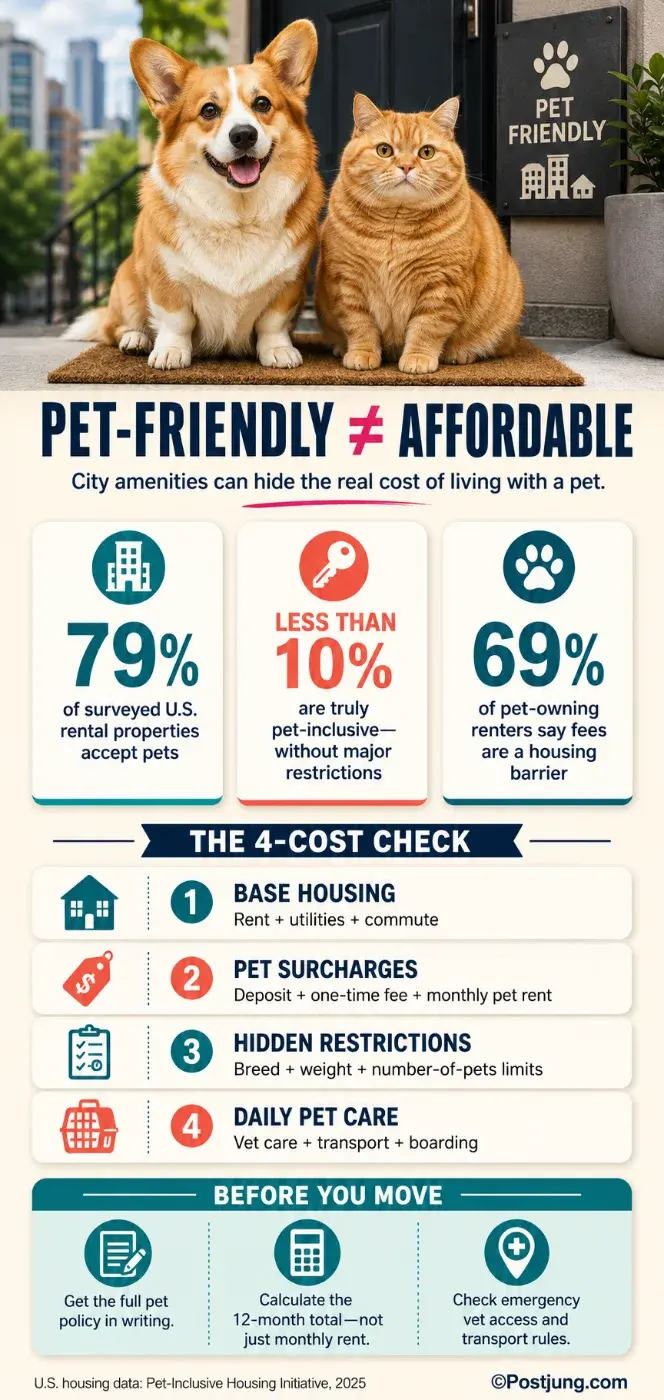
The difference can be substantial. The Pet-Inclusive Housing Initiative’s 2025 housing data found that although 79% of the U.S. rental properties it examined accepted pets, fewer than 10% qualified as pet-inclusive. Among surveyed pet-owning renters, 69% identified pet-related fees as an obstacle to securing housing.
An apartment marked “pets allowed,” therefore, may not be available to someone with a large dog, multiple animals, or a pet appearing on a restricted-breed list.
Demand is also significant. An Apartments.com renter survey published in 2025 found that a no-pets policy was an immediate deal-breaker for 38% of respondents.
When many pet owners compete for a smaller pool of usable rentals, low-cost options can disappear quickly.
The price is larger than the advertised rent
Base rent is only the beginning. Depending on the property and local law, renters may face:
- A refundable pet deposit
- A nonrefundable pet fee
- Monthly pet rent
- Separate charges for each animal
- Cleaning or move-out costs
- Required pet screening, insurance, or registration
A modest monthly surcharge becomes meaningful over a full lease. It becomes more expensive again when it is charged separately for two animals.
Upfront costs present another problem. A home might be affordable month to month but still require a security deposit, pet deposit, first month’s rent, moving expenses, and application charges at the same time.
Housing researchers generally evaluate affordability in relation to income—not by asking whether a property simply has a low advertised price. In the United States, the Department of Housing and Urban Development defines a household as cost-burdened when housing costs exceed 30% of income. Eurostat uses a different measure, defining housing-cost overburden as spending more than 40% of disposable household income on housing.
Using its measure, Eurostat reported that almost 10% of the European Union’s city population lived in housing-cost-overburdened households in 2024, compared with 6% in rural areas. The city rate reached 29% in Greece and 23% in Denmark.
These figures are not specific to pet owners, but they show the financial pressure into which pet fees and restricted housing choices are added.
Restrictions can create costs without appearing on the bill
The consequences are not limited to formal fees. A renter may have to choose a more expensive neighborhood, accept a longer commute, remain in an unsuitable home, or pay moving and application costs repeatedly after discovering that a listing’s pet policy does not cover their animal.
A 2024 peer-reviewed Frontiers in Veterinary Science study interviewed 24 current, former, and prospective pet owners in Houston, Texas. Participants described high pet charges, breed and size restrictions, confusing policies, housing instability, and safety concerns.
The study was qualitative and focused on one U.S. city, so it should not be treated as a measurement of every rental market. Its interviews nevertheless demonstrate how a nominally pet-friendly property can remain inaccessible to the people who need it.
Everyday pet care also changes the calculation
Affordable pet ownership depends on more than rent. Residents must also consider food, routine veterinary care, emergency treatment, medication, grooming, boarding, transportation, and insurance where available.
In the United States, the Bureau of Labor Statistics reported that prices for pet services, including veterinary care, were 5.1% higher in June 2026 than a year earlier. Pet services excluding veterinary care rose 6.3%.
Location affects how those expenses are managed. A neighborhood with a nearby veterinarian, safe walking routes, and pet-friendly public transportation may reduce travel time or the need for a car. Conversely, plentiful premium clinics, boutiques, and daycare centers do not help much when basic veterinary treatment or housing remains beyond a household’s budget.
A better way to compare cities
Pet owners considering a move should evaluate four separate questions:
- Can I afford the base housing? Compare rent or mortgage costs with household income, utilities, transportation, and other necessities.
- Does the housing accept my actual pet? Check species, number, weight, age, and breed rules—not just the “pet-friendly” filter.
- What is the total pet-related housing cost? Request every deposit, fee, monthly charge, insurance condition, and move-out obligation in writing.
- Can I afford daily life with my pet? Examine local veterinary prices, emergency access, transportation rules, boarding, and outdoor space.
A genuinely accessible city needs both sides of the equation: public amenities that welcome animals and housing that ordinary pet owners can obtain without destabilizing their finances.
Dog parks and water bowls are visible signs of welcome. The harder test is whether people and their animals can afford to stay.
SOURCES USED:
- Eurostat — Housing in Europe: 2025 edition
- U.S. Bureau of Labor Statistics — Consumer Price Index, June 2026
- Frontiers in Veterinary Science — Barriers to finding and maintaining pet-inclusive affordable housing
- Pet-Inclusive Housing Initiative — Pets and Housing Data: 2025 Edition
- Apartments.com — What Renters Want: 10 Key Stats From New Survey

เขียนโดย Postjung Insights
 เปิดรายชื่อ 5 โรงเรียนเป้าหมาย เด็กสอบเข้าต้องเตรียมตัวให้พร้อม
 อำเภอที่มีชื่ออำเภอสั้นที่สุด 3 อำเภอเท่านั้นในประเทศไทย
 โรงเรียนที่มีนักเรียนมากที่สุดในไทย
 ซาบีดา” เรียกถกด่วน ปมภาพ “ชุดไทย” ถูกนำไปอ้างเป็นชุดกัมพูชา
 รู้หรือไม่? เปิดรายได้พนักงานส่งพัสดุของแต่ละแอป วันหนึ่งได้เท่าไร
 ตาราง “เด่นเหนือเด่นใต้” งวด 1 ต.ค. 69 เปิดข้อมูลตามโพย เลขไหนอยู่ตรงไหน
 ส่องเลข 3 สำนักพิมพ์ งวด 1 ต.ค. 69 ตัวไหนมีข้อมูลตรงกัน
 Ctrip แพลตฟอร์มการท่องเที่ยวของจีน เปิดขายตั๋วสำหรับทริปท่องเที่ยวอวกาศ ของ Virgin Galactic 6 วัน ในราคาประมาณ 24 ล้านบาท
 สถิติย้อนหลัง 10 ปี ออกเลขไหนบ้างมาดูกัน
 แปลปกสลาก งวด 1 ต.ค. 69 ส่องตัวเลขจากภาพปกสลากกินแบ่งรัฐบาล
 'สควีชชี่'ของเล่นที่กำลังเป็นไวรัลอาจถูกเจ้าหน้าที่ของสนามบินยึดได้ ตรวจสอบให้ดีก่อนนำขึ้นเครื่อง
 บุ๋ม ปนัดดา” เล่าเบื้องหลังหญิงตีเนียน หลังเจออยู่กลางวงสัมภาษณ์ “หนุ่ม กรรชัย”ซาบีดา” เรียกถกด่วน ปมภาพ “ชุดไทย” ถูกนำไปอ้างเป็นชุดกัมพูชาเปิดรายชื่อ 5 โรงเรียนเป้าหมาย เด็กสอบเข้าต้องเตรียมตัวให้พร้อม
 หนุ่มขับ Porsche ใจหล่อสุดๆ ติดประกาศเด็กหายไว้รอบคัน..หวังช่วยเผยแพร่ข้อมูลให้ตามหาได้เร็วขึ้น
 วาบิ-ซาบิ (Wabi-Sabi) ปรัชญาญี่ปุ่นที่สอนให้เราโอบกอดความไม่สมบูรณ์แบบ
 English Edition