Why dogs destroy things when left alone—and what it really means

Chewed furniture is not always a sign of boredom or disobedience. The timing, location, and accompanying behavior can reveal whether a dog is exploring, under-stimulated, afraid of confinement, or experiencing genuine separation distress.
A dog that tears apart a cushion while home alone is not necessarily angry with its owner. Destruction can come from ordinary chewing, excess energy, outside stimulation, confinement frustration, or anxiety triggered by being separated from a person.
The damage alone cannot identify the cause. What the dog does immediately before and after its owner leaves—and where the destruction occurs—often provides the more useful clues.
The location of the damage can tell a story
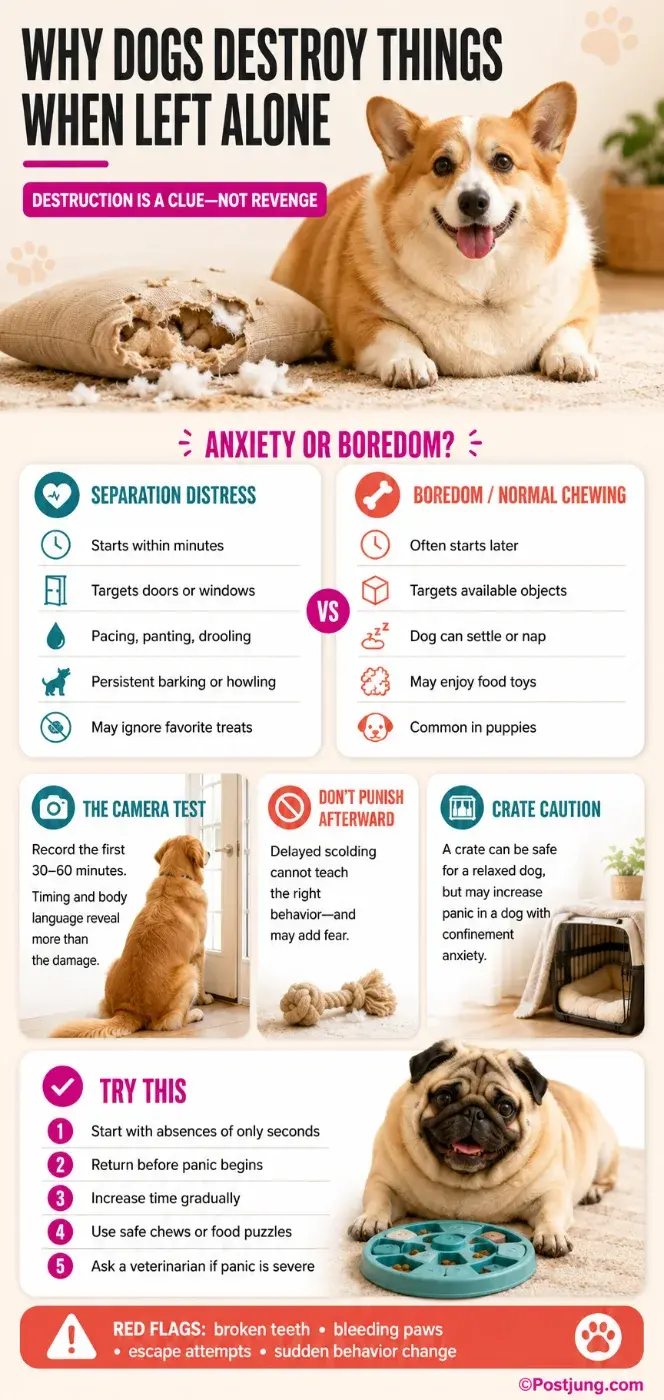
Dogs experiencing separation distress frequently focus on exit points. They may scratch doors, chew window frames, tear at flooring near an entrance, or damage a crate while apparently trying to escape or reunite with their owner.
Other signs can include persistent barking or howling, pacing, panting, drooling, trembling, refusing food, or urinating and defecating indoors. These behaviors often begin within minutes of the owner’s departure, according to the ASPCA’s guidance on separation anxiety.
That pattern differs from a dog that settles down after departure and chews an available object much later. The latter behavior could be related to boredom, exploratory play, a lack of appropriate chew items, or simply access to something attractive.
Puppies also explore with their mouths and may chew while teething. A young dog destroying a shoe does not automatically have an anxiety disorder.
A camera may reveal what the damage cannot
Because the behavior occurs when nobody is home, owners often see only the aftermath. Recording the dog for the first 30 to 60 minutes after departure can provide much better evidence.
Look for the sequence of events. Does the dog remain fixed on the door? Does it pace continuously, vocalize, pant despite a comfortable temperature, or repeatedly attempt to escape? Does it ignore a food toy it would normally enjoy? Or does it relax before becoming interested in an unattended object?
Veterinary behavior specialists recommend video because destruction and barking can have several possible causes. The Merck Veterinary Manual notes that incomplete housetraining, scavenging, outside stimuli, noise sensitivity, and confinement anxiety should be considered before separation distress is diagnosed.
A veterinarian should also rule out medical problems when a dog suddenly begins soiling the house, appears unusually restless, or shows a major behavioral change.
Why punishment usually makes things worse
Scolding a dog after returning home does not teach it what should have happened hours or minutes earlier. The dog is more likely to connect the owner’s anger with the owner’s return than with the damaged object.
Punishment can also add uncertainty and fear to an already anxious situation. A guilty-looking posture—lowered head, tucked body, or avoidance—shows that the dog is responding to the owner’s body language. It does not prove that the dog planned the destruction or understands a delayed punishment.
Crating is not a universal solution either. A dog that already feels safe and relaxed in a crate may rest comfortably there. A dog with confinement anxiety or severe separation distress may panic, damage its teeth and nails, or injure itself trying to escape. The crate should not be used simply to contain escalating panic.
Rebuilding tolerance starts with very short absences
Treatment aims to change how the dog feels about being alone, not merely prevent access to furniture.
For mild cases, a veterinarian or qualified behavior professional may recommend a predictable routine, appropriate exercise and enrichment, relaxation training, and a special food toy offered only during calm absences. The dog must still be comfortable enough to eat; a highly distressed dog may ignore food entirely.
Graduated departure training begins with absences short enough that the dog does not panic—sometimes only seconds. The duration is increased gradually. If distress returns, the next practice absence should be shorter.
This process is often called systematic desensitization and may be combined with counterconditioning, in which being alone predicts something positive. A research review published in Veterinary Medicine: Research and Reports found this combined behavioral approach among the most consistently supported strategies, while noting that treatment must be adapted to the individual dog.
During treatment, long unavoidable absences can repeatedly push the dog beyond its coping threshold. When practical, help from a trusted sitter, family member, or suitable day-care service can reduce these setbacks.
Moderate or severe cases may require medication alongside behavioral work. Medication decisions should be made by a veterinarian; drugs do not replace gradual training and should never be improvised from human prescriptions.
The most useful first step is therefore not buying a stronger crate or hiding every shoe. Record the dog, examine when and where the behavior begins, and look for the broader pattern. Once the cause is clearer, the response can address the dog’s actual need instead of treating all destruction as disobedience.
SOURCES USED:

เขียนโดย Postjung Insights
 เปิดรายชื่อ 5 โรงเรียนเป้าหมาย เด็กสอบเข้าต้องเตรียมตัวให้พร้อม
 ซาบีดา” เรียกถกด่วน ปมภาพ “ชุดไทย” ถูกนำไปอ้างเป็นชุดกัมพูชา
 รู้หรือไม่? เปิดรายได้พนักงานส่งพัสดุของแต่ละแอป วันหนึ่งได้เท่าไร
 หนุ่มขับ Porsche ใจหล่อสุดๆ ติดประกาศเด็กหายไว้รอบคัน..หวังช่วยเผยแพร่ข้อมูลให้ตามหาได้เร็วขึ้น
 'สควีชชี่'ของเล่นที่กำลังเป็นไวรัลอาจถูกเจ้าหน้าที่ของสนามบินยึดได้ ตรวจสอบให้ดีก่อนนำขึ้นเครื่อง
 อำเภอที่มีชื่ออำเภอสั้นที่สุด 3 อำเภอเท่านั้นในประเทศไทย
 โรงเรียนที่มีนักเรียนมากที่สุดในไทย
 แปลปกสลาก งวด 1 ต.ค. 69 ส่องตัวเลขจากภาพปกสลากกินแบ่งรัฐบาล
 ตาราง “เด่นเหนือเด่นใต้” งวด 1 ต.ค. 69 เปิดข้อมูลตามโพย เลขไหนอยู่ตรงไหน
 Ctrip แพลตฟอร์มการท่องเที่ยวของจีน เปิดขายตั๋วสำหรับทริปท่องเที่ยวอวกาศ ของ Virgin Galactic 6 วัน ในราคาประมาณ 24 ล้านบาท
 โรสแมรี่ แฮร์ริส ‘ป้าเมย์’ แห่ง Spider-Man ฉบับโทบีย์ แม็คไกวร์ อายุครบ 99 ปี
 เรียก “ป๋อง สุพรรณ” เซียนพระดัง แจงปมมูลนิธิฯ วัดพุทไธศวรรย์ซาบีดา” เรียกถกด่วน ปมภาพ “ชุดไทย” ถูกนำไปอ้างเป็นชุดกัมพูชาเปิดรายชื่อ 5 โรงเรียนเป้าหมาย เด็กสอบเข้าต้องเตรียมตัวให้พร้อมหนุ่มขับ Porsche ใจหล่อสุดๆ ติดประกาศเด็กหายไว้รอบคัน..หวังช่วยเผยแพร่ข้อมูลให้ตามหาได้เร็วขึ้น
 วาบิ-ซาบิ (Wabi-Sabi) ปรัชญาญี่ปุ่นที่สอนให้เราโอบกอดความไม่สมบูรณ์แบบ
 English Edition