Why Hot Spots Can Spread So Quickly on Dogs

A small patch of irritated skin can become a painful, oozing sore within hours. The rapid change is driven by an itch–lick–scratch cycle, often intensified by moisture trapped beneath the coat.
A hot spot on a dog can grow from a barely noticeable red patch into a raw, painful lesion within hours. The change may look like an infection racing across the skin, but the main driver is often the dog’s own repeated licking, biting, and scratching.
Veterinarians call these lesions acute moist dermatitis or pyotraumatic dermatitis. The MSD Veterinary Manual classifies hot spots as a form of surface pyoderma, meaning the problem affects the skin’s surface rather than automatically indicating a deep infection.
The cycle that makes a hot spot expand
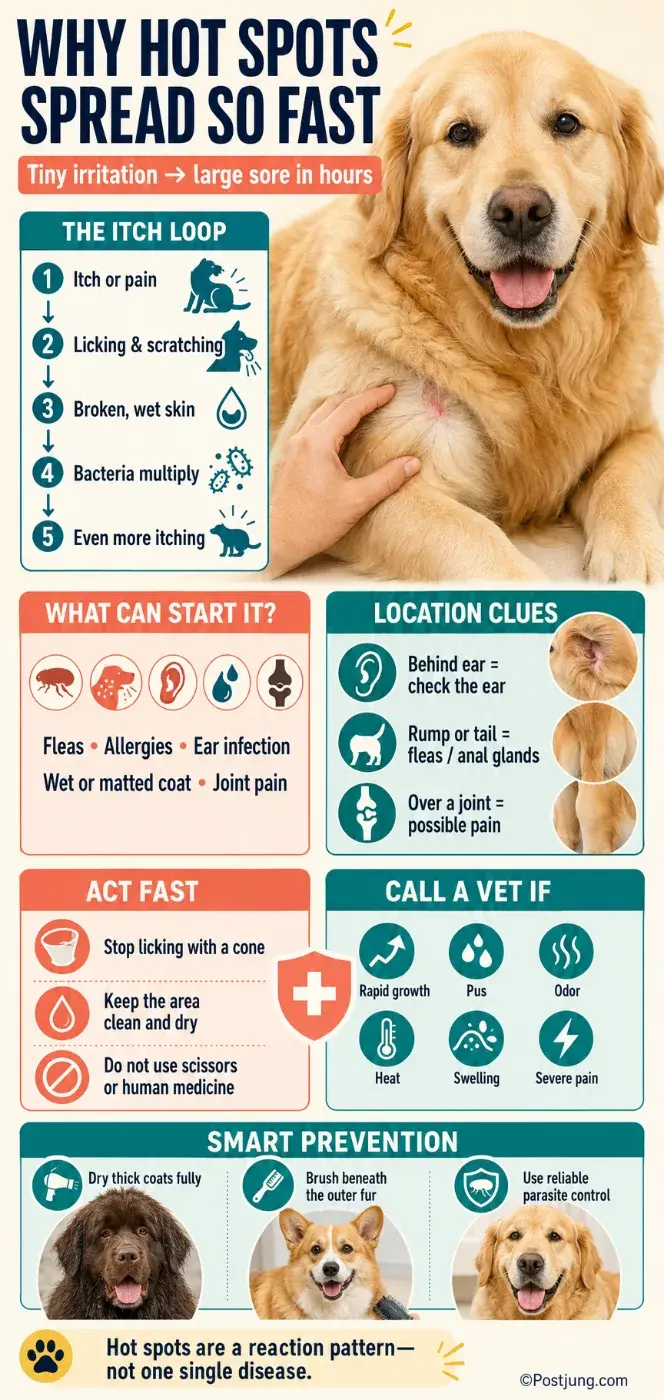
A hot spot usually begins with something that makes one area itch, hurt, or feel uncomfortable. The dog responds by scratching or chewing it. That friction damages the skin barrier, while licking adds moisture and further irritation.
Damaged skin becomes more inflamed, which makes it itch even more. The dog then returns to the same area, repeating the cycle:
Irritation leads to scratching. Scratching creates a wound. The wound causes more inflammation and itching, prompting still more licking and chewing.
This self-trauma can extend beyond the original irritated patch. According to VCA Animal Hospitals, a pinpoint area of redness can become a much larger raw lesion over a very short period.
Moisture adds another problem. Saliva, rainwater, bathwater, or water left in the coat after swimming can remain trapped against the skin, particularly beneath mats or a dense undercoat. Warm, damp skin creates favorable conditions for bacteria already living on a dog’s body to multiply.
This is why long-haired and double-coated dogs may develop lesions that are much larger than they first appear. The surrounding fur can conceal redness, discharge, odor, and damaged skin until the coat is lifted.
The first itch can come from many places
A hot spot describes the skin’s reaction, not the underlying cause. Common triggers include:
- Fleas, mites, or other insect bites
- Environmental or food-related allergies
- Ear infections
- Moisture trapped beneath thick or matted fur
- Skin infections or grooming irritation
- Anal gland inflammation
- Joint or back pain that prompts repeated licking
- Persistent licking associated with stress or boredom
Location can offer a clue. A lesion behind or below an ear may follow an itchy ear infection, especially in a dog with drop ears. A hot spot near the base of the tail can be associated with fleas or anal gland discomfort. Repeated licking over a hip or joint may signal pain rather than a primary skin problem.
Treating only the visible sore without identifying the trigger can allow the problem to return.
What a hot spot looks and feels like
Typical hot spots are red, moist, inflamed, and missing hair. They may feel warmer than nearby skin and can ooze fluid, develop a crust, smell unpleasant, or become extremely sensitive.
Common locations include the head, neck, hips, legs, and the area around the tail. Some dogs react defensively when the lesion is touched because it is painful, even if they are normally gentle.
A rapidly enlarging sore is not necessarily “spreading” from dog to dog. Hot spots are a pattern of inflammation and self-injury rather than one single contagious disease. However, some possible triggers—including fleas and certain mites—can affect other animals. Similar-looking fungal or parasitic skin conditions also require a different diagnosis and treatment.
What owners can do first
The immediate priority is to stop further licking and chewing. A properly fitted Elizabethan collar or another veterinary-approved protective collar can interrupt the cycle while the skin is assessed.
Keep the area dry and avoid tightly covering it in a way that traps additional moisture. A small, superficial lesion may be cleaned gently, but products should be selected with veterinary guidance. Some human creams, pain relievers, disinfectants, and essential oils can irritate a wound or be dangerous if a dog licks them.
Do not use scissors close to inflamed skin. Hot spots can be painful, and a sudden movement may result in an accidental cut. A veterinarian or experienced veterinary groomer can clip the surrounding coat safely, sometimes with sedation if the dog is uncomfortable.
Veterinary treatment may include clipping and cleaning the area, controlling pain and itching, treating a secondary infection, and addressing the original trigger. Antibiotics are not automatically needed for every small lesion, but deeper or infected sores may require prescription treatment.
When a veterinarian should examine the dog
Contact a veterinarian if the lesion is expanding quickly, extremely painful, producing pus, developing a strong odor, or becoming increasingly hot or swollen. Worsening redness, continued oozing, multiple lesions, or a failure to begin healing also deserve professional assessment.
Prompt care is especially sensible when the sore is close to an eye or deep inside the ear, the dog seems unwell, or the cause is unclear. Skin tumors, bite wounds, fungal disease, parasites, and deeper bacterial infections can sometimes resemble a hot spot.
Prevention starts beneath the fur
Regular flea and parasite control can remove a major source of itching. Dogs that swim or are frequently bathed should be dried thoroughly, including beneath the outer coat and around the ears.
Brushing helps reveal tangles, damp undercoat, early redness, and areas the dog has begun licking. Owners should also pay attention to repeated chewing around the paws, ears, hips, and tail rather than waiting for an obvious open sore.
A hot spot grows quickly because irritation, moisture, and self-trauma reinforce one another. Interrupting that cycle early—and finding out what caused the first itch—can prevent a small skin problem from becoming a far more painful one.
This information is general and cannot identify the cause of an individual dog’s lesion. A veterinarian should examine rapidly worsening, painful, recurrent, or infected-looking skin problems.
SOURCES USED:

เขียนโดย Postjung Insights
 รู้หรือไม่? เปิดรายได้พนักงานส่งพัสดุของแต่ละแอป วันหนึ่งได้เท่าไร
 ซาบีดา” เรียกถกด่วน ปมภาพ “ชุดไทย” ถูกนำไปอ้างเป็นชุดกัมพูชา
 หนุ่มขับ Porsche ใจหล่อสุดๆ ติดประกาศเด็กหายไว้รอบคัน..หวังช่วยเผยแพร่ข้อมูลให้ตามหาได้เร็วขึ้น
 เปิดรายชื่อ 5 โรงเรียนเป้าหมาย เด็กสอบเข้าต้องเตรียมตัวให้พร้อม
 โรงเรียนที่มีนักเรียนมากที่สุดในไทย
 แปลปกสลาก งวด 1 ต.ค. 69 ส่องตัวเลขจากภาพปกสลากกินแบ่งรัฐบาล
 'สควีชชี่'ของเล่นที่กำลังเป็นไวรัลอาจถูกเจ้าหน้าที่ของสนามบินยึดได้ ตรวจสอบให้ดีก่อนนำขึ้นเครื่อง
 อำเภอที่มีชื่ออำเภอสั้นที่สุด 3 อำเภอเท่านั้นในประเทศไทย
 Ctrip แพลตฟอร์มการท่องเที่ยวของจีน เปิดขายตั๋วสำหรับทริปท่องเที่ยวอวกาศ ของ Virgin Galactic 6 วัน ในราคาประมาณ 24 ล้านบาท
 เปิด 5 โรงเรียนหญิงล้วนเก่าแก่ของไทย ที่มีประวัติยาวนานกว่าศตวรรษ
 โรสแมรี่ แฮร์ริส ‘ป้าเมย์’ แห่ง Spider-Man ฉบับโทบีย์ แม็คไกวร์ อายุครบ 99 ปี
 ตาราง “เด่นเหนือเด่นใต้” งวด 1 ต.ค. 69 เปิดข้อมูลตามโพย เลขไหนอยู่ตรงไหนซาบีดา” เรียกถกด่วน ปมภาพ “ชุดไทย” ถูกนำไปอ้างเป็นชุดกัมพูชาเปิดรายชื่อ 5 โรงเรียนเป้าหมาย เด็กสอบเข้าต้องเตรียมตัวให้พร้อมหนุ่มขับ Porsche ใจหล่อสุดๆ ติดประกาศเด็กหายไว้รอบคัน..หวังช่วยเผยแพร่ข้อมูลให้ตามหาได้เร็วขึ้น
 วาบิ-ซาบิ (Wabi-Sabi) ปรัชญาญี่ปุ่นที่สอนให้เราโอบกอดความไม่สมบูรณ์แบบ
 English Edition