12 Questions to Ask Before Buying Pet Insurance
A low premium or generous reimbursement rate can hide exclusions, benefit caps, and substantial upfront costs. These questions help reveal how a pet insurance policy would work when your animal actually needs treatment.
Pet insurance can soften the financial shock of an accident or serious illness, but the headline coverage percentage rarely tells the whole story. A policy may reimburse only eligible expenses, impose separate treatment limits, exclude conditions linked to earlier symptoms, or require you to pay the veterinarian first.
Before comparing prices, ask each insurer the same questions and request written answers. That makes it easier to compare what the policies would actually deliver—not merely how attractive they look on a quotation page.
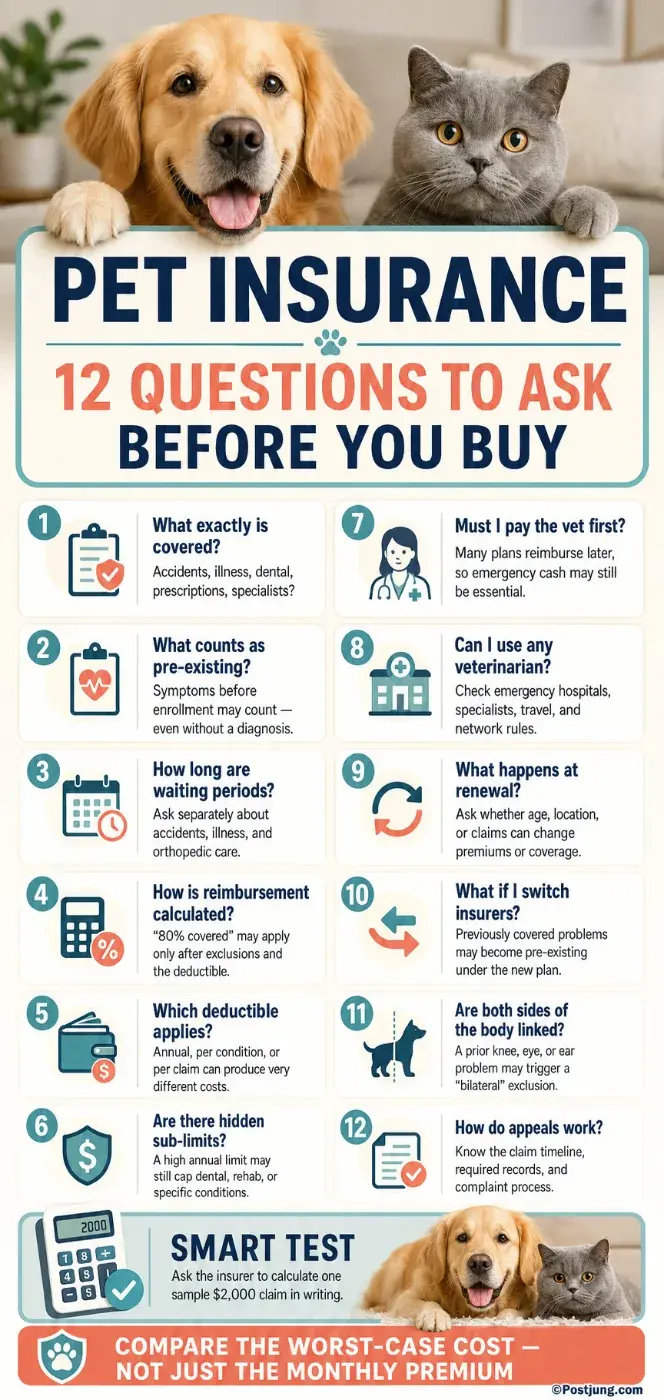
1. What type of treatment does the policy cover?
Start by establishing whether the plan covers accidents only, accidents and illnesses, or routine and preventive care as well.
Depending on the policy, eligible treatment may include diagnostic imaging, surgery, hospitalization, emergency care, prescription medication, cancer treatment, or specialist services. Vaccinations, parasite prevention, dental treatment, behavioral therapy, pregnancy-related care, and elective procedures may be excluded or offered separately.
Do not assume that “comprehensive” has the same meaning across insurers. Ask for the complete policy wording and a list of exclusions.
2. How does the policy define a pre-existing condition?
This may be the most consequential question in the entire comparison.
A pre-existing condition is not always limited to a formal diagnosis made before enrollment. Under some policy definitions, signs or symptoms recorded before coverage began—or during a waiting period—may be enough for a later claim to be excluded.
Ask whether the insurer reviews your pet’s full veterinary history and whether it can conduct a medical-record review before the first claim. If possible, request written confirmation of any conditions that will be excluded.
3. Are curable conditions ever reconsidered?
Some insurers may reconsider a temporary condition after the pet has fully recovered and remained symptom-free for a specified period. Others apply permanent exclusions.
Ask:
- How long must the pet be symptom-free?
- Is a veterinary examination required?
- Must the owner formally request a review?
- Will the removal of an exclusion be confirmed in writing?
Never assume an old condition has become eligible merely because it has not returned.
4. Are hereditary, congenital, and bilateral conditions covered?
Hereditary disorders are genetically transmitted, while congenital conditions are present from birth. Policies may cover them, limit their benefits, or exclude them entirely.
Also ask about “bilateral conditions.” These affect body parts that have left and right sides, such as eyes, ears, hips, or knees. If one side was affected before coverage began, some policies may treat a later problem on the opposite side as related and exclude it.
This detail can be especially important for pets with breed-associated orthopedic, eye, skin, or respiratory risks.
5. What are the waiting periods?
Coverage may not begin immediately after purchase. Waiting periods can differ for accidents, illnesses, and orthopedic conditions.
Ask for the exact waiting period attached to every category of coverage. Find out whether symptoms that first appear during that period will remain excluded after the waiting period ends.
Rules vary by location. For example, the National Association of Insurance Commissioners’ U.S. model law prohibits accident waiting periods and limits certain illness or orthopedic waiting periods, but the model must be adopted locally before it becomes applicable law. Check the rules where the policy is issued.
6. How are reimbursements calculated?
A policy advertising “80% reimbursement” does not necessarily pay 80% of the total veterinary bill.
The insurer may first remove non-covered charges, apply a deductible, enforce a treatment sub-limit, and then calculate its percentage. Some policies reimburse from the actual eligible bill, while others use a benefit schedule or a limit based on what the insurer considers a customary fee.
Ask the company to calculate a sample claim. For example, if an eligible treatment costs $2,000, the deductible is $250, and reimbursement is 80%, one possible calculation would produce a $1,400 payment:
($2,000 − $250) × 80% = $1,400
The owner would pay the remaining $600—and potentially more if consultation fees, medication, or other items were excluded. The exact order and method depend on the policy.
7. Is the deductible annual, per condition, or per claim?
The word “deductible” can describe very different arrangements.
An annual deductible generally has to be met once during each policy year. A per-condition deductible may apply separately to each illness or injury. A per-claim deductible could be charged every time a new claim is submitted.
For a pet requiring repeated treatment, these differences can substantially change the final cost.
8. What limits and sub-limits apply?
Look beyond the main annual benefit limit. A policy with a high overall limit may still impose much smaller caps on dental illness, diagnostic tests, rehabilitation, prescription food, specialist treatment, or particular conditions.
Ask whether limits apply:
- Per claim
- Per condition
- Per year
- Across the pet’s lifetime
- To specific treatments or body systems
Also ask whether unused benefits carry forward. Usually, they do not—but the contract controls.
9. Must I pay the veterinarian upfront?
Many pet insurance policies work by reimbursement: the owner pays the full veterinary bill and submits a claim afterward. Direct payment to the clinic may be available only from certain insurers, at participating practices, or with prior approval.
Even with insurance, you may therefore need enough cash or available credit to cover an emergency bill temporarily. Ask how long claims usually take, what documents are required, and whether preauthorization is available for expensive planned treatment.
10. Can I use any veterinarian or specialist?
Confirm whether the policy permits treatment by any licensed veterinarian or restricts owners to a network. Ask specifically about emergency hospitals, veterinary specialists, telehealth consultations, alternative therapies, and treatment received while traveling.
The American Veterinary Medical Association supports policies that allow owners to choose their veterinarians, including emergency and specialist facilities, but individual contracts and local markets may differ.
11. What happens as my pet gets older?
Ask whether the insurer has a maximum enrollment age and how premiums, deductibles, reimbursement percentages, or coverage can change over time.
A policy that is affordable for a young animal may become considerably more expensive later. Request an explanation of the factors used at renewal, including age, location, veterinary-cost inflation, and claim history.
Switching insurers may not solve the problem. Conditions covered by the old policy could be treated as pre-existing by the new company, which can make continuity of coverage particularly valuable after a pet develops a chronic illness.
12. How are claims, appeals, cancellations, and renewals handled?
Before buying, find out:
- How a claim is submitted
- The usual processing time
- How the insurer explains a partial payment or denial
- Whether there is an internal appeal process
- Which insurance regulator or dispute-resolution service handles complaints
- Whether the policy can be canceled after a claim
- What happens to ongoing conditions at renewal
Keep the policy, medical records, invoices, claim decisions, and written correspondence. If a claim is denied, compare the reason with the exact exclusion or definition in the contract rather than relying only on a brief customer-service explanation.
Insurance or a dedicated savings fund?
Pet insurance transfers part of the risk of an unpredictable veterinary bill, but it does not make every treatment free. An alternative is to build a dedicated emergency fund, although a serious illness or accident can occur before that fund becomes large enough.
Some owners combine insurance for major unexpected expenses with savings for deductibles, preventive care, and excluded treatment. Whichever approach you choose, compare the worst realistic out-of-pocket amount—not simply the monthly premium.
Policy wording, consumer protections, and complaint procedures vary by country and jurisdiction. Verify the contract with the insurer and consult your local insurance regulator before making a financial decision.
SOURCES USED:
- National Association of Insurance Commissioners — Pet Insurance
- National Association of Insurance Commissioners — Pet Insurance Model Act
- Australian Government MoneySmart — Pet Insurance
- American Veterinary Medical Association — Pet Health Insurance Policy
- Washington State Office of the Insurance Commissioner — Pet Insurance

เขียนโดย Postjung Insights
 ซาบีดา” เรียกถกด่วน ปมภาพ “ชุดไทย” ถูกนำไปอ้างเป็นชุดกัมพูชา
 รู้หรือไม่? เปิดรายได้พนักงานส่งพัสดุของแต่ละแอป วันหนึ่งได้เท่าไร
 ตาราง “เด่นเหนือเด่นใต้” งวด 1 ต.ค. 69 เปิดข้อมูลตามโพย เลขไหนอยู่ตรงไหน
 'สควีชชี่'ของเล่นที่กำลังเป็นไวรัลอาจถูกเจ้าหน้าที่ของสนามบินยึดได้ ตรวจสอบให้ดีก่อนนำขึ้นเครื่อง
 Ctrip แพลตฟอร์มการท่องเที่ยวของจีน เปิดขายตั๋วสำหรับทริปท่องเที่ยวอวกาศ ของ Virgin Galactic 6 วัน ในราคาประมาณ 24 ล้านบาท
 เปิดรายชื่อ 5 โรงเรียนเป้าหมาย เด็กสอบเข้าต้องเตรียมตัวให้พร้อม
 อำเภอที่มีชื่ออำเภอสั้นที่สุด 3 อำเภอเท่านั้นในประเทศไทย
 ส่องเลข 3 สำนักพิมพ์ งวด 1 ต.ค. 69 ตัวไหนมีข้อมูลตรงกัน
 หนุ่มขับ Porsche ใจหล่อสุดๆ ติดประกาศเด็กหายไว้รอบคัน..หวังช่วยเผยแพร่ข้อมูลให้ตามหาได้เร็วขึ้น
 โรสแมรี่ แฮร์ริส ‘ป้าเมย์’ แห่ง Spider-Man ฉบับโทบีย์ แม็คไกวร์ อายุครบ 99 ปี
 โรงเรียนที่มีนักเรียนมากที่สุดในไทย
 เปิด 5 โรงเรียนหญิงล้วนเก่าแก่ของไทย ที่มีประวัติยาวนานกว่าศตวรรษซาบีดา” เรียกถกด่วน ปมภาพ “ชุดไทย” ถูกนำไปอ้างเป็นชุดกัมพูชาเปิดรายชื่อ 5 โรงเรียนเป้าหมาย เด็กสอบเข้าต้องเตรียมตัวให้พร้อมหนุ่มขับ Porsche ใจหล่อสุดๆ ติดประกาศเด็กหายไว้รอบคัน..หวังช่วยเผยแพร่ข้อมูลให้ตามหาได้เร็วขึ้น
 วาบิ-ซาบิ (Wabi-Sabi) ปรัชญาญี่ปุ่นที่สอนให้เราโอบกอดความไม่สมบูรณ์แบบ
 English Edition