Why separation anxiety can look like bad behavior in dogs
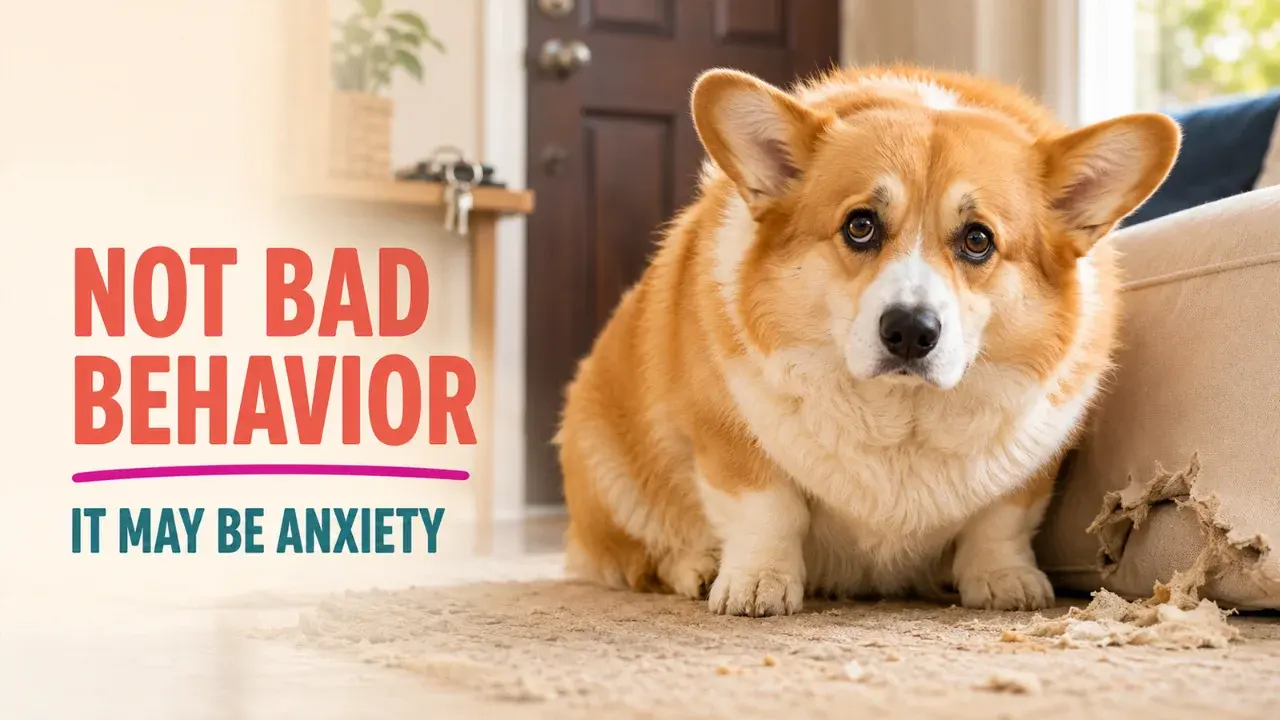
Chewed doors, nonstop barking, and indoor accidents can look like deliberate disobedience. But when these behaviors cluster around an owner’s departure, they may be signs of genuine distress.
A dog that tears up a cushion, urinates indoors, or barks for an hour may appear to be acting out because its owner left. Yet dogs with separation-related problems are not plotting revenge. Their behavior may be an attempt to cope with fear, panic, frustration, or another source of distress.
That distinction matters because punishment does not treat the underlying emotion. It can make the dog more anxious about the next departure—and about the owner’s return.
The timing tells a bigger story than the damage
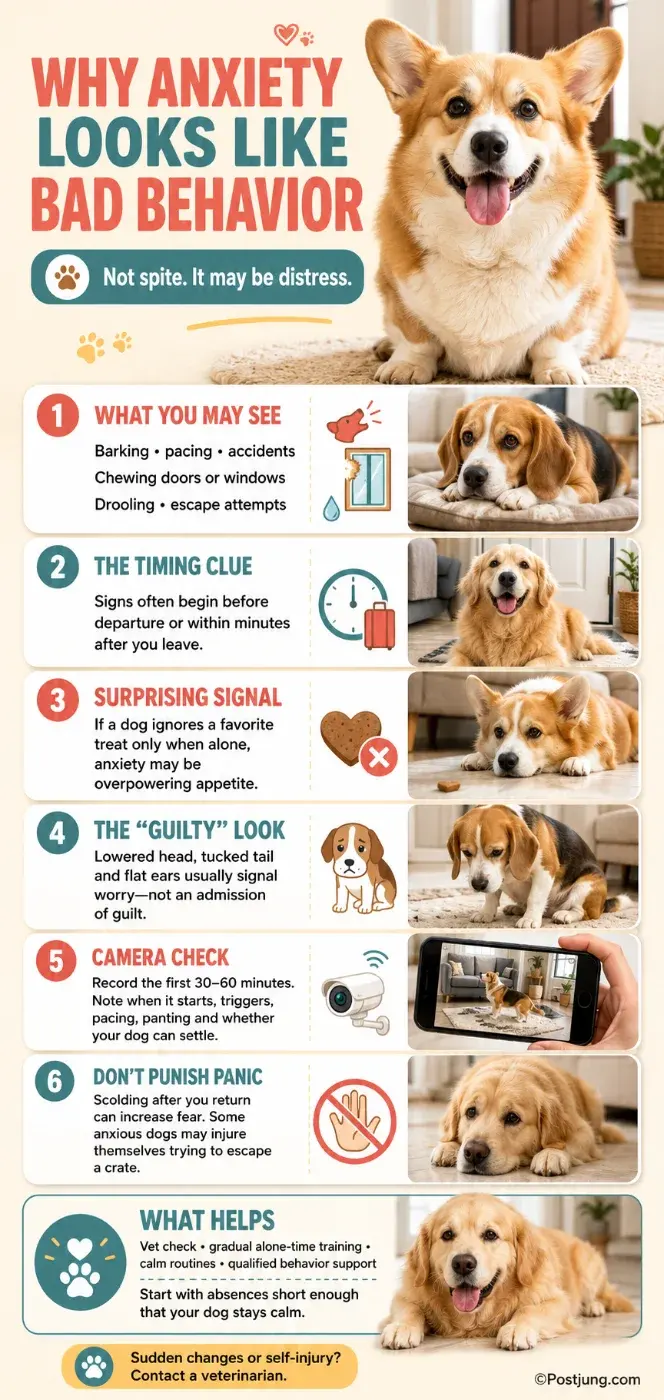
Separation-related distress often begins as an owner prepares to leave or shortly after the door closes. A dog may follow the owner from room to room, pant when keys are picked up, tremble as shoes go on, or stop eating once the owner disappears.
More visible signs can include:
- Barking, whining, or howling
- Pacing or repeatedly circling
- Scratching or chewing doors and windows
- Destroying objects carrying the owner’s scent
- Urinating or defecating indoors
- Drooling, vomiting, or refusing food
- Trying to escape from a room or crate
- Becoming intensely excited when the owner returns
The location of the damage can offer a clue. Destruction around exits may reflect an attempt to follow the owner rather than an ordinary urge to chew. But no single behavior confirms separation anxiety.
A dog may bark because people are passing a window, destroy furniture from boredom, soil the house because of incomplete training, or panic specifically when confined. Pain, urinary disease, digestive problems, sensory loss, and age-related cognitive changes can also alter behavior.
Veterinary behavior researchers therefore use “separation-related problems” as a broad description rather than assuming every dog has the same emotional condition. Research suggests that similar outward behaviors can arise from different internal states, including fear and frustration. A diagnostic framework published in Frontiers in Veterinary Science identified multiple behavioral patterns rather than one universal form of separation anxiety.
A camera can expose the signs owners never see
A pet camera or an old phone positioned safely in the room can provide more useful information than the mess found afterward. Record the period before departure and at least the first 30 to 60 minutes alone, without speaking through the device.
Look for when the behavior starts, what happens immediately before it, whether the dog can settle, and whether outside sounds trigger a reaction. Panting, freezing, scanning the doorway, and refusing a normally irresistible food toy may reveal distress that leaves no physical evidence.
Video can also help a veterinarian distinguish separation-related distress from noise sensitivity, barrier frustration, boredom, or a medical problem. VCA’s veterinary guidance calls an audio or video recording one of the best ways to assess what happens after the owner leaves.
The “guilty look” does not prove guilt
Owners sometimes interpret a lowered head, flattened ears, tucked tail, or avoidance as an admission of wrongdoing. These signals more likely reflect worry about the owner’s current posture, voice, or previous reactions.
A dog cannot reliably connect punishment delivered at homecoming with an act committed much earlier. Instead, it may learn that the owner’s return predicts anger. The RSPCA advises against scolding or punishing dogs for damage or accidents discovered after an absence because this can intensify anxiety.
Quietly moving the dog to another area before cleaning is more useful than forcing it to inspect the damage.
Treatment means staying below the panic point
Effective training is not simply leaving the dog alone until it stops protesting. A dog that becomes silent may still be distressed.
Gradual desensitization begins with an absence short enough that the dog remains calm—sometimes only a few seconds. The owner returns before distress begins and increases the duration in small, manageable steps. A review indexed by the U.S. National Library of Medicine found that systematic desensitization and counterconditioning are among the most promising behavioral approaches.
During treatment, families may need a sitter, daycare, help from friends, or adjusted schedules to avoid absences that exceed the dog’s current tolerance. Exercise, predictable routines, comfortable resting areas, and safe food toys can support the plan, but they do not cure severe anxiety by themselves.
A dog that ignores a favorite food after the owner leaves may be too distressed to eat. Similarly, adding another pet rarely solves anxiety centered on separation from a particular person.
Crates require special caution. A dog that already relaxes in a crate may find it reassuring, but a panicking dog may injure its teeth, paws, or nails while trying to escape. Confinement should never be used merely to prevent visible destruction.
When veterinary help is warranted
Arrange a veterinary examination when the behavior begins suddenly, involves self-injury, occurs in an older dog, or includes changes in thirst, urination, mobility, appetite, or awareness. Medical causes should be investigated before assuming the problem is behavioral.
Moderate or severe cases may require a veterinarian or qualified clinical animal behaviorist. Prescription medication can reduce anxiety enough for some dogs to learn during behavior modification, but the choice, dosage, monitoring, and duration must be determined by a veterinarian.
The most useful shift is also the simplest: treat the behavior as information. Once chewing, barking, or house soiling is viewed as a possible distress signal rather than an act of spite, the path forward becomes safer for the dog and more productive for the household.
SOURCES USED:
- VCA Animal Hospitals — Separation Anxiety in Dogs
- RSPCA — Recognising Separation-Related Behaviour and Anxiety in Dogs
- Frontiers in Veterinary Science — Developing Diagnostic Frameworks in Veterinary Behavioral Medicine
- Veterinary Medicine: Research and Reports — Canine Separation Anxiety: Strategies for Treatment and Management

เขียนโดย Postjung Insights
 รู้หรือไม่? เปิดรายได้พนักงานส่งพัสดุของแต่ละแอป วันหนึ่งได้เท่าไร
 เปิดรายชื่อ 5 โรงเรียนเป้าหมาย เด็กสอบเข้าต้องเตรียมตัวให้พร้อม
 อำเภอที่มีชื่ออำเภอสั้นที่สุด 3 อำเภอเท่านั้นในประเทศไทย
 หนุ่มขับ Porsche ใจหล่อสุดๆ ติดประกาศเด็กหายไว้รอบคัน..หวังช่วยเผยแพร่ข้อมูลให้ตามหาได้เร็วขึ้น
 ตาราง “เด่นเหนือเด่นใต้” งวด 1 ต.ค. 69 เปิดข้อมูลตามโพย เลขไหนอยู่ตรงไหน
 โรงเรียนที่มีนักเรียนมากที่สุดในไทย
 แปลปกสลาก งวด 1 ต.ค. 69 ส่องตัวเลขจากภาพปกสลากกินแบ่งรัฐบาล
 Ctrip แพลตฟอร์มการท่องเที่ยวของจีน เปิดขายตั๋วสำหรับทริปท่องเที่ยวอวกาศ ของ Virgin Galactic 6 วัน ในราคาประมาณ 24 ล้านบาท
 เปิด 5 โรงเรียนหญิงล้วนเก่าแก่ของไทย ที่มีประวัติยาวนานกว่าศตวรรษ
 ส่องเลข 3 สำนักพิมพ์ งวด 1 ต.ค. 69 ตัวไหนมีข้อมูลตรงกัน
 ซาบีดา” เรียกถกด่วน ปมภาพ “ชุดไทย” ถูกนำไปอ้างเป็นชุดกัมพูชา
 เรียก “ป๋อง สุพรรณ” เซียนพระดัง แจงปมมูลนิธิฯ วัดพุทไธศวรรย์ซาบีดา” เรียกถกด่วน ปมภาพ “ชุดไทย” ถูกนำไปอ้างเป็นชุดกัมพูชาเปิดรายชื่อ 5 โรงเรียนเป้าหมาย เด็กสอบเข้าต้องเตรียมตัวให้พร้อมหนุ่มขับ Porsche ใจหล่อสุดๆ ติดประกาศเด็กหายไว้รอบคัน..หวังช่วยเผยแพร่ข้อมูลให้ตามหาได้เร็วขึ้น
 วาบิ-ซาบิ (Wabi-Sabi) ปรัชญาญี่ปุ่นที่สอนให้เราโอบกอดความไม่สมบูรณ์แบบ
 English Edition