Why your cat may ignore a new toy
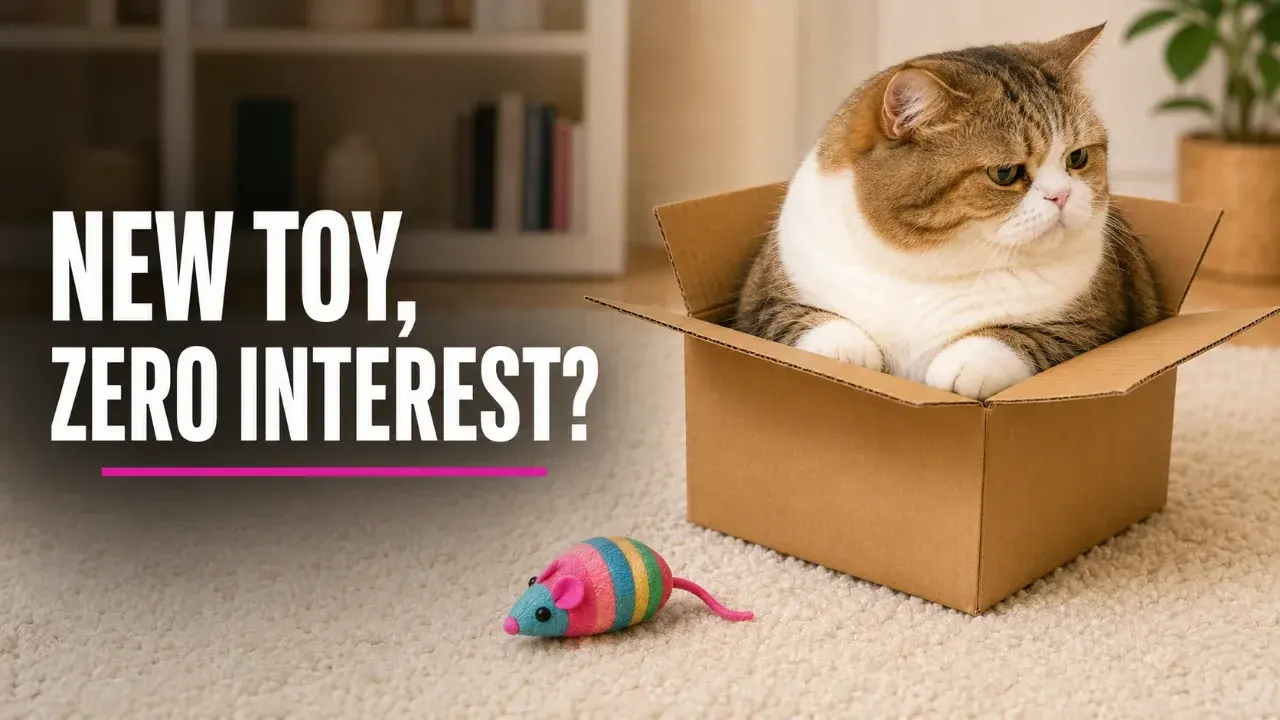
Cats do not judge toys by price or appearance. Movement, scent, timing, location, and individual hunting preferences can determine whether a new toy becomes a favorite or is treated like furniture.
You bring home a carefully chosen cat toy, place it on the floor, and wait. Your cat sniffs it once, walks away, and settles happily inside the packaging instead.
That reaction does not necessarily mean the toy was a bad purchase—or that your cat has stopped enjoying play. A toy that looks exciting to a person may offer very little of what attracts a cat: prey-like movement, a manageable target, a safe setting, and an opportunity to stalk and capture.
A toy on the floor may not look alive
Feline play often mirrors parts of the hunting sequence: searching, stalking, chasing, pouncing, catching, and manipulating. A toy left motionless in the middle of a room may therefore be less interesting than a paper ball skittering across the floor or a wand disappearing behind a chair.
The Feline Veterinary Medical Association recommends interactive toys that mimic prey, such as a toy mouse pulled across the floor or feathers moved through the air. It also advises allowing cats to catch the toy periodically; an endless chase without a successful capture can cause frustration.
Instead of waving a wand directly in your cat’s face, try moving it away from the cat as prey would move. Let it pause behind furniture, make short unpredictable movements, and occasionally allow a successful pounce.
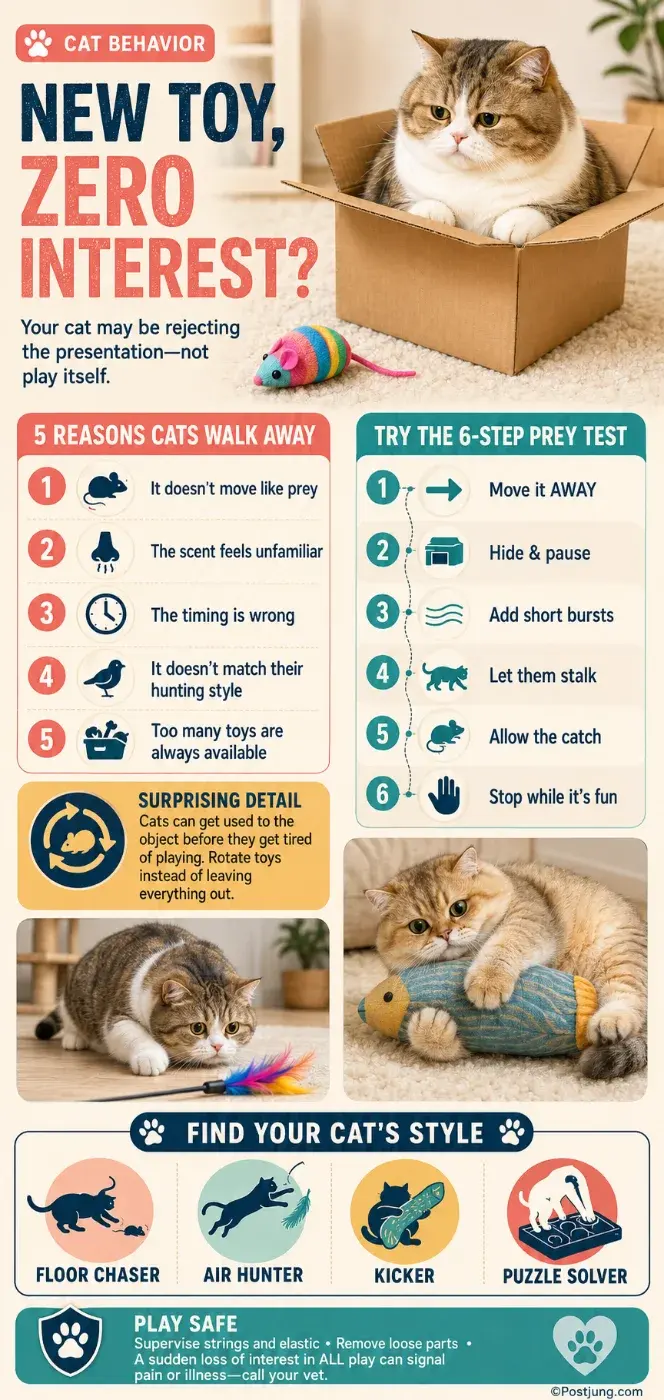
Cats have different hunting preferences
There is no single toy that appeals to every cat. One may prefer a mouse-sized object traveling along the floor, while another responds to feathers moving above it. Some enjoy kicking and biting a larger soft toy, and others are most engaged by food puzzles.
Research on feline play indicates that characteristics including size, novelty, and resemblance to prey can influence a cat’s response. A review published in Applied Animal Behaviour Science noted that smaller, mouse-sized toys attracted stronger responses in some experimental settings, but that does not make them universally superior.
Notice what your cat already chooses to pursue. A cat fascinated by insects may respond to small, rapid movements. One that watches birds through a window may prefer an aerial wand toy. The useful question is not “Which toy is best?” but “Which kind of movement does this cat find rewarding?”
New smells and noisy features may be discouraging
Cats use smell to evaluate their surroundings. According to the Feline Veterinary Medical Association, unfamiliar odors—including scents from animals, detergents, and household products—can be stressful to some cats.
A new toy may carry odors from its packaging, a store, another home, or scented materials added during manufacturing. Strong bells, motors, or sudden electronic movements may also startle a cautious cat.
Remove the packaging and leave the toy in a familiar, quiet area for a while without forcing interaction. Placing it near familiar bedding may make it less alien, but avoid adding perfumes or essential oils. Many essential oils can be unsafe for cats, and a strong artificial scent may make the object less appealing.
Timing and location change the response
A playful cat may still ignore a toy when sleepy, distracted, recently fed, or uncomfortable around another animal. Cats also need access to resources without feeling challenged by other pets.
Try the toy during a naturally active period, often around dawn or dusk, and choose a quiet area with room to stalk. In a multi-cat household, offer individual play sessions so a timid cat does not have to compete or remain alert to another cat.
Keep the first attempts brief. Ending while the cat is still interested can work better than continuing until the activity becomes repetitive.
Novelty helps—but interaction matters
Cats can lose interest when the same object remains available continuously. Research on adult domestic cats has found declining play responses after repeated exposure, followed by renewed interest when a visually different toy was introduced.
This suggests that cats can become accustomed to a particular object without losing their underlying motivation to play. Rotating a small selection of toys may therefore work better than leaving every toy out all the time.
A simple cardboard box, paper ball, or supervised wand can outperform an expensive electronic toy because it changes with human interaction. Hide toys between sessions, vary their movement, and reintroduce them later.
Give an ignored toy a second chance
Before abandoning a new toy, try changing the presentation:
- Let unfamiliar packaging odors fade in a quiet, familiar space.
- Move the toy away from the cat in short, prey-like bursts.
- Use furniture or a box to create places where the “prey” can hide.
- Allow the cat to stalk, pounce, and catch it.
- Test it during a naturally active part of the day.
- Stop if the cat appears frightened, irritated, or overwhelmed.
- Put it away and try again another day rather than forcing play.
Check toys regularly for loose pieces. International Cat Care warns that small parts can be swallowed, while strings or elastic attached to wand toys can become tangled around a cat’s neck or legs. Such toys should be used only under supervision and stored securely afterward.
Ignoring one toy is usually just a preference. A sudden loss of interest in all play, especially alongside hiding, reduced appetite, difficulty jumping, stiffness, aggression, or another behavioral change, deserves more attention. Pain and illness can alter normal activity, so contact a veterinarian if the change is persistent or unusual for your cat.
The toy your cat ignores today may become interesting once it moves like prey, smells familiar, and appears at the right moment. And if it never does, the cardboard box may still win.
SOURCES USED:
- Hall, Bradshaw and Robinson — Object play in adult domestic cats: The roles of habituation and disinhibition
- Feline Veterinary Medical Association and International Cat Care — Your Cat’s Environmental Needs
- International Cat Care — Playing with your cat
- International Cat Care — Caring for your new kitten
- Henning et al. — Cats just want to have fun: Associations between play and welfare

เขียนโดย Postjung Insights
 วงแหวนแฟร์รี่ (Fairy Circles): ปริศนาวงกลมกลางทะเลทราย ที่เรายังต้องหาคำตอบกันต่อไป...
 เปิดหลักฐานเก่า 120 ปี ปมภาพหญิงเมืองกำแพงเพชร โผล่เวที Miss Universe Cambodia 2026
 รู้หรือไม่? เปิดรายได้พนักงานส่งพัสดุของแต่ละแอป วันหนึ่งได้เท่าไร
 โรงเรียนที่มีนักเรียนมากที่สุดในไทย
 อำเภอที่มีชื่ออำเภอสั้นที่สุด 3 อำเภอเท่านั้นในประเทศไทย
 เปิด 5 สินค้าเกษตรจากลาวที่เข้าสู่ตลาดไทย สินค้าไหนมีบทบาทสำคัญที่สุด
 5 คณะที่เรียนจบมาแล้ว มีอาชีพรองรับมากกว่าที่คิด
 เลขเด็ดปฏิทิน "หลวงปู่โต๊ะ" งวดวันที่ 1 ตุลาคม 69..ส่องเลย เลขไหนให้โชค!
 แปลปกสลาก งวด 1 ต.ค. 69 ส่องตัวเลขจากภาพปกสลากกินแบ่งรัฐบาล
 เปิด 5 โรงเรียนหญิงล้วนเก่าแก่ของไทย ที่มีประวัติยาวนานกว่าศตวรรษ
 ตาราง “เด่นเหนือเด่นใต้” งวด 1 ต.ค. 69 เปิดข้อมูลตามโพย เลขไหนอยู่ตรงไหน
 เปิดรายชื่อโรงเรียนในไทยที่ “ว่ายน้ำ” อยู่ในหลักสูตร เรียนจริงตั้งแต่อนุบาลถึงมัธยมเปิดหลักฐานเก่า 120 ปี ปมภาพหญิงเมืองกำแพงเพชร โผล่เวที Miss Universe Cambodia 2026เปิด 5 สินค้าเกษตรจากลาวที่เข้าสู่ตลาดไทย สินค้าไหนมีบทบาทสำคัญที่สุดวงแหวนแฟร์รี่ (Fairy Circles): ปริศนาวงกลมกลางทะเลทราย ที่เรายังต้องหาคำตอบกันต่อไป...
 😃 ชวนเข้ามาดูกันอีกกับคนที่มีร่างกายพิเศษจนเหมือนมีกล่องสมบัติที่หายาก 😯5 คณะที่เรียนจบมาแล้ว มีอาชีพรองรับมากกว่าที่คิดเปิดรายชื่อโรงเรียนในไทยที่ “ว่ายน้ำ” อยู่ในหลักสูตร เรียนจริงตั้งแต่อนุบาลถึงมัธยม
 English Edition