Why pets scratch even when you cannot find fleas

Fleas are only one possible cause of itching—and they can be surprisingly difficult to spot. Allergies, microscopic mites, infections and ear problems can also make dogs and cats scratch, lick or overgroom.
A dog chewing its paws or a cat repeatedly grooming one patch of fur may be intensely itchy even when a careful search reveals no fleas. That does not mean the irritation is imaginary—or that parasites have been ruled out.
Veterinarians call itching “pruritus.” It is a symptom rather than a diagnosis, and the Merck Veterinary Manual identifies parasites, infections and allergies as its most common causes.
Scratching is only one sign. Pets may also lick, bite, chew or rub their skin, shake their head, scoot, or groom so frequently that the coat becomes thin. Cats, in particular, may remove evidence of a problem through persistent grooming before their owners notice anything on the skin.
Fleas can be present without being seen
“No visible fleas” is not the same as “no flea exposure.” Fleas move quickly, hide in warm areas and may be groomed away. Much of their life cycle also occurs in the environment rather than on the animal.
Cornell University’s College of Veterinary Medicine notes that veterinarians may diagnose fleas through adult insects, flea dirt or the characteristic distribution of skin irritation. In dogs, redness, hair loss and itching near the base of the tail or backs of the thighs can suggest flea allergy even when no adult flea is found.
A pet allergic to flea saliva may react intensely to minimal exposure. The itching can continue after the flea has disappeared, making the connection easy to miss.
Other parasites are possible too. Mites can be too small to see without a microscope, while lice and ticks may hide beneath thick fur. For this reason, parasite control is commonly one of the first steps in investigating an itchy pet.
Use only products intended for the animal’s species, weight and age. Some parasite treatments made for dogs can be dangerous to cats, so owners should check the label and consult a veterinarian before applying an unfamiliar product.
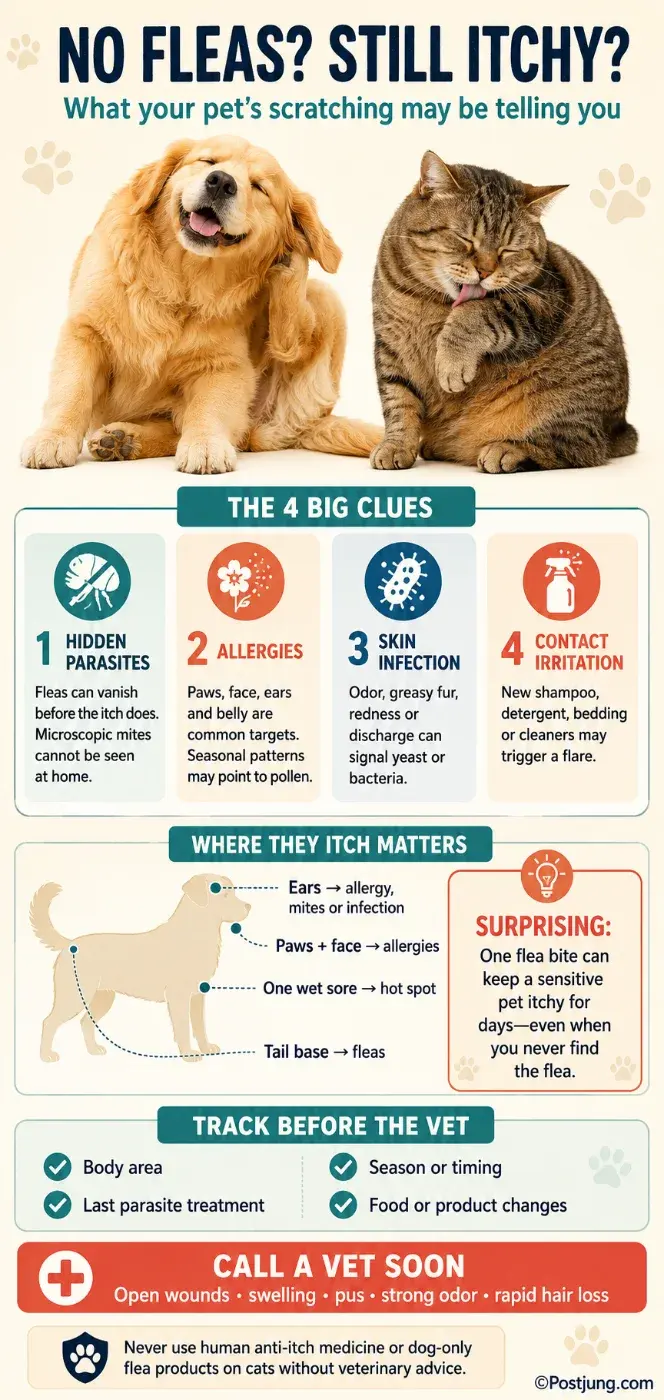
Allergies often affect the paws, face, ears and belly
Environmental allergies can be triggered by substances such as pollen, mold or dust mites. The symptoms may be seasonal, but indoor allergens can cause problems throughout the year.
Dogs with atopic dermatitis commonly lick or chew their paws and rub their face. Recurrent ear inflammation or infection may be part of the same allergic pattern. Cats can show allergies through excessive grooming, crusted patches, hair loss or lesions around the head and neck.
Food allergy can produce similar signs and may develop even after a pet has eaten the same ingredients for a long time. It cannot be reliably confirmed simply by switching foods for a few days.
A properly controlled elimination diet generally requires veterinary planning and strict adherence. Treats, flavored medication, table scraps and access to another animal’s food can undermine the trial. According to the American Animal Hospital Association’s allergic skin disease guidelines, atopy is diagnosed by excluding other causes; blood or skin allergy testing does not diagnose atopy by itself and is primarily used when allergen-specific immunotherapy is being planned.
Scratching can create a self-reinforcing cycle
Allergies and parasites may start the problem, but damaged skin can allow bacteria or yeast to multiply. The resulting infection produces additional inflammation and itching, causing the pet to scratch even more.
Warning signs include an unusual odor, greasy or flaky skin, redness, hair loss, crusts, moist sores, discharge or dark debris in the ears. A sudden tender, wet patch—often called a hot spot—can become substantially worse in a short time.
Simply stopping the itch may therefore be insufficient. A veterinarian may need to treat a secondary infection while also investigating the original trigger.
Contact irritation is another possibility. Shampoo, household cleaner, laundry detergent, plants or material from a new bed may irritate exposed skin. Timing can provide a clue: consider whether the problem began after grooming, swimming, cleaning the home, changing bedding or introducing a new product.
The pattern matters more than one isolated scratch
An occasional scratch is normal. Concern rises when the behavior becomes frequent, interrupts sleep or play, damages the skin, or repeatedly affects the same area.
Before the appointment, owners can record:
- When the itching began and whether it is getting worse
- Which parts of the body are affected
- Whether it changes with the season or location
- Current flea and tick prevention, including the last dose
- Recent food, treat, shampoo, bedding or cleaning-product changes
- Ear shaking, odor, hair loss, sores or digestive symptoms
- Previous treatments and whether they helped
Photos and short videos can be useful when the behavior is intermittent. Avoid bathing the pet immediately before the examination unless a veterinarian recommends it, because washing may temporarily alter skin lesions or remove diagnostic material.
The veterinary workup may include flea combing, examination of the ears, skin scrapings for mites and cytology to look for yeast or bacteria. Many skin conditions resemble one another, so diagnosis may require excluding possibilities and observing how the pet responds to a carefully chosen treatment.
Do not give human anti-itch medicine or apply essential oils, steroid creams or leftover pet medication without veterinary guidance. The appropriate treatment depends on the species, underlying cause and the animal’s broader health.
Prompt veterinary care is warranted if scratching produces open wounds, bleeding, swelling, pus, severe pain or rapid hair loss, or if the pet stops eating or seems unwell. Facial swelling or difficulty breathing should be treated as an emergency.
The most useful takeaway is simple: the absence of visible fleas narrows the investigation less than many owners expect. Persistent scratching is a clue that something is irritating the skin, and finding that cause—not merely suppressing the behavior—is what provides lasting relief.
SOURCES USED:
- American Animal Hospital Association — 2023 AAHA Management of Allergic Skin Diseases in Dogs and Cats Guidelines
- Merck Veterinary Manual — Itching (Pruritus) in Dogs
- Cornell University College of Veterinary Medicine — Fleas
- Cornell University College of Veterinary Medicine — Atopic Dermatitis
- Merck Veterinary Manual — Diagnosis of Skin Diseases in Small Animals

เขียนโดย Postjung Insights
 วงแหวนแฟร์รี่ (Fairy Circles): ปริศนาวงกลมกลางทะเลทราย ที่เรายังต้องหาคำตอบกันต่อไป...
 เปิดหลักฐานเก่า 120 ปี ปมภาพหญิงเมืองกำแพงเพชร โผล่เวที Miss Universe Cambodia 2026
 อำเภอที่มีชื่ออำเภอสั้นที่สุด 3 อำเภอเท่านั้นในประเทศไทย
 รู้หรือไม่? เปิดรายได้พนักงานส่งพัสดุของแต่ละแอป วันหนึ่งได้เท่าไร
 5 คณะที่เรียนจบมาแล้ว มีอาชีพรองรับมากกว่าที่คิด
 โรงเรียนที่มีนักเรียนมากที่สุดในไทย
 เปิด 5 สินค้าเกษตรจากลาวที่เข้าสู่ตลาดไทย สินค้าไหนมีบทบาทสำคัญที่สุด
 เปิด 5 โรงเรียนหญิงล้วนเก่าแก่ของไทย ที่มีประวัติยาวนานกว่าศตวรรษ
 เปิดรายชื่อโรงเรียนในไทยที่ “ว่ายน้ำ” อยู่ในหลักสูตร เรียนจริงตั้งแต่อนุบาลถึงมัธยม
 ตาราง “เด่นเหนือเด่นใต้” งวด 1 ต.ค. 69 เปิดข้อมูลตามโพย เลขไหนอยู่ตรงไหน
 แปลปกสลาก งวด 1 ต.ค. 69 ส่องตัวเลขจากภาพปกสลากกินแบ่งรัฐบาล
 Google ยอมรับแล้ว! Gemini AI เข้าถึงระบบบริษัทจริง 3 แห่ง ระหว่างการทดสอบความปลอดภัยเปิดหลักฐานเก่า 120 ปี ปมภาพหญิงเมืองกำแพงเพชร โผล่เวที Miss Universe Cambodia 2026เปิด 5 สินค้าเกษตรจากลาวที่เข้าสู่ตลาดไทย สินค้าไหนมีบทบาทสำคัญที่สุดวงแหวนแฟร์รี่ (Fairy Circles): ปริศนาวงกลมกลางทะเลทราย ที่เรายังต้องหาคำตอบกันต่อไป...
 😃 ชวนเข้ามาดูกันอีกกับคนที่มีร่างกายพิเศษจนเหมือนมีกล่องสมบัติที่หายาก 😯5 คณะที่เรียนจบมาแล้ว มีอาชีพรองรับมากกว่าที่คิดเปิดรายชื่อโรงเรียนในไทยที่ “ว่ายน้ำ” อยู่ในหลักสูตร เรียนจริงตั้งแต่อนุบาลถึงมัธยม
 English Edition