Why hot pavement can burn your dog’s paws—and what to do

A warm-looking sidewalk may be far hotter than the surrounding air. Here is how to check the ground, recognize a paw-pad burn, and respond safely.
A dog’s paw pads are tougher than human skin, but they are still living tissue. Prolonged contact with sun-heated asphalt, concrete, sand, artificial turf, or metal can cause painful burns, blistering, and peeling.
The danger is easy to underestimate because weather forecasts report air temperature—not the temperature of the surface beneath your dog’s feet.
Pavement can be much hotter than the air
Dark pavement absorbs solar energy and releases it slowly. Its surface temperature depends on direct sunlight, shade, material, wind, humidity, and how long it has been heating, so the reading on a weather app cannot tell you whether a particular sidewalk is safe.
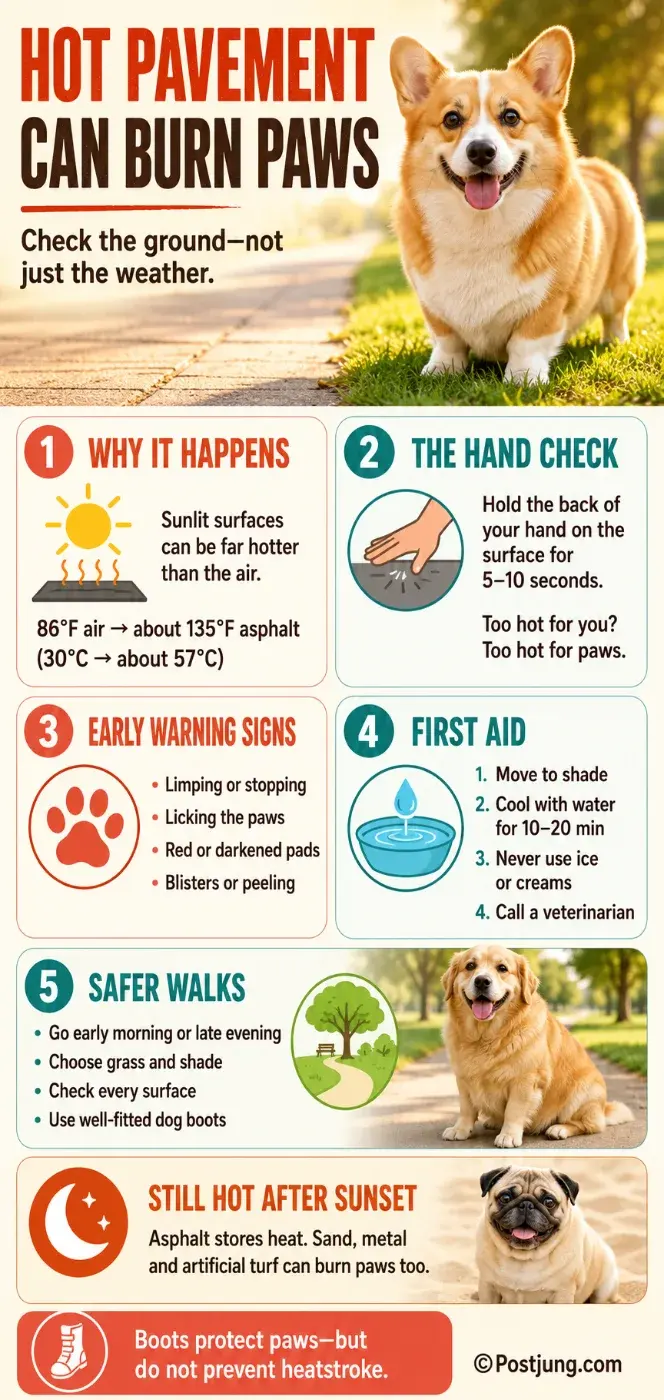
The American Animal Hospital Association says surface temperatures can be 40°F to 60°F—or about 22°C to 33°C—higher than the surrounding air under some conditions. It gives the example of asphalt reaching approximately 135°F (57°C) when the air temperature is 86°F (30°C).
This also explains why pavement can remain uncomfortable after the strongest sunlight has passed. A late-afternoon or early-evening walk is not automatically safe if the ground has stored heat throughout the day.
Cornell University’s College of Veterinary Medicine recommends scheduling walks during cooler periods, particularly early morning or evening. Early morning is often the safer choice because outdoor surfaces have had more time to release the previous day’s heat.
The hand test is a warning, not a guarantee
Animal-welfare and veterinary organizations offer slightly different versions of a simple test: hold your hand against the surface for five, seven, or ten seconds. If you cannot keep it there comfortably, your dog should not walk on it.
The variation in timing reveals an important point: this is a practical caution test, not a clinical measurement. It cannot account for every dog, surface, or duration of exposure. If the ground feels questionable, choose grass or a shaded path rather than treating the test as permission to continue.
Check the actual surfaces your dog will cross, including unshaded sections. Sand, metal plates, truck beds, artificial turf, and concrete can also become dangerously hot.
Well-fitting dog boots may provide a physical barrier, but they should be introduced gradually and checked for rubbing. They do not prevent overheating, so protective footwear should never be used to justify strenuous exercise in extreme heat.
Signs that a dog’s paw pads may be burned
A dog may not immediately cry out or stop walking. Watch for:
- Limping, slowing down, or refusing to walk
- Repeatedly lifting one or more feet
- Licking or chewing the paws
- Redness or unusual darkening of the pads
- Blisters, peeling skin, or missing areas of the pad
- Whimpering or pulling away when a paw is examined
Inspect all four paws after suspected exposure. Injury may affect several pads even if the dog appears to favor only one leg.
Do not force a painful dog to walk home across the same surface. Carry the dog if it is safe and practical, or move it by the shortest available route onto cooler ground.
What to do after a suspected paw burn
Move the dog away from the hot surface immediately. PDSA veterinary guidance recommends cooling burned skin with cool running water—or placing the affected area in cool water—for 10 to 20 minutes.
Do not use ice or iced water. Do not apply butter, oils, human burn creams, or other ointments unless a veterinarian specifically recommends a product for that dog.
Burns can be deeper than they initially appear and may become infected. PDSA advises contacting a veterinarian after any pet burn. Blistering, loose or exposed tissue, severe pain, refusal to walk, or injury involving multiple paws warrants prompt professional attention.
A veterinarian can assess the depth of the injury, provide appropriate pain relief, clean and dress the pads, and determine whether further treatment is needed.
Watch the whole dog, not only the paws
Hot pavement and heatstroke are separate hazards that can occur during the same walk. Heavy panting, excessive drooling, difficulty breathing, weakness, confusion, vomiting, seizures, or collapse may indicate dangerous overheating.
Cornell University advises moving an overheating dog into a cool environment, providing access to water, and wetting the dog with cool water while using a fan. Difficulty breathing, neurological symptoms, vomiting, or collapse require immediate veterinary care.
The safest decision happens before the leash goes on: inspect the conditions at ground level, favor cooler hours and softer surfaces, and shorten or replace the walk when the heat is excessive. Missing one outdoor walk is far safer than treating burned paws or heatstroke afterward.
SOURCES USED:
- American Animal Hospital Association — How to Protect Your Dog’s Paws from Hot Pavement
- Cornell University College of Veterinary Medicine — Summer Heat Safety Tips for Dogs
- RSPCA — Caring for Your Dog in Hot Weather
- PDSA — First Aid for Burns
- American Veterinary Medical Association — Walking or Running With Your Dog

เขียนโดย Postjung Insights
 รู้หรือไม่? เปิดรายได้พนักงานส่งพัสดุของแต่ละแอป วันหนึ่งได้เท่าไร
 เปิด 5 สินค้าเกษตรจากลาวที่เข้าสู่ตลาดไทย สินค้าไหนมีบทบาทสำคัญที่สุด
 เปิด 5 โรงเรียนหญิงล้วนเก่าแก่ของไทย ที่มีประวัติยาวนานกว่าศตวรรษ
 เปิดหลักฐานเก่า 120 ปี ปมภาพหญิงเมืองกำแพงเพชร โผล่เวที Miss Universe Cambodia 2026
 วงแหวนแฟร์รี่ (Fairy Circles): ปริศนาวงกลมกลางทะเลทราย ที่เรายังต้องหาคำตอบกันต่อไป...
 อำเภอที่มีชื่ออำเภอสั้นที่สุด 3 อำเภอเท่านั้นในประเทศไทย
 โรงเรียนที่มีนักเรียนมากที่สุดในไทย
 5 คณะที่เรียนจบมาแล้ว มีอาชีพรองรับมากกว่าที่คิด
 แปลปกสลาก งวด 1 ต.ค. 69 ส่องตัวเลขจากภาพปกสลากกินแบ่งรัฐบาล
 ตาราง “เด่นเหนือเด่นใต้” งวด 1 ต.ค. 69 เปิดข้อมูลตามโพย เลขไหนอยู่ตรงไหน
 สถิติย้อนหลัง 10 ปี ออกเลขไหนบ้างมาดูกัน
 เลขเด็ดปฏิทิน "หลวงปู่โต๊ะ" งวดวันที่ 1 ตุลาคม 69..ส่องเลย เลขไหนให้โชค!เปิดหลักฐานเก่า 120 ปี ปมภาพหญิงเมืองกำแพงเพชร โผล่เวที Miss Universe Cambodia 2026เปิด 5 สินค้าเกษตรจากลาวที่เข้าสู่ตลาดไทย สินค้าไหนมีบทบาทสำคัญที่สุดวงแหวนแฟร์รี่ (Fairy Circles): ปริศนาวงกลมกลางทะเลทราย ที่เรายังต้องหาคำตอบกันต่อไป...
 😃 ชวนเข้ามาดูกันอีกกับคนที่มีร่างกายพิเศษจนเหมือนมีกล่องสมบัติที่หายาก 😯5 คณะที่เรียนจบมาแล้ว มีอาชีพรองรับมากกว่าที่คิด
 เปิดรายชื่อโรงเรียนในไทยที่ “ว่ายน้ำ” อยู่ในหลักสูตร เรียนจริงตั้งแต่อนุบาลถึงมัธยม
 English Edition