Why pet insurance is easier to buy before health problems start
Most pet insurance is designed for future, unexpected veterinary care—not conditions that have already appeared. Enrolling earlier can preserve more coverage options, but the policy details still matter.
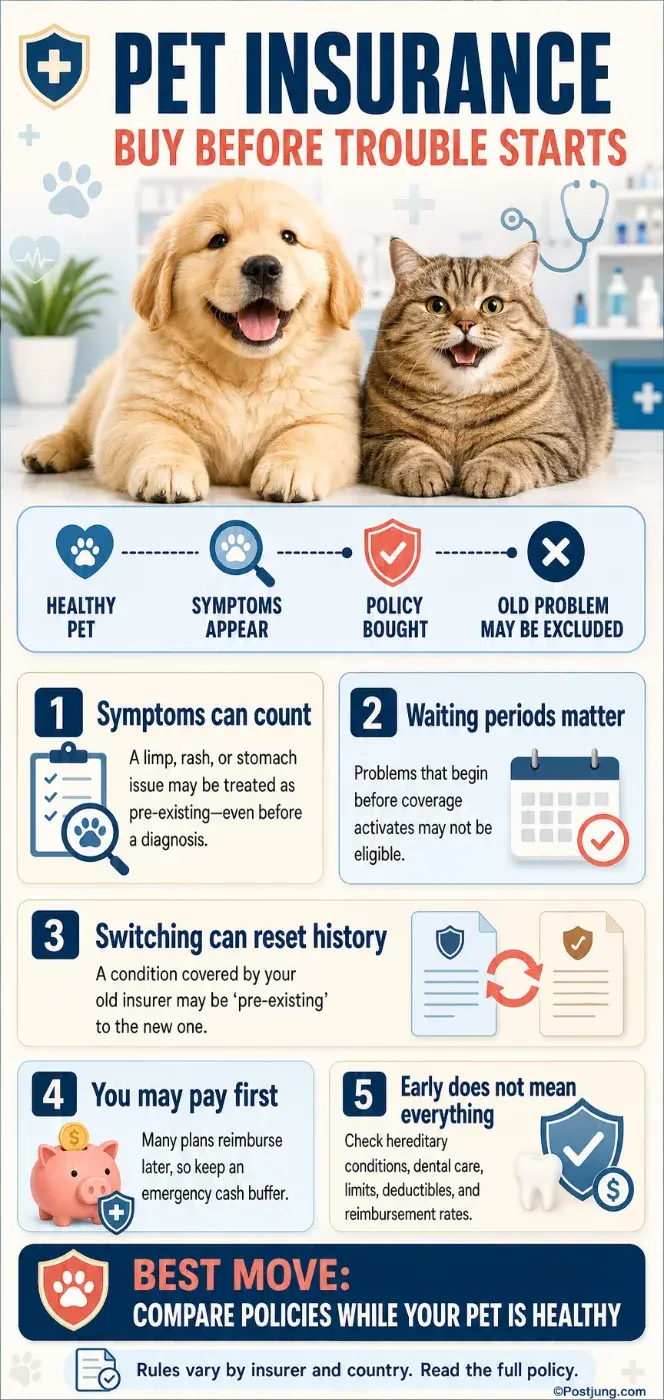
Pet insurance is generally easier to use effectively when it begins before a dog or cat develops symptoms. Once a medical problem appears in the veterinary record, a new insurer may treat that problem—and sometimes related future treatment—as a pre-existing condition.
Buying a policy after something goes wrong usually does not make that existing problem insurable. It may still provide useful protection against unrelated illnesses or injuries, but the condition that prompted the purchase could be excluded.
Pre-existing does not always mean formally diagnosed
Pet owners sometimes assume a condition becomes pre-existing only after a veterinarian gives it a name. Policy definitions can be broader.
Depending on the policy and local law, an insurer may examine whether the pet displayed symptoms, received treatment, or was the subject of veterinary advice before coverage began. A recurring limp, skin irritation, digestive problem, or other documented symptom could therefore matter even if the final diagnosis comes later.
The California Department of Insurance advises consumers to ask whether a policy excludes conditions for which the owner received medical advice or the animal received treatment before enrollment. Australia’s government-backed Moneysmart service similarly notes that many insurers consider signs and symptoms shown before enrollment when identifying pre-existing conditions.
That is the central reason earlier enrollment can preserve more options: a healthy pet generally has fewer recorded problems that could be excluded.
Waiting periods create a second reason not to delay
Coverage may not begin immediately after the first premium is paid. Many policies impose waiting periods during which some or all claims are ineligible.
The waiting period can differ by policy and type of treatment. If an illness or symptom begins during that period, expenses may not be covered—and the problem could affect future claims under that policy.
Pet owners should check the effective date for accident, illness, and orthopedic coverage separately rather than relying on a general statement that the policy “starts” on the purchase date.
Waiting periods also mean pet insurance is not an emergency funding tool. Purchasing coverage after noticing that a pet is unwell is unlikely to pay for the visit that is already needed.
Age can change the choices available
Enrollment at a younger age does not guarantee cheap premiums forever. Prices can rise as a pet ages, and insurers may consider factors such as species, breed, location, coverage level, medical history, and claims history.
Some providers also restrict new enrollment above certain ages or offer older animals different terms. The UK’s Association of British Insurers advises owners to budget for premiums that may rise with age and to compare policies on coverage—not price alone.
The point of enrolling early is therefore not that the policy will always remain inexpensive. It is that the owner may have a wider choice before age and medical history narrow the field.
Switching policies can reset the problem
A cheaper quote from another insurer may look attractive, but switching requires care. A condition covered under the existing policy may be treated as pre-existing by the new provider.
Moneysmart specifically warns that previously claimed conditions may be considered pre-existing when an owner moves to a new insurer. That makes continuity valuable, particularly after a pet develops a chronic or recurring problem.
Before switching, ask the prospective insurer to explain in writing how it will treat the pet’s complete medical history. Compare any savings with the value of coverage that could be lost.
Early enrollment still does not mean complete coverage
A policy purchased for a healthy puppy or kitten can still contain significant exclusions. Depending on the plan, these may involve hereditary or congenital disorders, dental treatment, routine care, preventive services, bilateral conditions, prescription drugs, behavioral treatment, or breed-related problems.
Owners should also compare:
- Annual, lifetime, and per-condition benefit limits
- Deductibles, copayments, and reimbursement percentages
- Whether reimbursement uses the actual bill or a benefit schedule
- Whether the veterinarian must be paid in full before reimbursement
- How renewal premiums and coverage terms can change
- Whether temporary exclusions can be reviewed after recovery
- Which records or health examinations are required
The National Association of Insurance Commissioners notes that insurers may handle curable and incurable pre-existing conditions differently. Some curable conditions may become eligible after a defined symptom-free period, while chronic conditions can remain excluded or receive only limited coverage. The exact treatment depends on the contract and jurisdiction.
Insurance is only one way to prepare
Pet insurance transfers part of the financial risk to an insurer; it does not eliminate veterinary costs. Owners may still need enough cash or credit to pay the clinic before receiving reimbursement.
An emergency savings fund is another option and can cover expenses that a policy excludes. Its limitation is timing: a major bill early in the pet’s life may arrive before the account has accumulated enough money. Some households use both insurance and savings to cover different parts of the risk.
The right time to compare policies is therefore before an urgent diagnosis forces the decision. Review the full contract, disclose the pet’s history honestly, and ask how the insurer defines pre-existing conditions. Buying early cannot guarantee every claim will be paid, but it can prevent today’s unexplained symptom from becoming tomorrow’s permanent exclusion.
SOURCES USED:
- California Department of Insurance — Questions to Consider When Purchasing Pet Insurance
- Australian Government Moneysmart — Pet insurance
- National Association of Insurance Commissioners — Pet Insurance: It Could Save Your Pet’s Life, Could Save You Money
- Association of British Insurers — Guide to Pet Insurance
- North American Pet Health Insurance Association — State of the Industry Report 2026
California Department of Insurance — Questions to Consider When Purchasing Pet Insurance
Australian Government Moneysmart — Pet insurance
National Association of Insurance Commissioners — Pet Insurance: It Could Save Your Pet’s Life, Could Save You Money
Association of British Insurers — Guide to Pet Insurance
North American Pet Health Insurance Association — State of the Industry Report 2026

เขียนโดย Postjung Insights
 รู้หรือไม่? เปิดรายได้พนักงานส่งพัสดุของแต่ละแอป วันหนึ่งได้เท่าไร
 เปิดรายชื่อ 5 โรงเรียนเป้าหมาย เด็กสอบเข้าต้องเตรียมตัวให้พร้อม
 ซาบีดา” เรียกถกด่วน ปมภาพ “ชุดไทย” ถูกนำไปอ้างเป็นชุดกัมพูชา
 หนุ่มขับ Porsche ใจหล่อสุดๆ ติดประกาศเด็กหายไว้รอบคัน..หวังช่วยเผยแพร่ข้อมูลให้ตามหาได้เร็วขึ้น
 โรงเรียนที่มีนักเรียนมากที่สุดในไทย
 อำเภอที่มีชื่ออำเภอสั้นที่สุด 3 อำเภอเท่านั้นในประเทศไทย
 'สควีชชี่'ของเล่นที่กำลังเป็นไวรัลอาจถูกเจ้าหน้าที่ของสนามบินยึดได้ ตรวจสอบให้ดีก่อนนำขึ้นเครื่อง
 ตาราง “เด่นเหนือเด่นใต้” งวด 1 ต.ค. 69 เปิดข้อมูลตามโพย เลขไหนอยู่ตรงไหน
 Ctrip แพลตฟอร์มการท่องเที่ยวของจีน เปิดขายตั๋วสำหรับทริปท่องเที่ยวอวกาศ ของ Virgin Galactic 6 วัน ในราคาประมาณ 24 ล้านบาท
 แปลปกสลาก งวด 1 ต.ค. 69 ส่องตัวเลขจากภาพปกสลากกินแบ่งรัฐบาล
 เปิด 5 โรงเรียนหญิงล้วนเก่าแก่ของไทย ที่มีประวัติยาวนานกว่าศตวรรษ
 โรสแมรี่ แฮร์ริส ‘ป้าเมย์’ แห่ง Spider-Man ฉบับโทบีย์ แม็คไกวร์ อายุครบ 99 ปีซาบีดา” เรียกถกด่วน ปมภาพ “ชุดไทย” ถูกนำไปอ้างเป็นชุดกัมพูชาเปิดรายชื่อ 5 โรงเรียนเป้าหมาย เด็กสอบเข้าต้องเตรียมตัวให้พร้อมหนุ่มขับ Porsche ใจหล่อสุดๆ ติดประกาศเด็กหายไว้รอบคัน..หวังช่วยเผยแพร่ข้อมูลให้ตามหาได้เร็วขึ้น
 วาบิ-ซาบิ (Wabi-Sabi) ปรัชญาญี่ปุ่นที่สอนให้เราโอบกอดความไม่สมบูรณ์แบบ
 English Edition