Why older dogs may benefit from shorter, more frequent walks

Senior dogs still need regular movement, but aging joints, reduced stamina, and underlying health conditions can change how much they comfortably manage at once. The best routine follows the individual dog—not a fixed number of minutes.
Older dogs generally should not stop walking simply because they have slowed down. Regular, low-impact movement helps maintain muscle, supports joint stability, manages weight, and gives dogs valuable opportunities to sniff and explore.
What often needs to change is the format. A long outing that was easy in middle age may now leave a dog tired, stiff, or reluctant to walk later. Dividing that activity into shorter, more frequent walks can provide many of the same benefits with more opportunities to rest and recover.
Aging changes tolerance, not the need to move
There is no single age at which every dog becomes “senior.” Size, breed, body condition, previous injuries, and existing medical conditions all influence how quickly a dog’s physical needs change.
A healthy older dog may remain capable of substantial exercise. Another dog of the same age may have osteoarthritis, heart disease, reduced vision, muscle loss, or another condition that limits activity. Age alone therefore cannot determine the correct walking duration.
The American Animal Hospital Association notes that reduced mobility in senior pets may be connected to arthritic changes or other health problems. Veterinary assessment can help distinguish ordinary slowing from pain or disease that might be treatable.
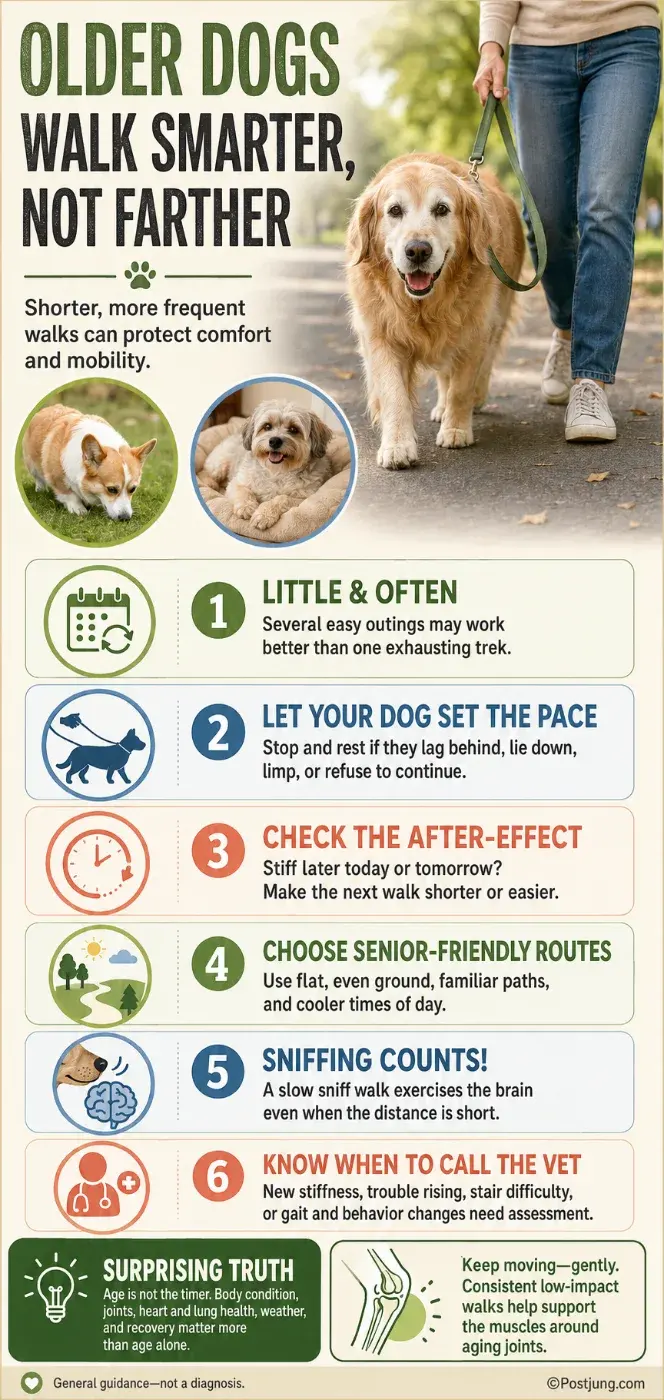
Why several short walks may work better
The RSPCA recommends a “little and often” approach for older dogs that find longer walks difficult. Shorter outings reduce the chance that a dog will travel farther than it can comfortably return, while preserving a predictable daily routine.
Consistent low-impact exercise is particularly useful for dogs with osteoarthritis. The American College of Veterinary Surgeons recommends replacing high-impact activities such as running and jumping with controlled activities such as leash walking. Gentle, regular movement can help maintain the muscles supporting affected joints.
Short does not have to mean unrewarding. An unhurried walk with time to sniff can provide mental stimulation even when relatively little distance is covered. On days when outdoor activity is limited, scent games, food puzzles, gentle play, or veterinarian-approved rehabilitation exercises can supplement—not necessarily replace—physical movement.
Let the dog set the pace
Rather than choosing an arbitrary time limit, begin with a flat, familiar route your dog can complete comfortably. Walk at the dog’s natural pace and allow rest stops.
Watch for changes during the outing:
- Falling behind or repeatedly stopping
- Lying down or refusing to continue
- Limping or an altered gait
- Difficulty negotiating curbs or steps
- Unusual reluctance to leave home
Recovery afterward matters too. New stiffness, difficulty rising, reduced enthusiasm for the next walk, or a clear decline later in the day may suggest that the previous outing was too demanding.
Keeping a simple record of walking time, route, weather, and recovery can reveal patterns that are easy to miss. Short videos of a dog walking, turning, rising, or climbing steps at home can also help a veterinarian assess changes in mobility, according to AAHA guidance.
Adjust only one part of the routine at a time—such as duration, pace, terrain, or frequency—so it is easier to see what the dog tolerates.
Weather and terrain matter more with age
Older dogs may cope less effectively with very hot or cold conditions. During warm weather, choose cooler times of day and avoid hot surfaces. In cold conditions, some dogs may benefit from suitable protective clothing.
Flat, even ground is usually easier than steep hills, loose gravel, or slippery surfaces. Dogs with declining sight or hearing may also feel more secure on familiar routes where unexpected bicycles, traffic, or unfamiliar dogs are easier to manage.
Do not dismiss every change as old age
Stiffness, difficulty getting out of bed, trouble climbing stairs, or an unexplained change in behavior should be discussed with a veterinarian. These signs may reflect pain or another medical issue rather than an unavoidable consequence of aging.
A veterinarian can assess the dog’s joints, heart, lungs, weight, and overall condition before helping establish an appropriate exercise plan. Rehabilitation, weight management, mobility aids, or pain treatment may allow some dogs to walk more comfortably.
The goal is not to achieve a particular distance. It is to keep each walk enjoyable, sustainable, and within the dog’s current ability. For many senior dogs, several calm outings are more valuable than one exhausting adventure.
SOURCES USED:

เขียนโดย Postjung Insights
 รู้หรือไม่? เปิดรายได้พนักงานส่งพัสดุของแต่ละแอป วันหนึ่งได้เท่าไร
 อำเภอที่มีชื่ออำเภอสั้นที่สุด 3 อำเภอเท่านั้นในประเทศไทย
 หนุ่มขับ Porsche ใจหล่อสุดๆ ติดประกาศเด็กหายไว้รอบคัน..หวังช่วยเผยแพร่ข้อมูลให้ตามหาได้เร็วขึ้น
 เปิดรายชื่อ 5 โรงเรียนเป้าหมาย เด็กสอบเข้าต้องเตรียมตัวให้พร้อม
 ซาบีดา” เรียกถกด่วน ปมภาพ “ชุดไทย” ถูกนำไปอ้างเป็นชุดกัมพูชา
 โรงเรียนที่มีนักเรียนมากที่สุดในไทย
 แปลปกสลาก งวด 1 ต.ค. 69 ส่องตัวเลขจากภาพปกสลากกินแบ่งรัฐบาล
 เรียก “ป๋อง สุพรรณ” เซียนพระดัง แจงปมมูลนิธิฯ วัดพุทไธศวรรย์
 Ctrip แพลตฟอร์มการท่องเที่ยวของจีน เปิดขายตั๋วสำหรับทริปท่องเที่ยวอวกาศ ของ Virgin Galactic 6 วัน ในราคาประมาณ 24 ล้านบาท
 ทำไมบ้านเลขที่ 23–24 Leinster Gardens จึงไม่มีห้องอยู่ด้านหลัง
 'สควีชชี่'ของเล่นที่กำลังเป็นไวรัลอาจถูกเจ้าหน้าที่ของสนามบินยึดได้ ตรวจสอบให้ดีก่อนนำขึ้นเครื่อง
 เปิด 5 โรงเรียนหญิงล้วนเก่าแก่ของไทย ที่มีประวัติยาวนานกว่าศตวรรษซาบีดา” เรียกถกด่วน ปมภาพ “ชุดไทย” ถูกนำไปอ้างเป็นชุดกัมพูชาเปิดรายชื่อ 5 โรงเรียนเป้าหมาย เด็กสอบเข้าต้องเตรียมตัวให้พร้อมหนุ่มขับ Porsche ใจหล่อสุดๆ ติดประกาศเด็กหายไว้รอบคัน..หวังช่วยเผยแพร่ข้อมูลให้ตามหาได้เร็วขึ้น
 วาบิ-ซาบิ (Wabi-Sabi) ปรัชญาญี่ปุ่นที่สอนให้เราโอบกอดความไม่สมบูรณ์แบบ
 English Edition