Why a Dog Harness Needs a More Precise Fit Than a Collar
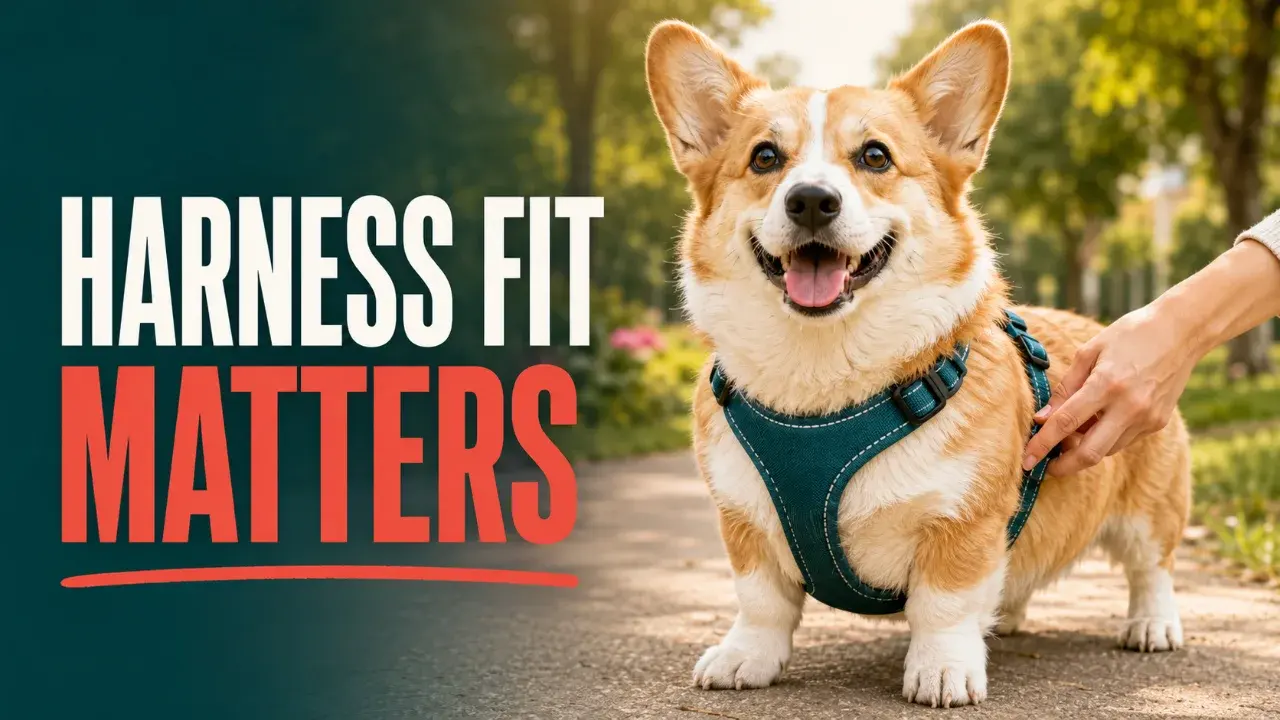
A harness spreads leash pressure across more of a dog’s body, but that advantage depends on correct placement. A poor fit can restrict movement, rub the skin, or let a dog escape.
A collar circles one relatively simple part of a dog’s body. A harness crosses several moving areas at once, which makes its fit more complicated—and more important.
A properly selected harness can reduce pressure on the neck and help keep some dogs secure. But more contact points create more opportunities for trouble if the straps sit in the wrong places.
A harness must work with a moving body
A flat collar mainly needs to stay secure without squeezing the neck or slipping over the head. A harness may wrap around the lower neck, chest, rib cage, shoulders, and torso.
Those areas do not remain still during a walk. A dog’s shoulder blades move beneath the skin, the front legs swing backward and forward, and the rib cage expands with breathing. The harness must stay stable without interfering with any of that motion.
VCA Animal Hospitals advises that a well-fitted body harness should allow free movement of the front legs and should not rub behind the elbows. It also warns that some designs lie over the shoulder joints, potentially restricting movement or concentrating pressure on sensitive tissues. VCA Animal Hospitals
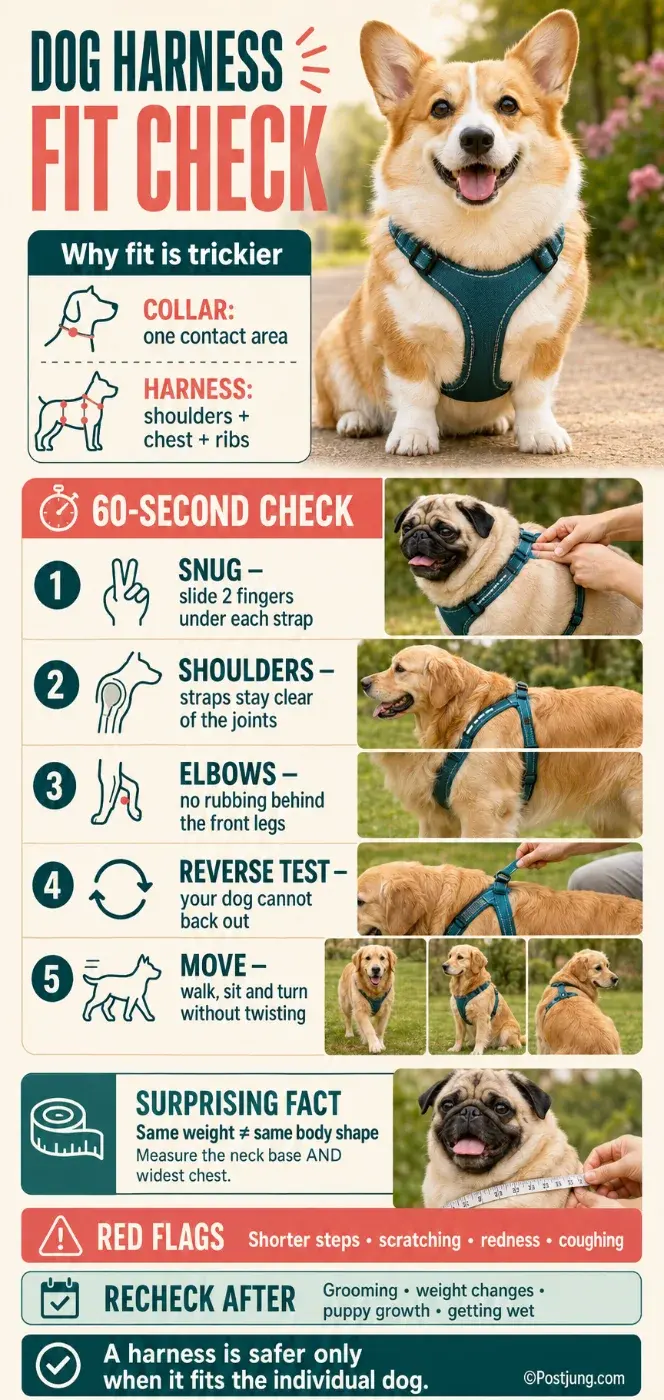
This is why choosing a harness by body weight alone is unreliable. Two dogs of equal weight can have very different chest depth, shoulder width, neck shape, and coat thickness.
Snug does not mean tight
A harness needs to be snug enough that it will not rotate, sag, or slide over the dog’s head when the dog backs away. At the same time, it must leave enough space for normal breathing and movement.
The familiar two-finger check can be a useful starting point, but it should not be the only test. The American Kennel Club recommends checking whether the legs move freely, looking for rubbing, and pulling gently in different directions to determine whether the dog could slip out. American Kennel Club
After adjusting the straps:
- Watch the dog walk, trot, turn, sit, and lower its head.
- Check that no strap cuts across the front of the shoulder joint.
- Look behind the elbows and in the armpits for rubbing.
- Make sure the harness does not twist when light leash pressure is applied.
- Test whether the dog could reverse out of it without deliberately frightening or pulling the dog.
The goal is secure contact without restricted movement.
A thick or fluffy coat can disguise looseness, while short-coated dogs may develop visible irritation more quickly. Run your fingers beneath each strap against the dog’s body rather than judging the fit only by appearance.
The shape matters as much as the size
Harnesses labeled small, medium, or large are not standardized across manufacturers. Even the right numerical size may be wrong for a particular dog’s proportions.
Many dogs move comfortably in a non-tightening H- or Y-shaped harness because these designs can leave the front of the shoulders relatively open when correctly positioned. VCA specifically recommends checking that no strap crosses the front of the shoulder and that the dog cannot back out. Deep-chested dogs may need an additional body strap for greater security. VCA Animal Hospitals
A front leash attachment may help a handler redirect a dog, but “no-pull” does not automatically mean comfortable or suitable. Some models tighten or press across the shoulders. A harness is a management tool—not a substitute for calm, reward-based leash training.
Back-clip models may work well for dogs that already walk without pulling. Dual-clip versions offer another option, although their straps still need to remain balanced rather than shifting toward whichever attachment is in use.
Watch the dog, not just the buckles
Dogs cannot explain that a strap pinches only when they turn or that damp fabric is rubbing beneath a front leg. Their behavior often provides the first clue.
Possible warning signs include:
- Shortened or unusually stiff front steps
- Reluctance to walk after the harness is attached
- Repeated scratching, biting, or turning toward a strap
- Hair loss, redness, dampness, or sore skin
- A harness that continually rotates to one side
- Coughing or noisy breathing when leash pressure is applied
- Sudden hesitation about having the harness put on
Remove the harness and inspect both the dog and the equipment if these signs appear. Persistent pain, coughing, skin injury, or altered movement warrants veterinary advice.
A dog that freezes during fitting may also be worried about the handling process rather than the harness dimensions. Introduce unfamiliar equipment gradually with treats and short, calm sessions. Comfort includes emotional comfort as well as physical fit.
A correct fit can change over time
Puppies can outgrow a harness quickly. Adult dogs may also need readjustment after weight changes, grooming, coat growth, or changes in muscle mass.
Check the fit before each walk with a new harness and periodically after that. Inspect webbing, stitching, clips, and leash rings for stretching or damage. Wet or dirty fabric should be cleaned and dried according to the manufacturer’s directions because trapped grit and moisture can worsen friction.
Do not leave a walking harness on an unsupervised dog unless the product is specifically intended for continuous wear. Straps and clips can catch on furniture, crates, vegetation, or another animal.
A collar still has a useful role for identification where appropriate, while a harness may be the better leash attachment for dogs that pull, have neck discomfort, or are vulnerable to pressure around the throat. The two items do not have to compete.
The important distinction is simple: a harness is only safer when it fits the individual dog. Measure carefully, test it during real movement, and treat every size label as a starting point—not proof of a proper fit.
VCA Animal Hospitals, American Kennel Club, Animals
REFERENCES:
https://vcahospitals.com/know-your-pet/collar-and-harness-options-for-dogs
https://vcahospitals.com/know-your-pet/controlling-pulling-on-walks
https://www.akc.org/expert-advice/lifestyle/choosing-the-right-dog-harness/
https://pmc.ncbi.nlm.nih.gov/articles/PMC12345489/

เขียนโดย Postjung Insights
 รู้หรือไม่? เปิดรายได้พนักงานส่งพัสดุของแต่ละแอป วันหนึ่งได้เท่าไร
 อำเภอที่มีชื่ออำเภอสั้นที่สุด 3 อำเภอเท่านั้นในประเทศไทย
 หัวลูกศรหินย้อนเวลา 80,000 ปี ในเอเชียกลาง… หลักฐานใหม่ชี้ โฮโม เซเปียนส์ อาจเคยบุกยุโรปเร็วขึ้นนับหมื่นปี!
 โรงเรียนที่มีนักเรียนมากที่สุดในไทย
 อินฟลูเอนเซอร์สาวผู้สร้างคอนเทนต์สำหรับผู้ใหญ่และมีรายได้ต่อปีกว่า 33 ล้านบาท ตัดสินใจเปลี่ยนอาชีพมาเป็นแพทย์แทน
 ตาราง “เด่นเหนือเด่นใต้” งวด 1 ต.ค. 69 เปิดข้อมูลตามโพย เลขไหนอยู่ตรงไหน
 ตึกยาวสวนกุหลาบฯ อายุเกิน 100 ปี ทำไมยังใช้เป็นห้องเรียนมาถึงวันนี้
 ฝูงลิงญี่ปุ่นนับสิบรุมล้อมและโจมตีชายคนหนึ่งในคานากาวะ
 ถ้าไม่กลัวเหนื่อย 7 อาชีพที่ตลาดยังต้องการ และค่าทักษะไปถึง 800 บาท/วัน
 เปิด 5 โรงเรียนหญิงล้วนเก่าแก่ของไทย ที่มีประวัติยาวนานกว่าศตวรรษ
 ส่องเลข 3 สำนักพิมพ์ งวด 1 ต.ค. 69 ตัวไหนมีข้อมูลตรงกัน
 สถิติย้อนหลัง 10 ปี ออกเลขไหนบ้างมาดูกันเปิด 5 โรงเรียนหญิงล้วนเก่าแก่ของไทย ที่มีประวัติยาวนานกว่าศตวรรษหัวลูกศรหินย้อนเวลา 80,000 ปี ในเอเชียกลาง… หลักฐานใหม่ชี้ โฮโม เซเปียนส์ อาจเคยบุกยุโรปเร็วขึ้นนับหมื่นปี!ถ้าไม่กลัวเหนื่อย 7 อาชีพที่ตลาดยังต้องการ และค่าทักษะไปถึง 800 บาท/วัน
 ทำไมแผนที่ส่วนใหญ่เอาทิศเหนือไว้ด้านบน ทั้งที่โลกไม่มี “ด้านบน” จริง ๆ?
 English Edition