Why Dogs Seem Jealous When You Pet Another Dog

A dog that wedges between you and another pet may be protecting access to something valuable: your attention. Research supports jealousy-like behavior in dogs, but the full explanation is more nuanced.
Your hand reaches down to pet another dog, and suddenly your own dog appears between you. They may paw at your leg, nudge your hand, bark, whine, or try to push the newcomer away.
It certainly looks like jealousy. Scientific research suggests that interpretation may be partly right—but dogs cannot tell us exactly what they feel, and similar behavior can also come from excitement, anxiety, learned attention-seeking, or resource guarding.
Your attention is valuable to your dog
Dogs form close social relationships with their caregivers. Food, toys, resting places, and human attention can all become resources that a dog values.
When another dog receives your affection, your pet may perceive a possible interruption to that access. Moving closer, touching you, or stepping between you and the other dog can be a way to restore the interaction.
In that sense, your attention can function like a social resource. The dog does not need to understand romance, betrayal, or fairness in the complex human sense. It only needs to recognize that a social rival is receiving something it wants.
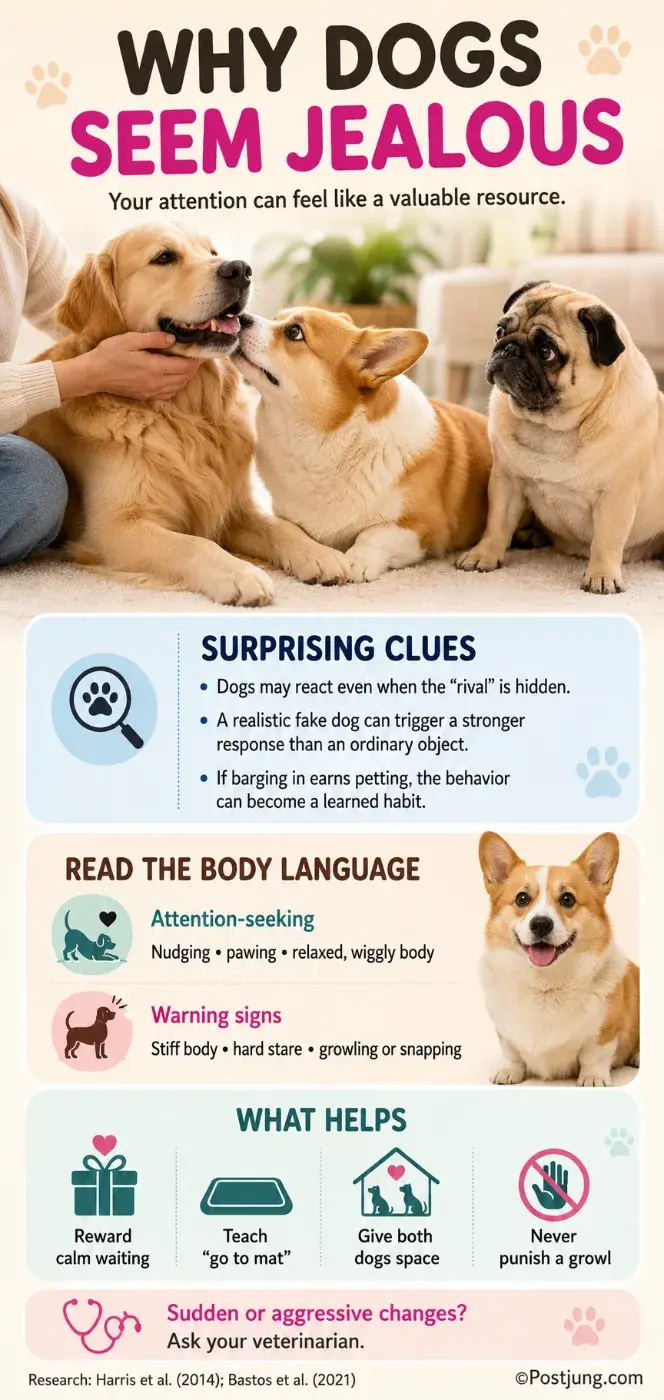
Dogs are also highly responsive to patterns. If pushing between two individuals repeatedly earns petting, eye contact, or reassuring words, the behavior can become stronger simply because it works.
Experiments have found jealousy-like responses
In a widely discussed 2014 study, researchers observed 36 dogs while their owners directed attention toward three objects. One was a realistic-looking stuffed dog that barked and wagged its tail; the other conditions involved a children’s book and a plastic jack-o’-lantern.
The dogs were more likely to push or touch their owners and the stuffed dog when the owners interacted with the apparent canine rival. Some also tried to place themselves between the two. The researchers described the pattern as evidence of a basic form of jealousy, although the experiment did not prove that dogs experience the emotion exactly as people do. PLOS ONE study
A 2021 study added another intriguing detail. Dogs pulled more strongly toward their owners when the owners appeared to interact with a realistic artificial dog—even after a barrier blocked the interaction from view. The researchers argued that the dogs were responding not merely to what they could see, but to a mentally represented interaction between their caregiver and a rival. Psychological Science study
Still, the evidence is not perfectly uniform. A separate experiment involving owners and unfamiliar people found that the dogs’ responses did not clearly establish jealousy rather than general attention-seeking or social interest. Animal Cognition study
The safest conclusion is that dogs can display behavior consistent with jealousy, but researchers cannot directly confirm that their private emotional experience matches ours.
Not every interruption means the same thing
A dog that quietly nudges your hand is communicating something different from one that freezes, stares, growls, snaps, or lunges.
Soft approaches may reflect excitement, curiosity, or a familiar strategy for getting attention. A tense body, fixed gaze, raised lip, or growl may signal discomfort and possible conflict over access to a valued person.
Context matters. Ask what happens before and after the behavior:
- Does it occur only around unfamiliar dogs?
- Does your dog behave similarly when you pet a household pet?
- Is the dog relaxed and wiggly or stiff and watchful?
- Does pushing in reliably result in attention?
- Are food, toys, furniture, or confined spaces also involved?
- Did the behavior begin suddenly?
Household dogs can compete over a special person just as they might compete over food, toys, or resting places. Fear, frustration, pain, environmental changes, and overlooked body-language signals can also contribute to fighting. VCA Animal Hospitals
That is why “jealous” should be a description, not a diagnosis.
Calm behavior should be more rewarding than barging in
Scolding, shouting, or physically pushing a tense dog away may increase frustration. Punishing a growl is particularly risky because the growl is a warning that the dog is uncomfortable. Suppressing the warning does not necessarily change the underlying emotion.
Instead, owners can teach an alternative behavior such as sitting nearby or going to a mat. Begin in an easy setting with no rival present, reward the dog for remaining in position, and gradually introduce brief interactions with another dog at a comfortable distance.
Keep the early sessions short. Reward relaxed body language before the dog feels the need to interrupt. If both dogs live in the same home, separate attention sessions and carefully managed shared sessions may be easier than expecting them to negotiate crowded affection immediately.
The practical goal is simple: calm waiting should reliably lead to good things, while barging, barking, or pawing should not become the fastest way to obtain attention.
Avoid forcing dogs to share close spaces when tension is already visible. Physical punishment and confrontational “dominance” techniques can worsen fear or defensive aggression rather than resolving the cause.
Know when the behavior needs professional help
Occasional nudging is usually different from repeated threats or fights. Seek veterinary guidance if the behavior appears suddenly, becomes more intense, or includes growling, snapping, biting, cornering another animal, or guarding a person.
Pain, reduced mobility, changes in hearing or vision, and other medical problems can alter how dogs respond socially. A veterinarian can first look for physical causes and, if needed, refer the case to a qualified behavior professional.
Until the dog has been assessed, manage the environment so the trigger does not keep producing confrontations. Distance, gates, separate resting areas, and controlled interactions can prevent the pattern from escalating.
Dogs may never experience jealousy in precisely the way humans describe it. What is clear is that they notice where our attention goes—and some will work surprisingly hard to bring it back.
PLOS ONE, Psychological Science, Animal Cognition, VCA Animal Hospitals
REFERENCES:
https://pmc.ncbi.nlm.nih.gov/articles/PMC4108309/
https://pubmed.ncbi.nlm.nih.gov/33825583/
https://pubmed.ncbi.nlm.nih.gov/29668684/
https://vcahospitals.com/know-your-pet/dog-behavior-problems-aggression-sibling-rivalry-diagnosis

เขียนโดย Postjung Insights
 รู้หรือไม่? เปิดรายได้พนักงานส่งพัสดุของแต่ละแอป วันหนึ่งได้เท่าไร
 ซาบีดา” เรียกถกด่วน ปมภาพ “ชุดไทย” ถูกนำไปอ้างเป็นชุดกัมพูชา
 หนุ่มขับ Porsche ใจหล่อสุดๆ ติดประกาศเด็กหายไว้รอบคัน..หวังช่วยเผยแพร่ข้อมูลให้ตามหาได้เร็วขึ้น
 'สควีชชี่'ของเล่นที่กำลังเป็นไวรัลอาจถูกเจ้าหน้าที่ของสนามบินยึดได้ ตรวจสอบให้ดีก่อนนำขึ้นเครื่อง
 เปิด 5 โรงเรียนหญิงล้วนเก่าแก่ของไทย ที่มีประวัติยาวนานกว่าศตวรรษ
 โรงเรียนที่มีนักเรียนมากที่สุดในไทย
 Ctrip แพลตฟอร์มการท่องเที่ยวของจีน เปิดขายตั๋วสำหรับทริปท่องเที่ยวอวกาศ ของ Virgin Galactic 6 วัน ในราคาประมาณ 24 ล้านบาท
 เปิดรายชื่อ 5 โรงเรียนเป้าหมาย เด็กสอบเข้าต้องเตรียมตัวให้พร้อม
 อำเภอที่มีชื่ออำเภอสั้นที่สุด 3 อำเภอเท่านั้นในประเทศไทย
 เรียก “ป๋อง สุพรรณ” เซียนพระดัง แจงปมมูลนิธิฯ วัดพุทไธศวรรย์
 แปลปกสลาก งวด 1 ต.ค. 69 ส่องตัวเลขจากภาพปกสลากกินแบ่งรัฐบาล
 ตาราง “เด่นเหนือเด่นใต้” งวด 1 ต.ค. 69 เปิดข้อมูลตามโพย เลขไหนอยู่ตรงไหนซาบีดา” เรียกถกด่วน ปมภาพ “ชุดไทย” ถูกนำไปอ้างเป็นชุดกัมพูชาเปิดรายชื่อ 5 โรงเรียนเป้าหมาย เด็กสอบเข้าต้องเตรียมตัวให้พร้อมหนุ่มขับ Porsche ใจหล่อสุดๆ ติดประกาศเด็กหายไว้รอบคัน..หวังช่วยเผยแพร่ข้อมูลให้ตามหาได้เร็วขึ้น
 วาบิ-ซาบิ (Wabi-Sabi) ปรัชญาญี่ปุ่นที่สอนให้เราโอบกอดความไม่สมบูรณ์แบบ
 English Edition