Why Cats Hide Pain—and the Subtle Signs Owners Miss
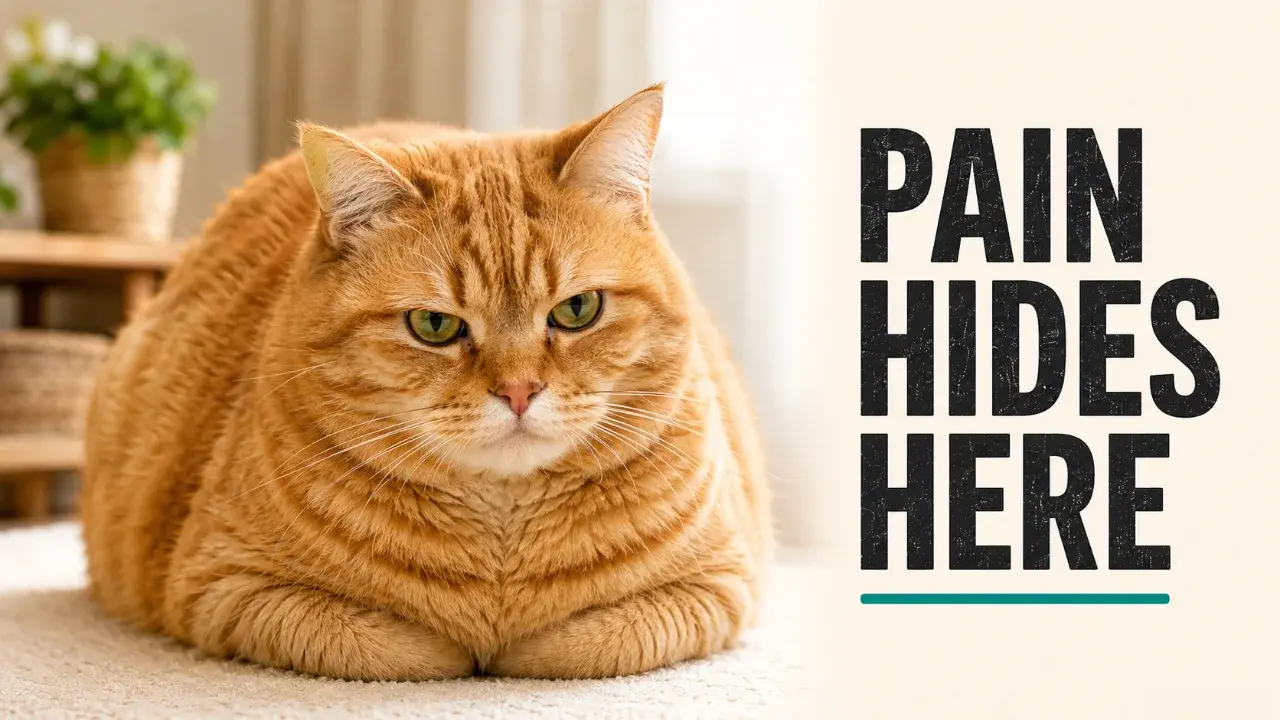
Cats rarely cry out when something hurts. Their pain is more likely to appear as a small change in jumping, grooming, eating, or simply where they choose to sleep.
A cat in pain may still eat, purr, walk across the room, and greet its owner. That outward calm can be dangerously reassuring.
Unlike people, cats often reveal discomfort through small departures from their normal routine. Recognizing pain therefore depends less on waiting for an obvious cry and more on noticing that something familiar has quietly changed.
Hiding pain is protection, not stubbornness
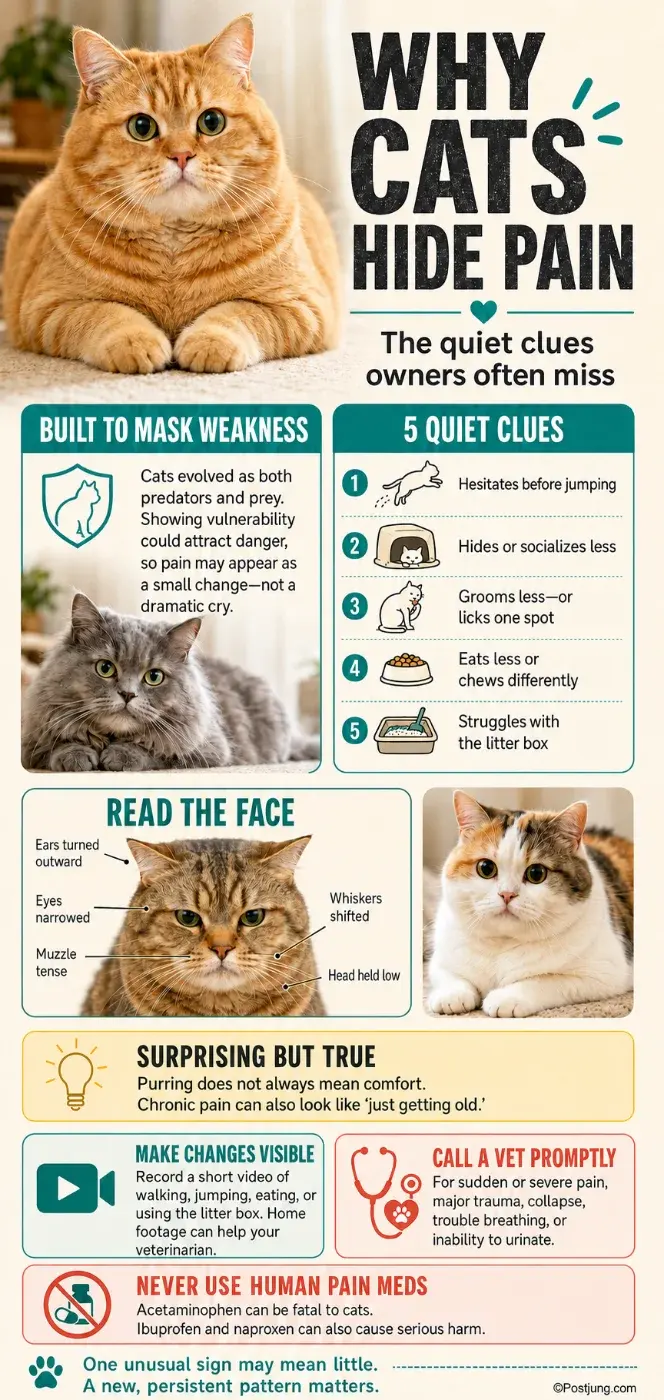
Cats do not conceal pain because they are trying to deceive their owners. The behavior is better understood as a survival response inherited from their wild ancestors.
Although cats are highly capable hunters, small feline species can also become prey. Showing weakness could attract a threat or reduce an animal’s ability to defend territory and secure food. Cats also evolved largely as solitary hunters, without a social group that could reliably protect an injured member.
Researchers reviewing feline pain behavior have suggested that this history may help explain why cats can mask discomfort. Still, the evolutionary explanation should not be treated as the sole cause. Temperament, environment, fear, stress, and the type of illness or injury can all affect what an individual cat displays. Systematic review of feline pain behavior
The result is an animal whose distress may look less like a dramatic reaction and more like silence, withdrawal, or reduced activity. Pain in cats is often a pattern of change, not one unmistakable symptom.
The clues are usually hiding in everyday routines
Behavioral changes are among the most useful signs of feline pain because owners know what is normal for their own cat.
A cat that once jumped directly onto a counter may begin using a chair as an intermediate step. Another may pause before climbing stairs, sleep downstairs instead of upstairs, or stop visiting a favorite windowsill.
Other possible changes include:
- Hiding or withdrawing more than usual
- Eating less or approaching food without finishing it
- Moving slowly or hesitating before jumping
- Grooming less, leaving the coat greasy or unkempt
- Repeatedly licking one area of the body
- Becoming unusually irritable when touched
- Sleeping in an unfamiliar place or posture
- Having difficulty entering or using the litter box
- Losing interest in play or social contact
None of these behaviors proves that a cat is in pain. Stress, fear, illness, and environmental changes can produce similar signs. The important question is whether the behavior is new, persistent, or noticeably different from that cat’s baseline.
The Feline Veterinary Medical Association advises owners to pay attention to exactly these kinds of behavioral changes and share them with their veterinarian. Feline pain-management guide
A cat’s face can change, too
Acute pain may alter a cat’s facial expression in measurable ways. Researchers developed the Feline Grimace Scale to evaluate five features: ear position, tightening around the eyes, muzzle tension, whisker position, and head position.
A cat experiencing pain may hold its ears farther apart or rotate them outward. Its eyes may appear partially closed, its muzzle may look tense, and its head may sit lower in relation to the shoulders.
The scale was developed and validated through observations of cats with naturally occurring painful conditions before and after pain relief. It can help owners learn what discomfort may look like, but a facial score is a screening aid, not a home diagnosis. Scientific Reports study
Context also matters. A sleepy, frightened, or stressed cat may narrow its eyes or flatten its ears without being in pain. Looking at several signals—and comparing them with the cat’s usual behavior—is more informative than judging one photograph or expression.
Purring does not always mean everything is fine
Purring is commonly associated with contentment, but it should not be used as proof that a cat is comfortable. Cats may purr in a variety of situations, including when they are frightened, stressed, ill, or seeking reassurance.
The same caution applies to eating. A cat that accepts a treat can still be experiencing dental pain, arthritis, abdominal discomfort, or another problem. Pain does not always stop every normal behavior at once.
Chronic pain is particularly easy to mistake for aging or personality. An older cat that no longer jumps, plays, or grooms as before may be described as “slowing down.” Sometimes that change reflects a treatable medical condition rather than an unavoidable part of getting older.
What owners can do before the appointment
If a change is subtle, record a short video of the cat walking, jumping, eating, or entering the litter box. A cat may behave differently at a clinic, and footage from home can give the veterinary team valuable context.
Keep brief notes about when the change began, whether it is getting worse, and what activities appear difficult. Do not deliberately press, stretch, or manipulate a suspected painful area; a frightened or hurting cat may bite or scratch defensively.
Sudden or severe changes deserve prompt veterinary attention. Contact a veterinarian or emergency clinic if the cat appears to be in intense pain, has sustained significant trauma, collapses, struggles to breathe, or cannot urinate.
Most importantly, never give a cat a human pain reliever without veterinary direction. The U.S. Food and Drug Administration warns that acetaminophen, also known as paracetamol, is fatal to cats. Human NSAIDs such as ibuprofen and naproxen can also cause serious harm. U.S. FDA pet medication guidance
Cats may be skilled at keeping pain quiet, but they rarely hide every clue. The owner who notices that a jump has become a climb—or that a social cat has started sleeping alone—may spot the problem before it becomes impossible to overlook.
Feline Veterinary Medical Association, Scientific Reports, National Library of Medicine, U.S. Food and Drug Administration
REFERENCES:
https://pmc.ncbi.nlm.nih.gov/articles/PMC11149010/
https://catvets.com/wp-content/uploads/2024/12/FelineVMA-Pain-Management_Web.pdf
https://www.nature.com/articles/s41598-019-55693-8
https://www.fda.gov/animal-veterinary/animal-health-literacy/get-facts-about-pain-relievers-pets

เขียนโดย Postjung Insights
 รู้หรือไม่? เปิดรายได้พนักงานส่งพัสดุของแต่ละแอป วันหนึ่งได้เท่าไร
 เปิดรายชื่อ 5 โรงเรียนเป้าหมาย เด็กสอบเข้าต้องเตรียมตัวให้พร้อม
 โรงเรียนที่มีนักเรียนมากที่สุดในไทย
 อำเภอที่มีชื่ออำเภอสั้นที่สุด 3 อำเภอเท่านั้นในประเทศไทย
 'สควีชชี่'ของเล่นที่กำลังเป็นไวรัลอาจถูกเจ้าหน้าที่ของสนามบินยึดได้ ตรวจสอบให้ดีก่อนนำขึ้นเครื่อง
 ตาราง “เด่นเหนือเด่นใต้” งวด 1 ต.ค. 69 เปิดข้อมูลตามโพย เลขไหนอยู่ตรงไหน
 เปิด 5 โรงเรียนหญิงล้วนเก่าแก่ของไทย ที่มีประวัติยาวนานกว่าศตวรรษ
 โรสแมรี่ แฮร์ริส ‘ป้าเมย์’ แห่ง Spider-Man ฉบับโทบีย์ แม็คไกวร์ อายุครบ 99 ปี
 ซาบีดา” เรียกถกด่วน ปมภาพ “ชุดไทย” ถูกนำไปอ้างเป็นชุดกัมพูชา
 แปลปกสลาก งวด 1 ต.ค. 69 ส่องตัวเลขจากภาพปกสลากกินแบ่งรัฐบาล
 หนุ่มขับ Porsche ใจหล่อสุดๆ ติดประกาศเด็กหายไว้รอบคัน..หวังช่วยเผยแพร่ข้อมูลให้ตามหาได้เร็วขึ้น
 Ctrip แพลตฟอร์มการท่องเที่ยวของจีน เปิดขายตั๋วสำหรับทริปท่องเที่ยวอวกาศ ของ Virgin Galactic 6 วัน ในราคาประมาณ 24 ล้านบาทซาบีดา” เรียกถกด่วน ปมภาพ “ชุดไทย” ถูกนำไปอ้างเป็นชุดกัมพูชาเปิดรายชื่อ 5 โรงเรียนเป้าหมาย เด็กสอบเข้าต้องเตรียมตัวให้พร้อมหนุ่มขับ Porsche ใจหล่อสุดๆ ติดประกาศเด็กหายไว้รอบคัน..หวังช่วยเผยแพร่ข้อมูลให้ตามหาได้เร็วขึ้น
 วาบิ-ซาบิ (Wabi-Sabi) ปรัชญาญี่ปุ่นที่สอนให้เราโอบกอดความไม่สมบูรณ์แบบ
 English Edition