Why Dogs Jump on Guests—and How to Teach a Calmer Hello
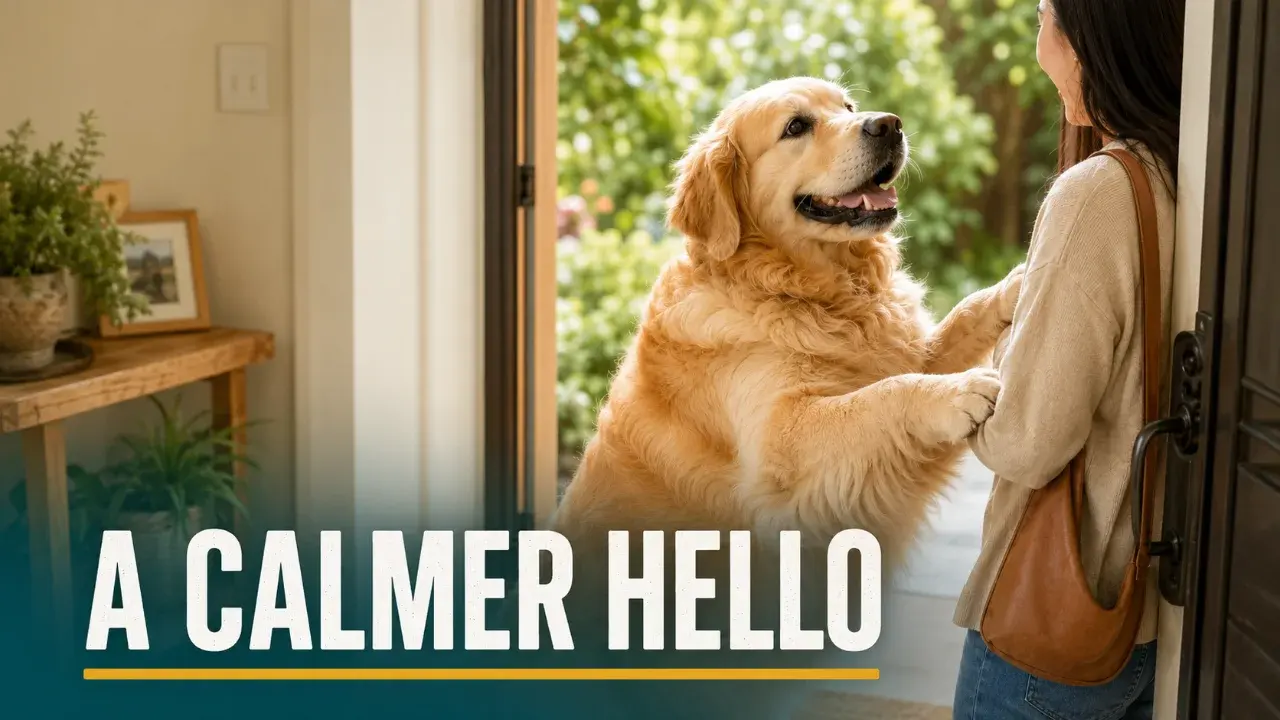
Jumping is often a dog’s fastest route to attention and face-to-face contact. A few changes at the door can replace that chaotic greeting with a safer, calmer habit.
A guest walks through the door, and suddenly the dog becomes a furry spring. Paws land on clothing, the visitor steps backward, and everyone starts talking at once.
The behavior can feel unruly, but most dogs are not trying to take charge. Jumping is usually a greeting strategy that has worked before—and every exciting arrival gives the dog another chance to practice it.
Your dog is trying to get closer
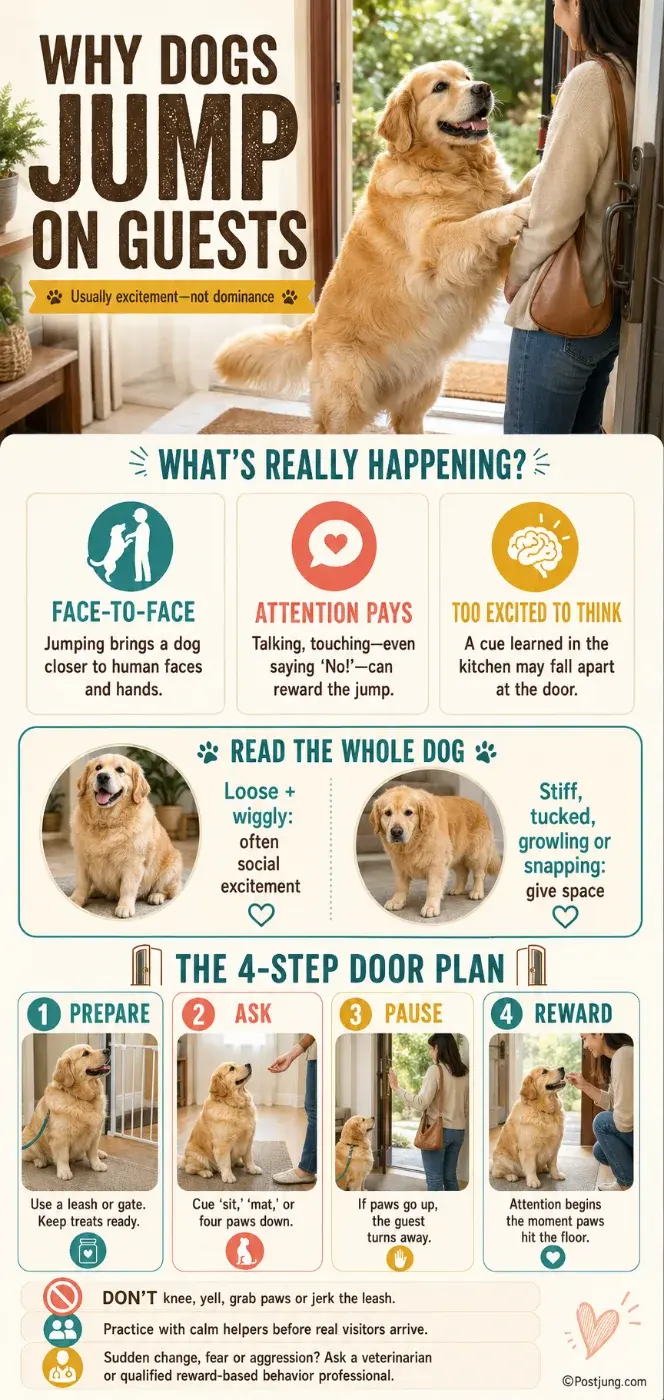
Dogs naturally greet one another near face level. Humans are much taller, so jumping brings a dog closer to our hands, faces, voices, and attention.
Social dogs may jump because they are excited to reconnect with someone. Others have learned that placing their paws on a person quickly produces exactly what they want: eye contact, touch, conversation, or play.
Even an annoyed response can be rewarding. Pushing a dog away, repeating their name, grabbing their paws, or laughing still gives them attention. From the dog’s perspective, attention can reinforce the behavior, even when the human delivering it is frustrated.
VCA Animal Hospitals describes jumping as a common greeting behavior and notes that dogs can learn to repeat it when it gives them access to social interaction. VCA Animal Hospitals
It usually is not a dominance contest
Jumping is sometimes interpreted as a dog trying to dominate a visitor. That explanation can lead owners to use physical corrections or intimidating handling when the real issue is excitement, habit, or unclear expectations.
The American Veterinary Society of Animal Behavior advises using reward-based training and teaching animals the behavior people want to see. Its guidance specifically identifies environmental management and reinforcement of desirable responses as appropriate ways to address common problems such as jumping. American Veterinary Society of Animal Behavior
The useful question is not “How do I show the dog who is boss?” It is “What should the dog do when the door opens?”
“Sit,” “go to your mat,” or simply keeping all four paws on the floor gives the dog a clear answer.
Why guests make training difficult
Dogs are excellent at noticing differences between situations. They may sit calmly for their owner but jump on a visitor who squeals, bends down, or begins petting immediately.
Mixed reactions make the lesson harder. If five guests ignore jumping but the sixth enthusiastically hugs the dog, jumping can remain worth trying. An occasional payoff is still a payoff.
High excitement also makes familiar cues harder to follow. A dog who sits perfectly in a quiet kitchen may struggle when the doorbell rings and a favorite person enters carrying bags.
That is why training should begin away from real arrivals. Practice sitting or settling near the door while the home is quiet, then add small distractions before rehearsing with a cooperative visitor.
Build a calmer greeting one step at a time
Before a guest arrives, prepare small treats and attach a leash if the dog can be safely handled that way. A baby gate or another room can prevent the dog from rushing the entrance while everyone gets settled.
Ask for a familiar behavior such as “sit” or “mat.” Reward the dog before excitement escalates. Calm behavior should open access to the guest; jumping should temporarily make the greeting pause.
The visitor can help by following a simple routine:
- Approach only while the dog has four paws down.
- Turn slightly away and withhold attention if the dog jumps.
- Resume the greeting as soon as the dog returns to the floor.
- Pet calmly around the chest or side rather than waving hands above the dog’s head.
- Keep the first interaction brief, then give the dog another opportunity to settle.
Treats should be delivered low, near the floor, so the reward does not encourage the dog to spring upward again. The RSPCA recommends reward-based training and notes that asking a dog to sit when greeting people makes jumping less likely. RSPCA
If the dog cannot respond, create more distance or use the gate. That is not failure. It means the situation is currently too stimulating for learning.
Ignoring alone may not be enough
Turning away can remove attention, but the dog still needs an alternative behavior that pays off. Otherwise, everyone may spend several exhausting minutes waiting for the dog to guess the right answer.
Teach the replacement before testing it. Reward sitting, standing quietly, or resting on a mat many times when no visitors are present. Gradually practice with a household member stepping through the door, then with a familiar helper.
Exercise and enrichment may reduce excess energy, but they do not automatically teach polite greetings. A tired dog can still jump if jumping remains the most practiced way to say hello.
Avoid kneeing the dog, shouting, spraying water, or jerking the leash. Punishment can create fear or make visitors predict unpleasant experiences, while leaving the dog uncertain about what to do instead.
Not every jump means friendly excitement
Watch the dog’s whole body. Loose movement, wiggling, and an eagerness to approach often fit social excitement. A stiff posture, tucked tail, repeated retreating and advancing, growling, snapping, or intense barking may indicate fear, conflict, or another behavior problem.
Keep children, older adults, and anyone with limited balance separated from an uncontrolled greeting. A friendly dog can still knock someone down.
If the behavior includes aggression, appears suddenly, or remains difficult to manage, consult a veterinarian or a qualified reward-based behavior professional. Safety comes before greeting practice, and some dogs are more comfortable not meeting visitors at all.
The goal is not to suppress a dog’s happiness. It is to give that excitement a safer shape—one in which guests can enter comfortably and the dog still receives the connection they were seeking.
REFERENCES:
https://vcahospitals.com/know-your-pet/dog-behavior-problems-greeting-behavior-jumping-up
https://avsab.org/wp-content/uploads/2021/08/AVSAB-Humane-Dog-Training-Position-Statement-2021.pdf
https://www.rspca.org.uk/adviceandwelfare/pets/dogs/training/sit
https://www.rspca.org.uk/adviceandwelfare/pets/dogs/training

เขียนโดย Postjung Insights
 อำเภอที่มีชื่ออำเภอสั้นที่สุด 3 อำเภอเท่านั้นในประเทศไทย
 เปิดรายชื่อ 5 โรงเรียนเป้าหมาย เด็กสอบเข้าต้องเตรียมตัวให้พร้อม
 หนุ่มขับ Porsche ใจหล่อสุดๆ ติดประกาศเด็กหายไว้รอบคัน..หวังช่วยเผยแพร่ข้อมูลให้ตามหาได้เร็วขึ้น
 เปิด 5 โรงเรียนหญิงล้วนเก่าแก่ของไทย ที่มีประวัติยาวนานกว่าศตวรรษ
 รู้หรือไม่? เปิดรายได้พนักงานส่งพัสดุของแต่ละแอป วันหนึ่งได้เท่าไร
 Ctrip แพลตฟอร์มการท่องเที่ยวของจีน เปิดขายตั๋วสำหรับทริปท่องเที่ยวอวกาศ ของ Virgin Galactic 6 วัน ในราคาประมาณ 24 ล้านบาท
 ซาบีดา” เรียกถกด่วน ปมภาพ “ชุดไทย” ถูกนำไปอ้างเป็นชุดกัมพูชา
 เรียก “ป๋อง สุพรรณ” เซียนพระดัง แจงปมมูลนิธิฯ วัดพุทไธศวรรย์
 โรงเรียนที่มีนักเรียนมากที่สุดในไทย
 แปลปกสลาก งวด 1 ต.ค. 69 ส่องตัวเลขจากภาพปกสลากกินแบ่งรัฐบาล
 'สควีชชี่'ของเล่นที่กำลังเป็นไวรัลอาจถูกเจ้าหน้าที่ของสนามบินยึดได้ ตรวจสอบให้ดีก่อนนำขึ้นเครื่อง
 โรสแมรี่ แฮร์ริส ‘ป้าเมย์’ แห่ง Spider-Man ฉบับโทบีย์ แม็คไกวร์ อายุครบ 99 ปีซาบีดา” เรียกถกด่วน ปมภาพ “ชุดไทย” ถูกนำไปอ้างเป็นชุดกัมพูชาเปิดรายชื่อ 5 โรงเรียนเป้าหมาย เด็กสอบเข้าต้องเตรียมตัวให้พร้อมหนุ่มขับ Porsche ใจหล่อสุดๆ ติดประกาศเด็กหายไว้รอบคัน..หวังช่วยเผยแพร่ข้อมูลให้ตามหาได้เร็วขึ้น
 วาบิ-ซาบิ (Wabi-Sabi) ปรัชญาญี่ปุ่นที่สอนให้เราโอบกอดความไม่สมบูรณ์แบบ
 English Edition