Why Cats Paw at Water Before Drinking—and When It Matters
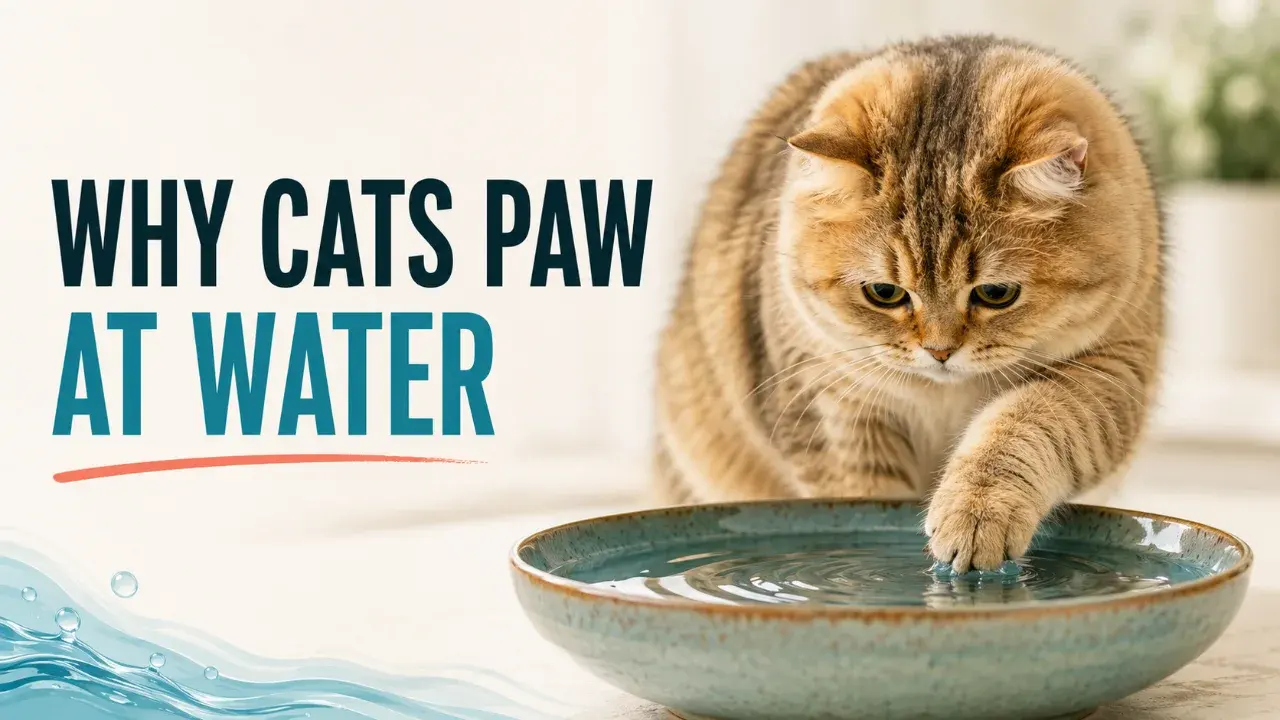
That quick tap may help a cat inspect the water, create visible movement, or avoid an uncomfortable bowl. Usually harmless, the behavior can occasionally reveal something worth checking.
A cat approaches its water bowl, dips in one paw, watches the ripples, and only then lowers its head to drink. The ritual can look fussy, but it is usually a form of investigation, play, or personal preference rather than a sign that anything is wrong.
There is an important qualification: feline behavior research has not identified one universal reason that every cat does this. The most sensible explanation often depends on what the cat does next, the design of the bowl, and whether the behavior is new.
A moving surface gives a cat more information
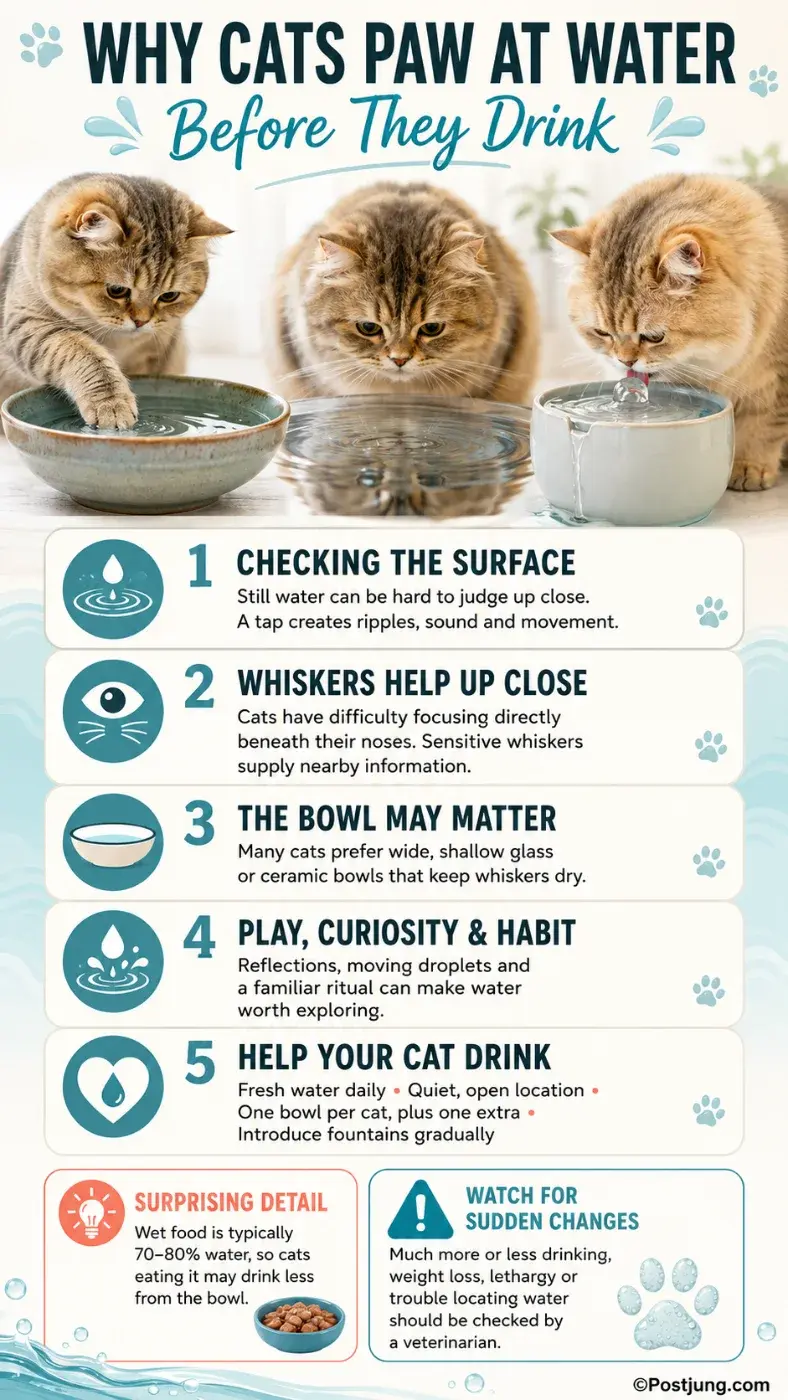
Clear, still water offers few obvious visual cues, especially in a smooth bowl under flat indoor lighting. Cats also have difficulty focusing on objects directly beneath their noses. Their whiskers help compensate by detecting nearby objects and subtle air movement, as VCA Animal Hospitals explains.
A light paw tap disturbs the surface. The resulting movement, sound, and physical sensation may help the cat judge where the water begins and how deep it is. In simple terms, ripples create information that a perfectly still surface does not.
That explanation is reasonable, but it should not be treated as a scientifically confirmed motive for every cat. One cat may be checking the water level, while another may simply enjoy watching the movement.
Sometimes the bowl is the real issue
A cat that repeatedly touches the water may be reacting to the container rather than the water itself.
Deep or narrow bowls can force a cat to push its face inside, allowing its whiskers to touch the sides or become wet. International Cat Care recommends experimenting with wide, shallow bowls and notes that many cats prefer glass or ceramic containers filled close to the brim. Some cats may also dislike metal bowls because they can be reflective, cold, or noisy. Its guide to encouraging cats to drink emphasizes that individual preference matters.
“Whisker fatigue” is frequently offered as a definitive explanation online, but the evidence is more nuanced. In a study published in the Journal of Feline Medicine and Surgery, cats did not eat more, spend longer eating, or drop less food when given a whisker-friendly dish. Some appeared to prefer the new dish, but the results did not show that bowl-related whisker stress affected feeding behavior overall. The research concerned food bowls rather than pawing at drinking water, so it cannot directly explain the behavior.
The fairest conclusion is that there is no single proven explanation, although bowl comfort can matter to individual cats.
Curiosity can become a personal ritual
Water moves, reflects light, produces sound, and leaves droplets that can be chased. For a curious cat, that makes a water bowl both a drinking source and a small interactive object.
Some cats scoop water onto the floor and lick it there. Others drink from the wet paw itself. A cat may also repeat the behavior because it has become part of its routine—or because splashing reliably gets a reaction from someone nearby.
This does not mean the cat is necessarily afraid of still water or instinctively testing it for poison. Those explanations are often repeated as fact, but the same behavior can arise from simpler causes such as curiosity, play, bowl preference, or learned habit.
A preference for movement may also explain why some cats favor faucets and pet fountains. Cornell University’s feline hydration guidance notes that fountains increase water intake for some cats, although preferences vary.
The location can affect how comfortable drinking feels
Cats may hesitate to place their heads in a bowl if the location makes them feel exposed. A container pushed tightly against a wall can force the cat to turn its back on the room while drinking.
International Cat Care recommends quiet drinking areas that are accessible from more than one side and positioned away from litter boxes, noisy appliances, and busy walkways. In homes with several pets, multiple water sources can also prevent one animal from blocking another’s access.
Try placing the bowl where the cat can see the room while drinking. The change may reduce cautious tapping if insecurity was contributing to the behavior.
When pawing deserves a closer look
Occasional tapping or splashing is generally harmless. What matters most is whether the behavior has suddenly changed.
Watch for a change in the pattern, especially if the cat:
- Repeatedly paws at the bowl but struggles to drink
- Suddenly drinks much more or less than usual
- Appears unable to locate the water
- Bumps into objects or shows other possible vision changes
- Drools, drops food, or seems uncomfortable lowering its head
- Develops weight loss, lethargy, appetite changes, or increased urination
Excessive drinking can accompany conditions including kidney disease, diabetes, and hyperthyroidism, while reduced intake may be associated with dental pain, weakness, or poor access to water. A veterinarian should assess a persistent or sudden change rather than relying on the pawing behavior alone.
A simple bowl experiment may provide the answer
Offer a wide, shallow glass or ceramic bowl alongside the existing container. Fill it near the brim, keep the water fresh, and clean the bowl regularly. Place it in a calm, open location away from food scraps and the litter box.
A fountain is another option, but introduce it gradually and continue providing a regular bowl until the cat clearly accepts it. Some cats like moving water; others dislike the sound or vibration.
Most importantly, offer choices, not corrections. Pawing at water is rarely something that needs to be stopped. For many cats, it is simply their preferred way of gathering a little more information before taking a drink.
International Cat Care, Cornell Feline Health Center, VCA Animal Hospitals, Journal of Feline Medicine and Surgery
REFERENCES:
https://icatcare.org/resources/cat-carer-guide-encouraging-your-cat-to-drink.pdf
https://www.vet.cornell.edu/departments-centers-and-institutes/cornell-feline-health-center/health-information/feline-health-topics/hydration
https://vcahospitals.com/know-your-pet/why-do-cats-have-whiskers
https://pubmed.ncbi.nlm.nih.gov/32538246/

เขียนโดย Postjung Insights
 เปิดหลักฐานเก่า 120 ปี ปมภาพหญิงเมืองกำแพงเพชร โผล่เวที Miss Universe Cambodia 2026
 อำเภอที่มีชื่ออำเภอสั้นที่สุด 3 อำเภอเท่านั้นในประเทศไทย
 รู้หรือไม่? เปิดรายได้พนักงานส่งพัสดุของแต่ละแอป วันหนึ่งได้เท่าไร
 วงแหวนแฟร์รี่ (Fairy Circles): ปริศนาวงกลมกลางทะเลทราย ที่เรายังต้องหาคำตอบกันต่อไป...
 5 คณะที่เรียนจบมาแล้ว มีอาชีพรองรับมากกว่าที่คิด
 เปิด 5 สินค้าเกษตรจากลาวที่เข้าสู่ตลาดไทย สินค้าไหนมีบทบาทสำคัญที่สุด
 เปิดรายชื่อโรงเรียนในไทยที่ “ว่ายน้ำ” อยู่ในหลักสูตร เรียนจริงตั้งแต่อนุบาลถึงมัธยม
 Google ยอมรับแล้ว! Gemini AI เข้าถึงระบบบริษัทจริง 3 แห่ง ระหว่างการทดสอบความปลอดภัย
 เปิด 5 โรงเรียนหญิงล้วนเก่าแก่ของไทย ที่มีประวัติยาวนานกว่าศตวรรษ
 โรงเรียนที่มีนักเรียนมากที่สุดในไทย
 ตาราง “เด่นเหนือเด่นใต้” งวด 1 ต.ค. 69 เปิดข้อมูลตามโพย เลขไหนอยู่ตรงไหน
 แปลปกสลาก งวด 1 ต.ค. 69 ส่องตัวเลขจากภาพปกสลากกินแบ่งรัฐบาลเปิดหลักฐานเก่า 120 ปี ปมภาพหญิงเมืองกำแพงเพชร โผล่เวที Miss Universe Cambodia 2026เปิด 5 สินค้าเกษตรจากลาวที่เข้าสู่ตลาดไทย สินค้าไหนมีบทบาทสำคัญที่สุดวงแหวนแฟร์รี่ (Fairy Circles): ปริศนาวงกลมกลางทะเลทราย ที่เรายังต้องหาคำตอบกันต่อไป...
 😃 ชวนเข้ามาดูกันอีกกับคนที่มีร่างกายพิเศษจนเหมือนมีกล่องสมบัติที่หายาก 😯5 คณะที่เรียนจบมาแล้ว มีอาชีพรองรับมากกว่าที่คิดเปิดรายชื่อโรงเรียนในไทยที่ “ว่ายน้ำ” อยู่ในหลักสูตร เรียนจริงตั้งแต่อนุบาลถึงมัธยม
 English Edition