Why Kittens Attack Ankles—and How to Redirect the Habit

Your kitten probably is not angry with you. Moving feet make irresistible targets for hunting-style play, especially when a young cat needs a better outlet for all that energy.
A kitten hiding behind the couch may look perfectly innocent—until someone walks past. In an instant, the tiny hunter launches at an ankle, wraps both front paws around it and delivers a flurry of playful bites.
This ambush can hurt, but it usually is not personal. Ankle attacks are commonly a form of play, driven by the same stalking and pouncing behaviors kittens practice when chasing toys or wrestling with littermates.
Your feet behave like moving prey
To a young cat, ankles have several qualities that make them difficult to resist. They move quickly, change direction without warning and occasionally disappear behind furniture or around a doorway.
Loose pant legs, socks and shoelaces can make the target even more exciting. When a person jerks a foot away after being grabbed, the movement may unintentionally continue the chase.
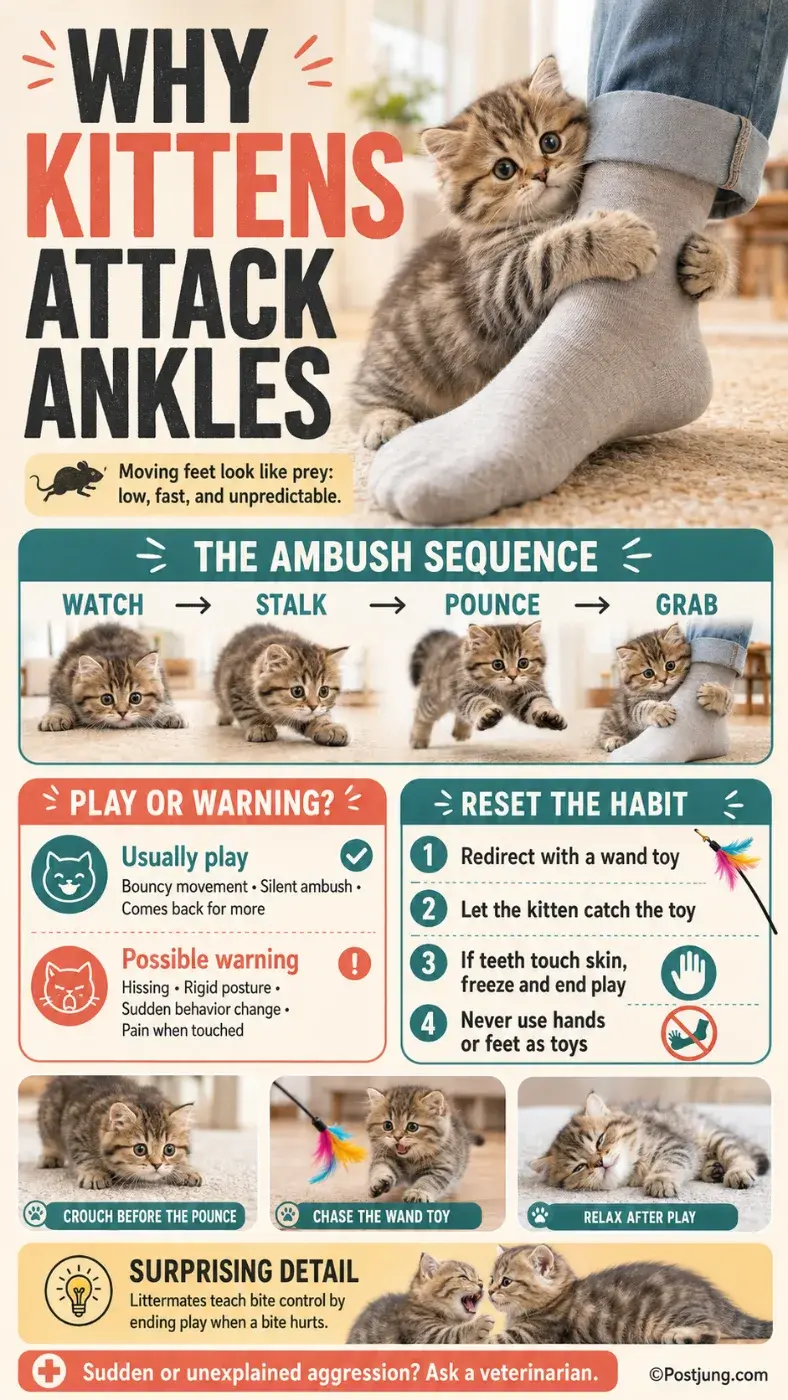
The result is a miniature hunting sequence: watch, stalk, hide, rush, grab and bite. The kitten is not necessarily trying to injure anyone. It is rehearsing behaviors that come naturally to cats.
Kittens also have enormous amounts of playful energy. If they do not have enough appropriate opportunities to chase, catch and wrestle, an ordinary trip through the hallway can become the day’s most interesting event.
Some kittens never learned when play is too rough
Young cats normally learn important boundaries while playing with their mother and littermates. When one kitten bites too hard, the other kitten may squeal, fight back or end the game.
That reaction teaches a lesson: rough behavior makes play stop.
Kittens raised without littermates, separated early or given limited opportunities for social play may not have developed the same level of bite and claw control. Even kittens that grew up with siblings can become overly enthusiastic when excited.
People can accidentally strengthen the habit as well. Wiggling fingers under a blanket, wrestling with bare hands or encouraging a kitten to chase toes teaches the cat that human body parts are acceptable toys.
What seems adorable when the kitten is tiny becomes considerably less charming once its claws, teeth and body are stronger.
Is it playful—or something more serious?
Playful ambushes often follow a recognizable pattern. The kitten watches from a hiding place, wiggles its rear end, pounces and quickly returns for another round. The behavior may occur in the same location or at predictable times, such as when the household becomes active.
Play can look intense. A kitten may have wide pupils, a rapidly moving tail or ears turned partly backward while preparing to pounce.
Fear-based aggression tends to come with a different overall message. A frightened cat may crouch, hiss, growl, flatten its ears tightly, raise its fur or try to escape. A highly agitated cat may also redirect its reaction toward a nearby person after seeing another animal or experiencing a frightening noise.
Pain matters, too. If a normally gentle kitten suddenly begins biting, reacts strongly when touched or shows changes in movement, appetite, grooming or litter-box habits, the behavior deserves veterinary attention. A sudden personality change should not be dismissed as play.
Redirect the hunt before the ambush begins
Watch for patterns. If attacks usually happen beside the sofa, near a doorway or during a particular part of the day, start an interactive play session before the kitten takes up its ambush position.
A wand or fishing-pole-style toy keeps claws and teeth away from skin while allowing the kitten to stalk, chase and capture something appropriate. Move the toy across the floor and around objects like prey rather than dangling it directly in the kitten’s face.
Let the kitten catch the toy regularly. A game that offers no successful capture can become frustrating.
Solo toys also help between interactive sessions. Lightweight balls, toy mice, food-dispensing puzzles and other safe objects that can be batted or chased give the kitten alternatives when no person is available. Rotating toys can keep familiar objects interesting.
Consistency is essential. Everyone in the household should follow the same rule: hands, feet and ankles never become playthings.
What to do when a kitten grabs your leg
Avoid kicking, shaking the kitten off violently or turning the encounter into a noisy struggle. Physical punishment can create fear, damage trust and make aggressive behavior worse.
Pause rather than offering more exciting movement. Once you can disengage safely, end the interaction and briefly withdraw attention. The message should be simple and consistent: biting people makes the fun stop.
After the kitten has calmed, redirect its energy to a toy held well away from your body. Do not immediately wave fingers or toes as a distraction, because that reinforces exactly the association you are trying to change.
If attacks are frequent, keeping a wand toy nearby can help you redirect the kitten before it reaches your leg. The goal is not to eliminate hunting-style play. It is to move that behavior onto a safe target.
Children should always be supervised around a kitten that bites or scratches. Cat bites and scratches can spread germs even when the injury initially appears minor. If the skin is broken, clean the wound promptly and seek medical advice for a deep bite, worsening pain, redness, swelling or other signs of infection.
Most ankle ambushes become manageable when a kitten receives suitable play, predictable boundaries and enough chances to use its energy. Your feet may move like prey, but with patient redirection, they do not have to remain on the household hunting list.
Cornell Feline Health Center, ASPCA, San Francisco SPCA, Centers for Disease Control and Prevention
REFERENCES:
https://www.vet.cornell.edu/departments-centers-and-institutes/cornell-feline-health-center/health-information/feline-health-topics/feline-behavior-problems-aggression
https://www.aspca.org/pet-care/cat-care/common-cat-behavior-issues/aggression-cats
https://www.sfspca.org/resource/play-aggression/
https://www.cdc.gov/healthy-pets/about/cats.html

เขียนโดย Postjung Insights
 โรงเรียนที่มีนักเรียนมากที่สุดในไทย
 รมว.วัฒนธรรมเอาจริง! จ่อส่งหนังสือทักท้วง Miss Universe Cambodia ปมใช้ภาพหญิงกำแพงเพชร หากไม่แก้ เตรียมใช้กฎหมาย
 รู้หรือไม่? เปิดรายได้พนักงานส่งพัสดุของแต่ละแอป วันหนึ่งได้เท่าไร
 MRT เตาปูนกลับมาเปิดปกติแล้ว รมช.คมนาคมเผยปมไฟไหม้ พบประกายไฟจากชุดสายไฟ 750 โวลต์
 อำเภอที่มีชื่ออำเภอสั้นที่สุด 3 อำเภอเท่านั้นในประเทศไทย
 เปิด 5 โรงเรียนหญิงล้วนเก่าแก่ของไทย ที่มีประวัติยาวนานกว่าศตวรรษ
 ดูหนัง–ซีรีส์ฟรีอาจไม่ฟรีอย่างที่คิด! เปิดโทษละเมิดลิขสิทธิ์ เตือนคนปล่อยคอนเทนต์เถื่อน เสี่ยงทั้งคุกทั้งปรับ
 แมคาเดเมีย (Macadamia): ราชินีแห่งถั่ว กับขุมทรัพย์โภชนาการจากออสเตรเลีย
 นักวิชาการ ม.อ.ไม่ปลื้ม! "ลิซ่า" ชวนดื่มหมดแก้ว ลั่น! เหยื่อเหล้าในไทยตายเยอะกว่าก่อการร้ายทั่วโลก
 5 คณะที่เรียนจบมาแล้ว มีอาชีพรองรับมากกว่าที่คิด
 ตาราง “เด่นเหนือเด่นใต้” งวด 1 ต.ค. 69 เปิดข้อมูลตามโพย เลขไหนอยู่ตรงไหน
 งูมัลกา (Mulga Snake): นักล่าแห่งผืนดินแห้งแล้ง ของทวีปออสเตรเลีย กับฉายา King Brown กัดคนได้ถึงตาย
 English Edition