Why Dogs Sleep by the Front Door—and When It Matters
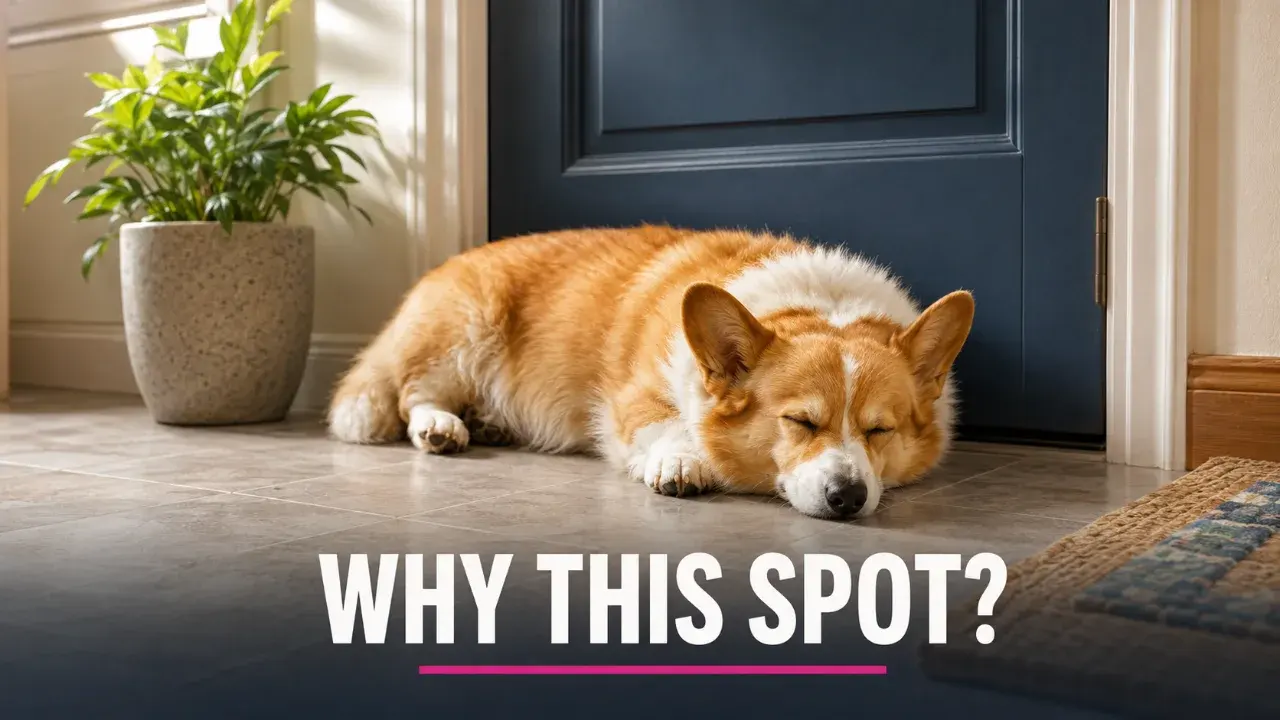
The front door may offer a cool floor, a familiar routine, and the best view of household activity. Context—not the sleeping spot alone—reveals what your dog may be communicating.
A dog stretched across the front door can look like a devoted guard waiting to protect the household. Sometimes the explanation is much simpler: that particular patch of floor may be cool, quiet, familiar, and perfectly positioned for observing everyone who comes and goes.
There is no single meaning behind the behavior. To understand it, look at what your dog does before settling there, how relaxed they appear, and how they respond when the door opens.
The doorway is an information-rich spot
The front door concentrates many of the things dogs notice. It carries outdoor scents, footsteps from the hallway or sidewalk, vehicle sounds, and the movements of family members leaving and returning.
A dog resting nearby can monitor that activity without walking from room to room. For a curious or alert dog, it is the household equivalent of choosing a seat with a view.
Some dogs may also react territorially to people or animals approaching the home. That is different from merely sleeping near the entrance. Cornell University’s veterinary guidance describes territorial behavior at doors as lunging, growling, snapping, or intense reactions to passersby—not peaceful napping by itself. Cornell University College of Veterinary Medicine
In other words, being near the door does not automatically mean guarding. A genuinely relaxed dog may simply have found a useful observation point.
It may be the coolest place in the house
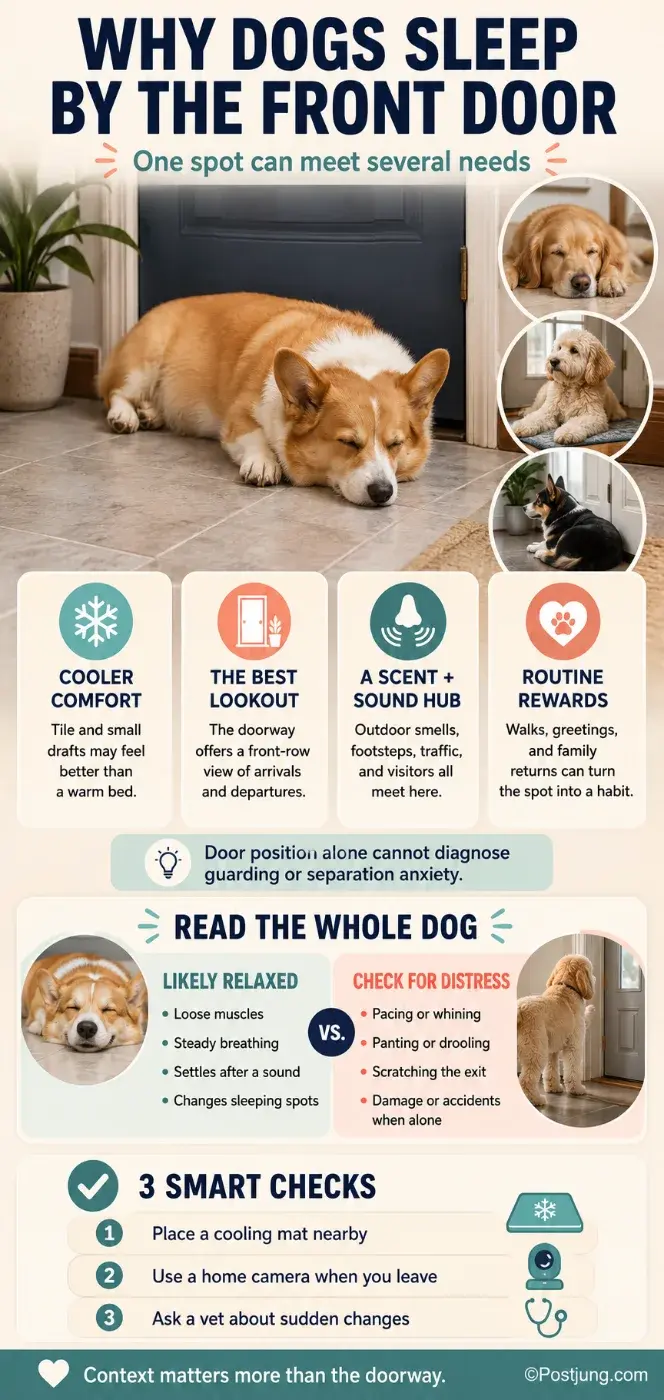
Flooring near an entrance is often tile, concrete, stone, or another hard material that stays cooler than carpet or a padded bed. Small drafts and frequent air movement can make the area even more appealing.
Dogs regulate heat differently from humans, and warm weather can change where they choose to rest. The American Kennel Club notes that dogs may abandon a soft bed for a cold floor or a breezy location when they need to cool down. American Kennel Club
This can be especially noticeable in hot, humid climates across Thailand and Southeast Asia, but it also happens during summer in American homes. If your dog moves between the doorway and other cool surfaces, comfort may be a stronger explanation than vigilance.
Make sure the area is safe, the door cannot swing into the dog, and no one is likely to trip over them. A cooling mat placed nearby may offer the same comfort without blocking the entrance.
Your dog may have learned the household schedule
Dogs are skilled observers of routines. Shoes, keys, bags, and movement toward the entrance can predict a walk, a delivery, a visitor, or a family member coming home.
If rewarding events repeatedly begin at the front door, resting there can become a learned habit. The dog is placing themselves where something interesting is most likely to happen.
That does not necessarily mean the dog is counting the minutes until one particular person returns. Dogs may associate the entrance with people coming home, but a favorite doorway spot is not proof of sadness or longing.
It is also not evidence that the dog is trying to dominate the family. Veterinary behavior guidance warns against assigning “alpha” meaning to ordinary doorway behavior. Doors are human-made structures, and the order in which a dog passes through one does not demonstrate rank, loyalty, or respect. VCA Animal Hospitals
Look at the whole dog, not just the location
A comfortable dog near the door will usually have loose muscles, calm breathing, and a natural sleeping posture. They may raise their head when they hear something and then settle again.
Concern is more appropriate when the doorway behavior comes with visible distress. Warning signs can include:
- Pacing or an inability to settle
- Repeated whining, barking, or howling
- Panting or drooling without an obvious heat-related cause
- Scratching, chewing, or digging at the exit
- House soiling after the owner leaves
- Refusing food when alone
- Frantic reactions to departure cues
Separation anxiety involves a pattern of distress connected to being left alone, not simply choosing to lie beside an exit. VCA Animal Hospitals notes that affected dogs may vocalize, damage doors or possessions, eliminate indoors, tremble, salivate, or become highly agitated as an owner prepares to leave. VCA Animal Hospitals
A home camera can help show what happens after everyone leaves. A dog that quietly sleeps by the door is displaying something very different from one that paces, cries, or attempts to escape.
A sudden change deserves attention
A long-standing doorway habit in an otherwise relaxed dog is usually less concerning than a new behavior accompanied by restlessness or confusion.
Older dogs may change their sleeping patterns because of pain, declining vision or hearing, or cognitive dysfunction. Cornell lists nighttime wandering, disorientation, altered interactions, increased anxiety, and changes in sleep as possible signs of canine cognitive dysfunction. Cornell University College of Veterinary Medicine
If the behavior appears suddenly, repeatedly disrupts sleep, or comes with physical or behavioral changes, schedule a veterinary checkup. Medical discomfort should be ruled out before assuming the cause is purely emotional.
For most dogs, though, the front door is simply a strategic place to rest: cool under the belly, rich with familiar sounds and scents, and close to the next household event. The best interpretation comes from the complete pattern—the dog’s posture, routine, reactions, and overall well-being—not from the doorway alone.
REFERENCES:
https://vcahospitals.com/know-your-pet/separation-anxiety-in-dogs
https://www.vet.cornell.edu/departments-centers-and-institutes/riney-canine-health-center/canine-health-topics/anxious-behavior-how-help-your-dog-cope-unsettling-situations
https://www.akc.org/expert-advice/health/why-does-my-dog-sleep-on-his-back/
https://vcahospitals.com/know-your-pet/dog-behavior-and-training-dominance-alpha-and-pack-leadership-what-does-it-really-mean

เขียนโดย Postjung Insights
 รู้หรือไม่? เปิดรายได้พนักงานส่งพัสดุของแต่ละแอป วันหนึ่งได้เท่าไร
 5 คณะที่เรียนจบมาแล้ว มีอาชีพรองรับมากกว่าที่คิด
 เปิดรายชื่อโรงเรียนในไทยที่ “ว่ายน้ำ” อยู่ในหลักสูตร เรียนจริงตั้งแต่อนุบาลถึงมัธยม
 เลขเด็ดปฏิทิน "หลวงปู่โต๊ะ" งวดวันที่ 1 ตุลาคม 69..ส่องเลย เลขไหนให้โชค!
 อำเภอที่มีชื่ออำเภอสั้นที่สุด 3 อำเภอเท่านั้นในประเทศไทย
 โรงเรียนที่มีนักเรียนมากที่สุดในไทย
 จุฬาฯ มหาวิทยาลัยแห่งแรกของไทย มีจุดเริ่มต้นในสมัยรัชกาลที่ 5
 Google ยอมรับแล้ว! Gemini AI เข้าถึงระบบบริษัทจริง 3 แห่ง ระหว่างการทดสอบความปลอดภัย
 โรงเรียนเพียงแห่งเดียวของประเทศไทย ที่อยู่มาตั้งแต่ยุครัชกาลที่ 4
 ตาราง “เด่นเหนือเด่นใต้” งวด 1 ต.ค. 69 เปิดข้อมูลตามโพย เลขไหนอยู่ตรงไหน
 สถิติย้อนหลัง 10 ปี ออกเลขไหนบ้างมาดูกัน
 ถ้าไม่กลัวเหนื่อย 7 อาชีพที่ตลาดยังต้องการ และค่าทักษะไปถึง 800 บาท/วัน
 😃 ชวนเข้ามาดูกันอีกกับคนที่มีร่างกายพิเศษจนเหมือนมีกล่องสมบัติที่หายาก 😯5 คณะที่เรียนจบมาแล้ว มีอาชีพรองรับมากกว่าที่คิดเปิดรายชื่อโรงเรียนในไทยที่ “ว่ายน้ำ” อยู่ในหลักสูตร เรียนจริงตั้งแต่อนุบาลถึงมัธยมGoogle ยอมรับแล้ว! Gemini AI เข้าถึงระบบบริษัทจริง 3 แห่ง ระหว่างการทดสอบความปลอดภัยเลขเด็ดปฏิทิน "หลวงปู่โต๊ะ" งวดวันที่ 1 ตุลาคม 69..ส่องเลย เลขไหนให้โชค!
 ทำไมของพลาสติกเก่าบางชิ้นถึง “เหนียว” ขึ้นมาเอง ทั้งที่ไม่ได้เปื้อนอะไร?
 English Edition