Why an AirTag Is Not a Replacement for a Pet GPS Tracker
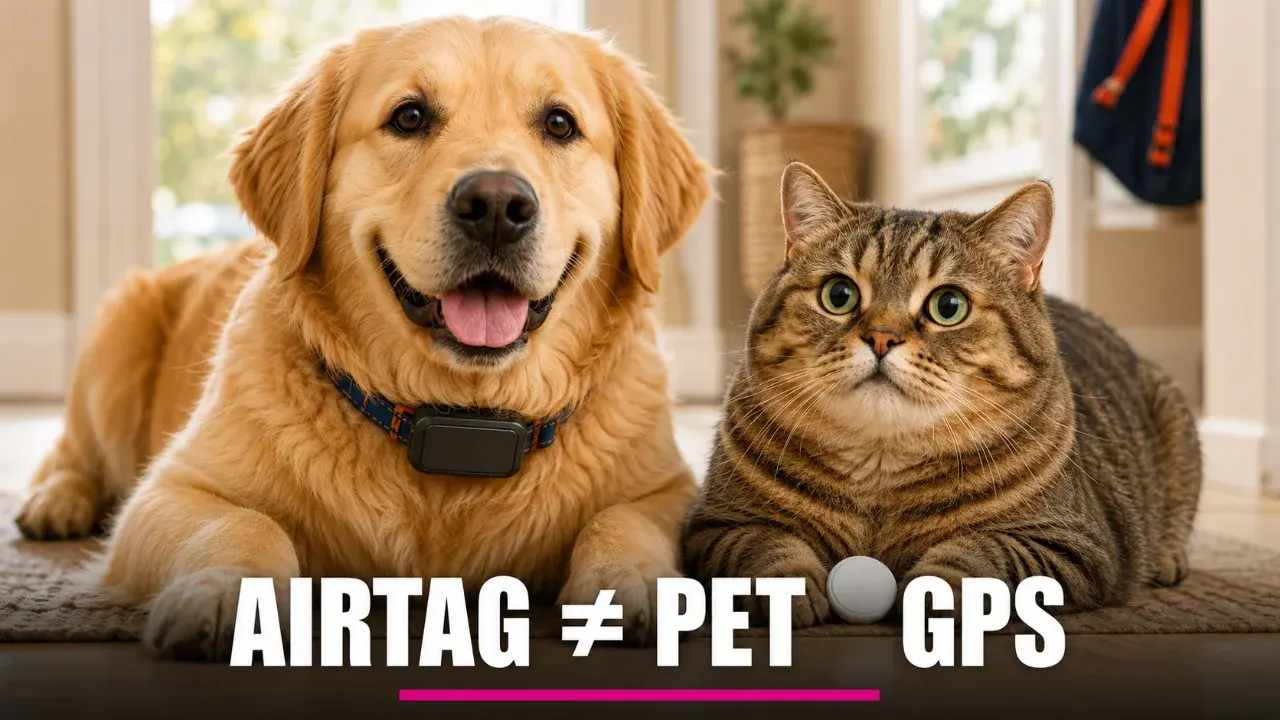
AirTags and pet GPS trackers can both display a location on a map, but they reach that result in fundamentally different ways. That difference matters most when a dog or cat disappears.
An AirTag attached to a collar may help an owner find a missing pet, especially in a busy neighborhood. But that does not turn it into a pet GPS tracker.
Apple describes its latest AirTag as a device designed exclusively for locating objects—not people or pets. The distinction is more than a product disclaimer: an AirTag does not calculate its own GPS location or send that location through a cellular network.
Instead, it depends on other Apple devices being nearby. That can work remarkably well in some places and leave owners with an old location in others.
An AirTag borrows another device’s location
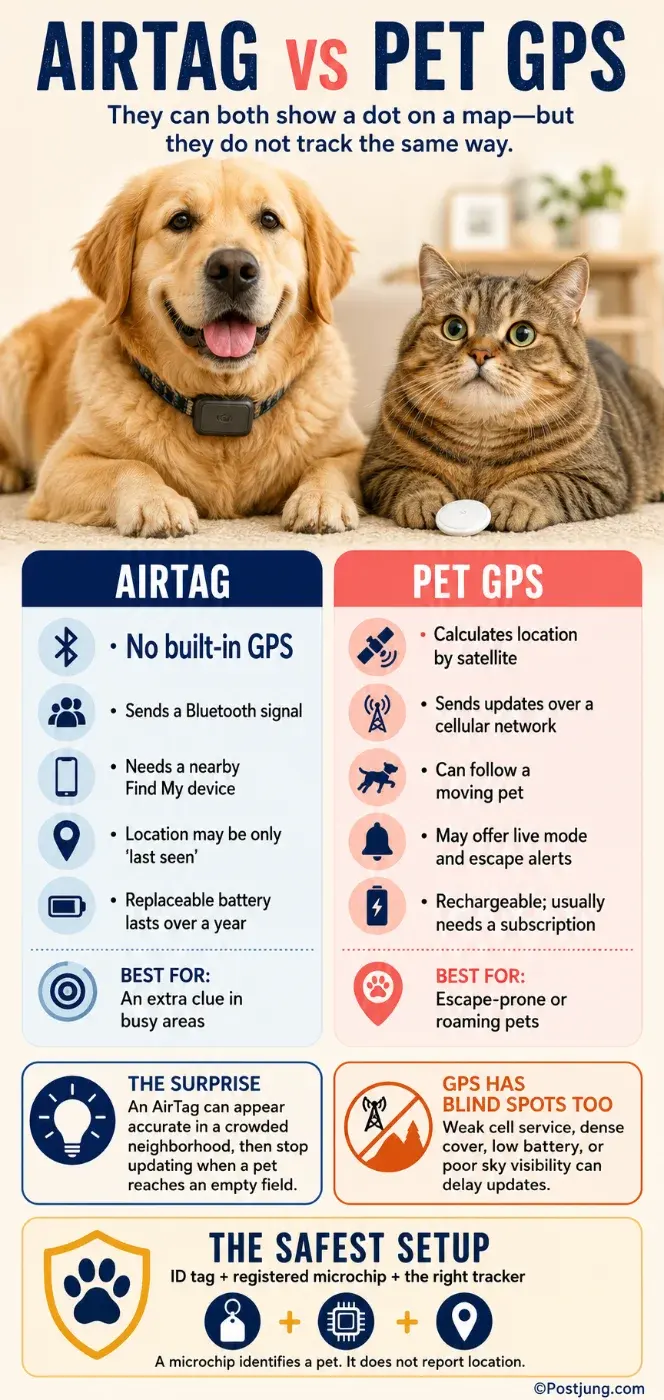
An AirTag emits a secure Bluetooth signal. When a compatible iPhone, iPad, or Mac in Apple’s Find My network detects that signal, the nearby device can relay the AirTag’s location to iCloud. Its owner then sees the reported location in the Find My app.
The process is encrypted and designed to keep the identity of the reporting device private. It also allows an AirTag to operate for more than a year on a replaceable coin-cell battery.
But the system has an important dependency: a nearby Find My device must detect the AirTag.
Imagine that a dog slips out of a yard and runs through a crowded residential area. Passing iPhones may report the AirTag repeatedly, making its position appear reasonably current.
If the same dog crosses an empty field, enters dense woodland, or wanders along a quiet rural road, there may be no compatible device close enough to detect the signal. The Find My app might continue showing the last reported location even though the dog has moved.
That location is not necessarily wrong. It is simply incomplete.
A pet GPS tracker produces and transmits its own position
A typical cellular pet tracker contains a GPS receiver that estimates its location using satellite signals. It then uses a built-in cellular connection to transmit that information to the manufacturer’s app.
Some models offer a live mode with updates every few seconds, location history, escape notifications, and virtual boundaries around a home or yard. These functions are designed around a moving animal rather than a misplaced set of keys.
A GPS tracker does not need a stranger with an iPhone to walk past. It can communicate across long distances wherever it has adequate satellite reception and compatible cellular coverage.
That does not make GPS infallible. Buildings, heavy tree cover, poor sky visibility, weak cellular service, a depleted battery, or a damaged device can delay or interrupt tracking. No collar-mounted device guarantees recovery.
The difference is that a pet GPS tracker is built to follow movement, while an AirTag is built to help locate an object through a crowdsourced device network.
The trade-off is battery life versus active tracking
AirTags are small, lightweight, and highly energy-efficient. Their replaceable batteries can last far longer than the rechargeable batteries in most cellular GPS trackers.
Active GPS and cellular communication require considerably more power. Depending on the tracker, settings, signal conditions, and frequency of location updates, owners may need to recharge it every few days or weeks.
Cellular trackers also commonly require a subscription. That fee supports the device’s connection to mobile networks, much like the data service used by a phone.
An AirTag generally avoids that recurring cellular cost because it does not have its own mobile-data connection. The lower operating cost comes with less control over when and where a new location will be reported.
Nearby finding is not the same as live tracking
AirTag’s Precision Finding can be useful once the owner is physically close to the tag. On compatible Apple devices, it can provide distance and directional guidance, while the AirTag’s speaker can play a sound.
Those tools could help locate a pet hiding under a porch or inside a nearby building. They are less useful when the owner does not yet know which neighborhood, road, or field to search.
Pet GPS trackers approach the problem from the opposite direction. Their strongest feature is often the ability to show the pet’s recent movement over a wider area. Some can also alert an owner when the animal leaves a predefined safe zone.
This leads to the most practical distinction:
AirTag is strongest during the final nearby search. A pet GPS tracker is intended to help with the wider chase.
Which option makes sense for your pet?
An AirTag may provide an inexpensive additional clue for an indoor cat that occasionally slips into a densely populated neighborhood. Owners should still understand that location updates can be irregular and depend heavily on nearby Apple devices.
A GPS tracker is generally the more appropriate option for an escape-prone dog, an outdoor cat, a pet traveling away from home, or an animal living near rural land. Before buying one, check its weight, collar attachment, waterproof rating, battery routine, cellular coverage, and subscription terms.
The device should also be suitable for the animal’s size and normal activity. Cat owners should pay particular attention to collar safety and use an appropriately fitted breakaway design when recommended.
Neither technology should replace ordinary identification. A visible ID tag gives the person who finds a pet an immediate way to contact the owner. A registered microchip provides permanent identification if the collar comes off, although a microchip is not a GPS tracker and cannot report a pet’s location.
The strongest setup is therefore layered: secure identification, an updated microchip record, and tracking technology suited to the animal’s real escape risk.
An AirTag can sometimes help bring a pet home. The mistake is assuming that seeing a dot on a map means it works like GPS.
Apple, Tractive, Humane World for Animals, American Veterinary Medical Association
REFERENCES:
https://www.apple.com/airtag/
https://www.apple.com/newsroom/2026/01/apple-introduces-new-airtag-with-expanded-range-and-improved-findability/
https://help.tractive.com/hc/en-us/articles/205663101-How-does-it-work-How-can-I-find-my-pet-with-a-Tractive-tracker
https://www.humanesociety.org/resources/how-microchip-can-keep-you-and-your-pet-together

เขียนโดย Postjung Insights
 อำเภอที่มีชื่ออำเภอสั้นที่สุด 3 อำเภอเท่านั้นในประเทศไทย
 รู้หรือไม่? เปิดรายได้พนักงานส่งพัสดุของแต่ละแอป วันหนึ่งได้เท่าไร
 5 คณะที่เรียนจบมาแล้ว มีอาชีพรองรับมากกว่าที่คิด
 Google ยอมรับแล้ว! Gemini AI เข้าถึงระบบบริษัทจริง 3 แห่ง ระหว่างการทดสอบความปลอดภัย
 เลขเด็ดปฏิทิน "หลวงปู่โต๊ะ" งวดวันที่ 1 ตุลาคม 69..ส่องเลย เลขไหนให้โชค!
 เปิด 5 โรงเรียนหญิงล้วนเก่าแก่ของไทย ที่มีประวัติยาวนานกว่าศตวรรษ
 จุฬาฯ มหาวิทยาลัยแห่งแรกของไทย มีจุดเริ่มต้นในสมัยรัชกาลที่ 5
 เปิดรายชื่อโรงเรียนในไทยที่ “ว่ายน้ำ” อยู่ในหลักสูตร เรียนจริงตั้งแต่อนุบาลถึงมัธยม
 ทำไมของพลาสติกเก่าบางชิ้นถึง “เหนียว” ขึ้นมาเอง ทั้งที่ไม่ได้เปื้อนอะไร?
 โรงเรียนที่มีนักเรียนมากที่สุดในไทย
 ตาราง “เด่นเหนือเด่นใต้” งวด 1 ต.ค. 69 เปิดข้อมูลตามโพย เลขไหนอยู่ตรงไหน
 อุทยานเขาใหญ่เรียกตัว “ตีนผี” หลังขับจี้ช้างป่าพ่อลูก ลั่นระยะ 50 เมตรต้องจำให้ขึ้นใจ
 😃 ชวนเข้ามาดูกันอีกกับคนที่มีร่างกายพิเศษจนเหมือนมีกล่องสมบัติที่หายาก 😯5 คณะที่เรียนจบมาแล้ว มีอาชีพรองรับมากกว่าที่คิดเปิดรายชื่อโรงเรียนในไทยที่ “ว่ายน้ำ” อยู่ในหลักสูตร เรียนจริงตั้งแต่อนุบาลถึงมัธยมGoogle ยอมรับแล้ว! Gemini AI เข้าถึงระบบบริษัทจริง 3 แห่ง ระหว่างการทดสอบความปลอดภัยเลขเด็ดปฏิทิน "หลวงปู่โต๊ะ" งวดวันที่ 1 ตุลาคม 69..ส่องเลย เลขไหนให้โชค!ทำไมของพลาสติกเก่าบางชิ้นถึง “เหนียว” ขึ้นมาเอง ทั้งที่ไม่ได้เปื้อนอะไร?
 English Edition