Why Landlords Charge Pet Deposits—and What Renters Should Check

Pet deposits are designed to cover rental damage beyond ordinary wear, but they are not the same as pet fees or monthly pet rent. Local laws and the wording of the lease can make a major difference.
A pet deposit can make an otherwise affordable apartment noticeably more expensive at move-in. From a landlord’s perspective, however, the charge is usually meant to create a financial cushion for damage or cleaning associated with an animal—not to punish tenants for owning pets.
The key word is “deposit.” A true pet deposit is generally refundable, subject to the lease and applicable law, if the animal causes no chargeable damage.
That sounds straightforward, but rental listings often use “pet deposit,” “pet fee,” and “pet rent” as though they mean the same thing. They do not.
The costs landlords are trying to anticipate
Most pets never seriously damage a home. Even so, animals can create repair or cleaning needs that are less common in a pet-free unit.
Possible issues include scratched doors, damaged flooring, stained carpet, chewed trim, lingering odors, flea treatment, or damage to a yard. In apartment buildings, animals may also affect hallways, elevators, and other shared spaces.
A deposit gives the property owner money that can be applied to documented costs after the tenant leaves. Without it, the landlord may have to bill the former tenant or pursue payment later.
The charge also allows landlords to separate ordinary rental risks from animal-related risks. This can make some property owners more willing to accept pets instead of imposing a complete no-pet policy.
Still, a deposit is not automatic permission to deduct money. Whether a landlord may keep any of it depends on the lease, evidence of damage, and state or local law.
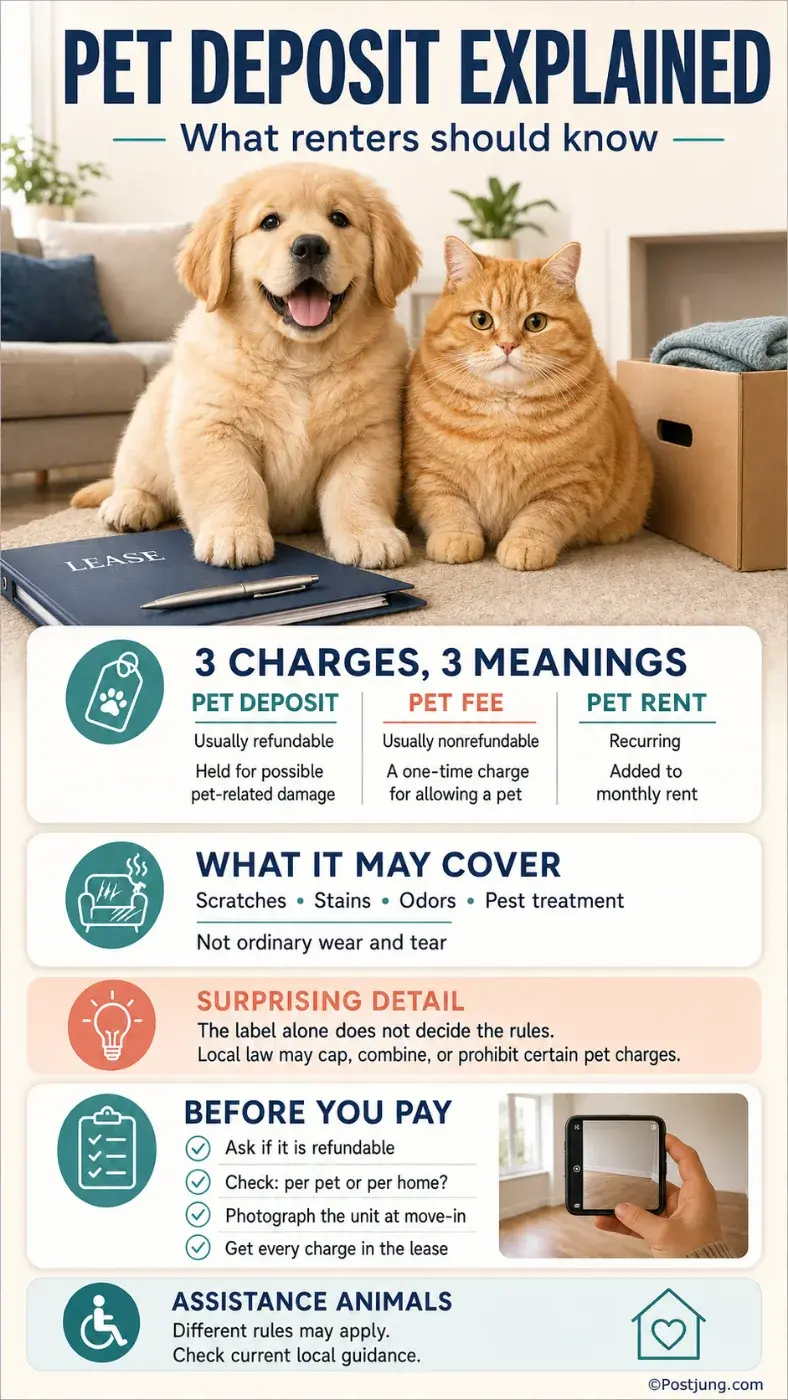
Pet deposit, pet fee, and pet rent are different
Before signing a lease, renters should identify exactly what they are being charged:
- A pet deposit is typically a refundable amount held against possible damage.
- A pet fee is generally a one-time, nonrefundable charge for allowing the animal.
- Pet rent is a recurring amount added to the monthly rent.
A property may charge one of these, a combination of them, or none at all. The terminology matters because the rules governing refundable deposits may not apply in the same way to fees or rent.
Local differences can be substantial. Seattle, for example, permits a pet damage deposit and pet rent but prohibits nonrefundable pet fees. The city limits the pet deposit to 25% of the first full month’s rent and requires it to be written into the rental agreement. Seattle Department of Construction and Inspections
California takes a different approach. Its statewide security-deposit limit generally applies to the total amount collected as security, regardless of what the landlord calls individual parts of the deposit. The California attorney general says security deposits may cover qualifying damage and cleaning, but not ordinary wear and tear. California Department of Justice
These examples show why there is no single nationwide pet-deposit rule for private rentals in the United States.
Damage is not the same as ordinary wear
A faded carpet or lightly worn flooring may simply reflect normal use. Deep stains, torn carpet, heavily scratched doors, or chewed woodwork may be treated differently.
The dividing line is not always obvious, especially when an item was already old. A landlord generally should not charge a tenant the full cost of replacing something that was damaged or near the end of its useful life before the tenancy began.
Renters can protect themselves by taking dated photos or video during move-in. The images should cover floors, doors, baseboards, carpet, screens, and any existing stains or scratches.
A written move-in checklist is equally useful. If the property manager provides one, the tenant should return it by the deadline and keep a copy.
Good documentation protects both sides. It helps a landlord establish new damage and helps a renter show that a problem already existed.
Assistance animals require special care
An assistance animal is not necessarily treated as an ordinary pet under housing law. Federal fair-housing guidance has long addressed reasonable-accommodation requests involving trained service animals and other disability-related animals.
This area changed in May 2026, when the U.S. Department of Housing and Urban Development issued new enforcement guidance. HUD said its fair-housing enforcement staff would recommend charges in animal-accommodation complaints only in cases involving animals trained to provide disability-related assistance. The memorandum also questioned earlier guidance that broadly opposed fees for untrained emotional-support animals. HUD’s May 2026 enforcement memorandum
That enforcement change does not erase state laws, local protections, other federal requirements, or the need for an individualized legal analysis. Renters and housing providers should avoid assuming that every animal—or every accommodation request—falls under the same rule.
What renters should ask before paying
The lease or pet addendum should answer several basic questions:
- Is the charge refundable?
- Is there also a nonrefundable fee or monthly pet rent?
- Does the amount apply per pet or per household?
- What types of damage can be deducted?
- Is an itemized statement required after move-out?
- Does the deposit count toward a state or local security-deposit cap?
- How and when must the remaining balance be returned?
Tenants should also request a receipt and keep the pet agreement with the lease. Verbal promises about refunds can be difficult to prove later.
A pet deposit is ultimately a form of risk-sharing. It gives landlords added protection while giving renters access to housing that might otherwise prohibit animals. Whether the arrangement is fair depends on the amount, the law, the lease language, and how deductions are handled after move-out.
Because rental laws vary by jurisdiction and can change, renters facing a disputed charge or an assistance-animal issue should consult a local housing agency, tenant organization, legal-aid provider, or qualified attorney.
U.S. Department of Housing and Urban Development, California Department of Justice, Seattle Department of Construction and Inspections, Connecticut Department of Banking
REFERENCES:
https://www.hud.gov/sites/default/files/hudclips/documents/AS-Trainor-Enforcement-Guidance-Assessing-Requests-for-the-use-of-an-animal-as-a-reasonable-accommodation-under-the-fair-housing-act.pdf
https://www.seattle.gov/construction-and-inspections/codes/common-code-questions/pets
https://oag.ca.gov/system/files/media/Know-Your-Rights-Security-Deposits-English.pdf
https://portal.ct.gov/dob/rental-security-deposits/rental-security-deposits/rental-security-deposits

เขียนโดย Postjung Insights
 รู้หรือไม่? เปิดรายได้พนักงานส่งพัสดุของแต่ละแอป วันหนึ่งได้เท่าไร
 อำเภอที่มีชื่ออำเภอสั้นที่สุด 3 อำเภอเท่านั้นในประเทศไทย
 โรงเรียนที่มีนักเรียนมากที่สุดในไทย
 เปิดรายชื่อ 5 โรงเรียนเป้าหมาย เด็กสอบเข้าต้องเตรียมตัวให้พร้อม
 หนุ่มขับ Porsche ใจหล่อสุดๆ ติดประกาศเด็กหายไว้รอบคัน..หวังช่วยเผยแพร่ข้อมูลให้ตามหาได้เร็วขึ้น
 แปลปกสลาก งวด 1 ต.ค. 69 ส่องตัวเลขจากภาพปกสลากกินแบ่งรัฐบาล
 โรสแมรี่ แฮร์ริส ‘ป้าเมย์’ แห่ง Spider-Man ฉบับโทบีย์ แม็คไกวร์ อายุครบ 99 ปี
 ซาบีดา” เรียกถกด่วน ปมภาพ “ชุดไทย” ถูกนำไปอ้างเป็นชุดกัมพูชา
 'สควีชชี่'ของเล่นที่กำลังเป็นไวรัลอาจถูกเจ้าหน้าที่ของสนามบินยึดได้ ตรวจสอบให้ดีก่อนนำขึ้นเครื่อง
 Ctrip แพลตฟอร์มการท่องเที่ยวของจีน เปิดขายตั๋วสำหรับทริปท่องเที่ยวอวกาศ ของ Virgin Galactic 6 วัน ในราคาประมาณ 24 ล้านบาท
 ตาราง “เด่นเหนือเด่นใต้” งวด 1 ต.ค. 69 เปิดข้อมูลตามโพย เลขไหนอยู่ตรงไหน
 เปิด 5 โรงเรียนหญิงล้วนเก่าแก่ของไทย ที่มีประวัติยาวนานกว่าศตวรรษซาบีดา” เรียกถกด่วน ปมภาพ “ชุดไทย” ถูกนำไปอ้างเป็นชุดกัมพูชาเปิดรายชื่อ 5 โรงเรียนเป้าหมาย เด็กสอบเข้าต้องเตรียมตัวให้พร้อมหนุ่มขับ Porsche ใจหล่อสุดๆ ติดประกาศเด็กหายไว้รอบคัน..หวังช่วยเผยแพร่ข้อมูลให้ตามหาได้เร็วขึ้น
 วาบิ-ซาบิ (Wabi-Sabi) ปรัชญาญี่ปุ่นที่สอนให้เราโอบกอดความไม่สมบูรณ์แบบ
 English Edition