Why Senior Cats May Suddenly Forget Their Daily Routine
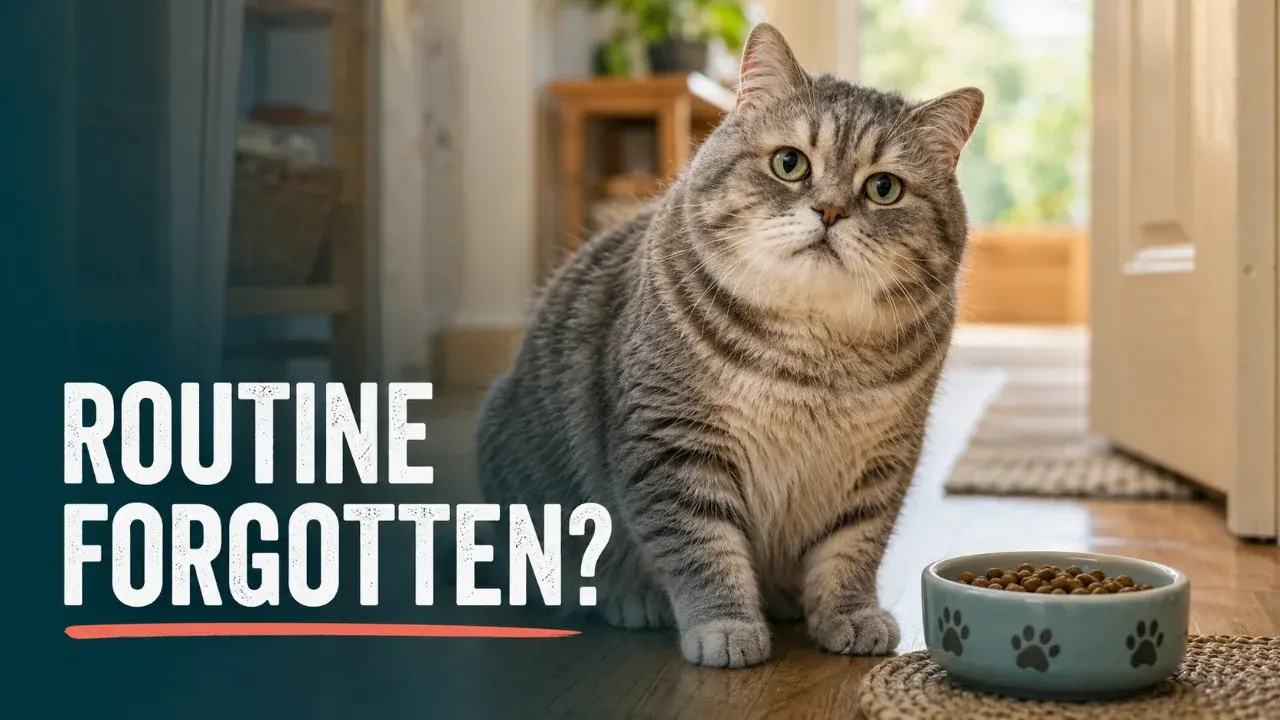
An older cat that misses meals, cries at night, or seems lost at home may be experiencing cognitive decline—but pain, poor vision, and treatable illnesses can cause similar changes.
Cats are famously devoted to routine, which makes a sudden change hard to miss. A senior cat may stop waiting by the food bowl, appear confused about where to sleep, or wander past a litter box it has used for years.
These changes can look like forgetfulness. Sometimes they are linked to age-related cognitive decline, but memory loss is only one possible explanation.
Aging can change how a cat processes familiar surroundings
Feline cognitive dysfunction is an age-related condition involving changes in memory, awareness, learning, and behavior. It is sometimes compared with dementia in people, although the conditions are not identical.
According to the Cornell Feline Health Center, noticeable signs may include disorientation, altered sleep patterns, reduced interest in play, staring at walls, nighttime vocalization, house soiling, and changes in interest in food or water.
A cat affected by cognitive decline may still recognize its family and enjoy affection. The difficulty may show up in smaller moments: walking into a room and appearing unsure why, becoming trapped behind furniture, or waiting at the wrong door.
Daily routines depend on several abilities working together. A cat must remember where something is, recognize the cues that lead to it, navigate the home, and physically complete the task. A decline in any part of that chain can make a familiar habit fall apart.
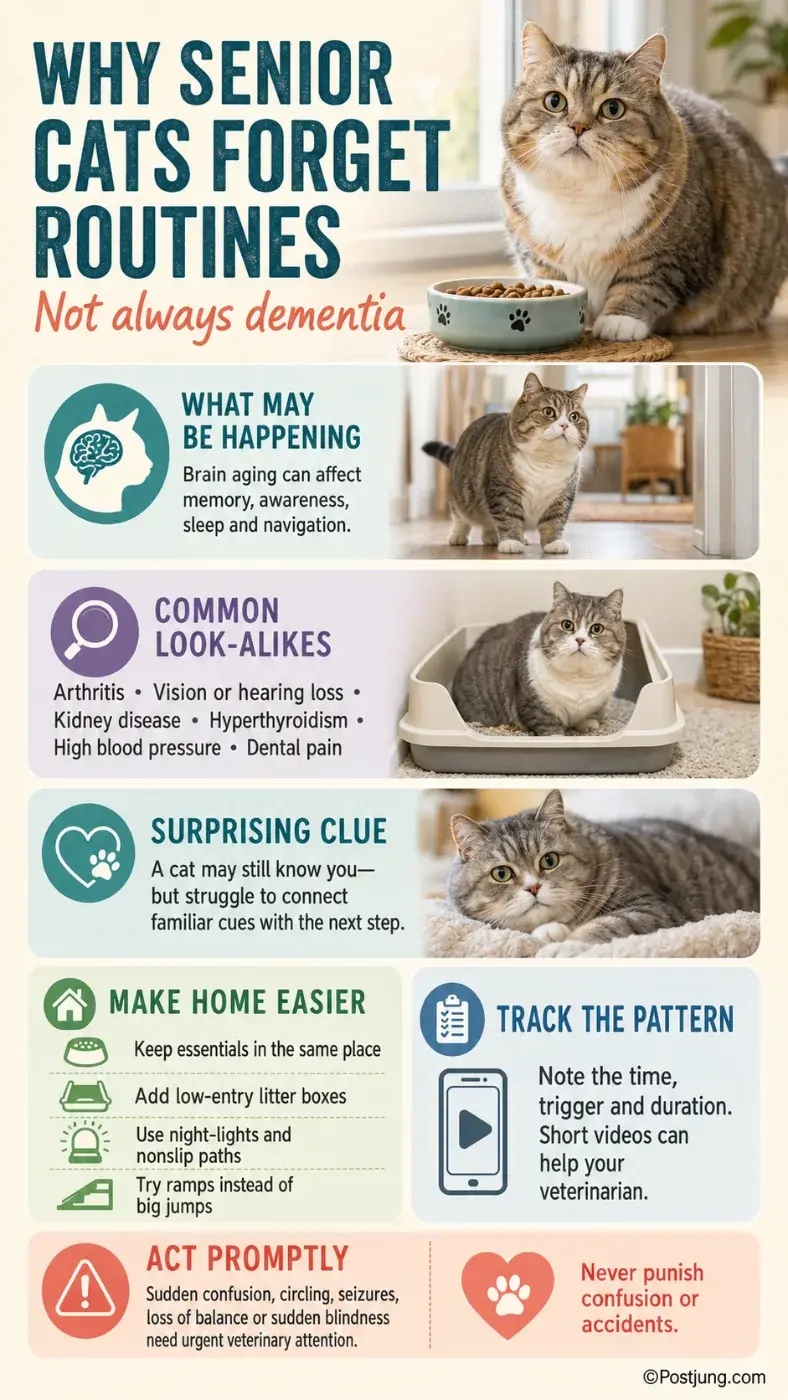
What looks like forgetfulness may begin elsewhere
Cognitive dysfunction cannot be identified from behavior alone. Older cats are vulnerable to several medical problems that can produce remarkably similar signs.
Arthritis may make climbing into a high-sided litter box painful. Dental disease can cause a cat to approach food and then back away. Kidney disease may increase urination, while hyperthyroidism or high blood pressure can contribute to restlessness and nighttime crying.
High blood pressure may also damage vision. A cat that can no longer see clearly may appear to have forgotten where its bed, water bowl, or doorway is located.
Hearing loss creates another confusing picture. A cat that once responded instantly to the sound of a food container may no longer hear it. Changes in smell can also make food less appealing or familiar.
This is why behavioral changes should not be dismissed as “just old age.” The 2021 American Association of Feline Practitioners senior-care guidelines emphasize evaluating medical, behavioral, environmental, and mobility changes together rather than treating age itself as the diagnosis.
Watch for a pattern, not one unusual moment
A single missed meal or restless night does not prove that a cat is losing its memory. Cats may temporarily change their routine because of stress, visitors, noise, unfamiliar smells, a moved piece of furniture, or conflict with another pet.
Cognitive changes are more concerning when they become repeated or progressive. Owners may notice that the cat:
- Gets lost in familiar rooms
- Stares into corners or at walls
- Sleeps more during the day and stays awake at night
- Cries without an obvious trigger
- Misses the litter box despite previously reliable habits
- Withdraws from play or social contact
- Becomes unusually clingy, restless, or irritable
- Appears unable to find food, water, or a usual sleeping place
Keeping a simple diary can help. Record when the behavior occurs, how long it lasts, and whether it is connected with eating, using the litter box, climbing, sleeping, or interacting with people.
Short videos can also give a veterinarian useful information that may not appear during a clinic visit.
A sudden dramatic change deserves prompt attention. Abrupt disorientation, circling, collapse, seizures, loss of balance, or apparent sudden blindness should not be assumed to be dementia.
Familiarity can make the home easier to navigate
A predictable environment can reduce confusion. Keep food, water, beds, and litter boxes in consistent locations whenever possible. Avoid rearranging furniture unnecessarily, especially if the cat has poor vision.
Low-sided litter boxes can help cats with stiff joints. A night-light may make hallways and feeding areas easier to find. Ramps, stable steps, and nonslip surfaces can preserve access to favorite resting places without requiring difficult jumps.
Some cats benefit from additional litter boxes and water stations, particularly in multistory homes. The goal is to shorten the distance between the cat and essential resources.
Gentle interaction still matters. Calm play, food puzzles suited to the cat’s abilities, brushing, and familiar social contact can provide stimulation without overwhelming an older animal. Consistency is often more helpful than novelty when a cat already seems confused.
Do not punish accidents, nighttime crying, or apparent failure to follow a routine. A confused or uncomfortable cat is not misbehaving deliberately, and punishment can add fear to an already difficult situation.
A checkup can reveal what behavior alone cannot
A veterinarian may review the cat’s behavioral history, mobility, vision, hearing, blood pressure, medications, and home environment. Depending on the findings, blood tests, urine testing, or additional examinations may be recommended.
There is no single home test that can confirm feline cognitive dysfunction. It is generally considered after other medical explanations have been investigated.
For families, the most useful first step is noticing what changed and documenting it clearly. Small changes can contain important medical clues, especially when they involve eating, drinking, elimination, movement, sleep, or awareness.
A senior cat that forgets part of its routine is not necessarily forgetting its family. It may be struggling to interpret its surroundings, cope with discomfort, or complete a once-easy task. Patient observation and veterinary care can help identify the reason—and make the cat’s familiar world easier to understand again.
This information is educational and is not a substitute for an examination by a veterinarian.
Cornell Feline Health Center, American Association of Feline Practitioners, Journal of Feline Medicine and Surgery
REFERENCES:
https://www.vet.cornell.edu/departments-centers-and-institutes/cornell-feline-health-center/health-information/feline-health-topics/cognitive-dysfunction
https://pmc.ncbi.nlm.nih.gov/articles/PMC10812122/
https://pmc.ncbi.nlm.nih.gov/articles/PMC11220932/
https://pmc.ncbi.nlm.nih.gov/articles/PMC9774186/

เขียนโดย Postjung Insights
 หัวลูกศรหินย้อนเวลา 80,000 ปี ในเอเชียกลาง… หลักฐานใหม่ชี้ โฮโม เซเปียนส์ อาจเคยบุกยุโรปเร็วขึ้นนับหมื่นปี!
 ฝูงลิงญี่ปุ่นนับสิบรุมล้อมและโจมตีชายคนหนึ่งในคานากาวะ
 รู้หรือไม่? เปิดรายได้พนักงานส่งพัสดุของแต่ละแอป วันหนึ่งได้เท่าไร
 ส่องเลข 3 สำนักพิมพ์ งวด 1 ต.ค. 69 ตัวไหนมีข้อมูลตรงกัน
 อำเภอที่มีชื่ออำเภอสั้นที่สุด 3 อำเภอเท่านั้นในประเทศไทย
 โรงเรียนที่มีนักเรียนมากที่สุดในไทย
 ยูเครนขอจัดการประชุมสุดยอดกับญี่ปุ่น
 ถ้าไม่กลัวเหนื่อย 7 อาชีพที่ตลาดยังต้องการ และค่าทักษะไปถึง 800 บาท/วัน
 สถิติย้อนหลัง 10 ปี ออกเลขไหนบ้างมาดูกัน
 เปิด 5 โรงเรียนหญิงล้วนเก่าแก่ของไทย ที่มีประวัติยาวนานกว่าศตวรรษ
 อินฟลูเอนเซอร์สาวผู้สร้างคอนเทนต์สำหรับผู้ใหญ่และมีรายได้ต่อปีกว่า 33 ล้านบาท ตัดสินใจเปลี่ยนอาชีพมาเป็นแพทย์แทน
 ตาราง “เด่นเหนือเด่นใต้” งวด 1 ต.ค. 69 เปิดข้อมูลตามโพย เลขไหนอยู่ตรงไหนเปิด 5 โรงเรียนหญิงล้วนเก่าแก่ของไทย ที่มีประวัติยาวนานกว่าศตวรรษหัวลูกศรหินย้อนเวลา 80,000 ปี ในเอเชียกลาง… หลักฐานใหม่ชี้ โฮโม เซเปียนส์ อาจเคยบุกยุโรปเร็วขึ้นนับหมื่นปี!ถ้าไม่กลัวเหนื่อย 7 อาชีพที่ตลาดยังต้องการ และค่าทักษะไปถึง 800 บาท/วัน
 ทำไมแผนที่ส่วนใหญ่เอาทิศเหนือไว้ด้านบน ทั้งที่โลกไม่มี “ด้านบน” จริง ๆ?
 English Edition