Why Dogs Seem to Bark at Nothing at Night

A dog staring into a dark hallway may be responding to a sound, scent, movement, or physical discomfort that people cannot detect. The pattern—and the dog’s body language—can help reveal what is happening.
A dog that suddenly barks at an empty window or dark hallway probably is not reacting to “nothing.” The trigger may simply be outside human awareness—a faint sound, a passing scent, a small animal, or movement hidden by darkness.
Sometimes the explanation is ordinary alert behavior. In other cases, repeated nighttime barking can point to anxiety, discomfort, or cognitive changes in an older dog.
The night is not as quiet to a dog
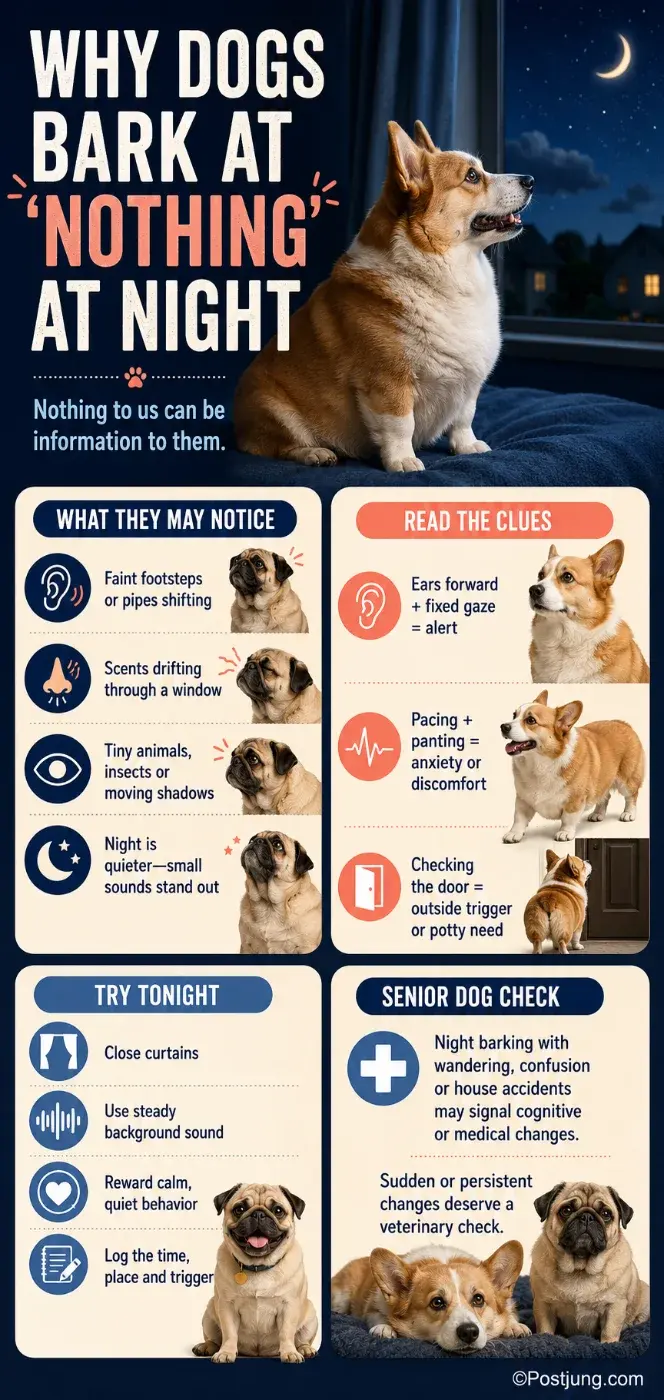
Dogs experience their surroundings differently from people. The Royal Society for the Prevention of Cruelty to Animals notes that dogs can hear ultrasound, detect quieter sounds than humans, see better in dim light, and rely on a highly developed sense of smell.
That means a dog may notice activity long before anyone else in the room does. Possible triggers include footsteps outside, another dog moving nearby, wildlife in the yard, pipes shifting, an elevator stopping on another floor, or insects and rodents inside a wall.
A scent drifting through an open window can also prompt a reaction even when the source is no longer visible. Dogs may gather information from an odor left behind by a person or animal that passed minutes earlier.
Nighttime makes these signals easier to notice. Once household conversations, traffic, televisions, and appliances quiet down, a small noise that disappeared into the daytime background can suddenly stand out.
Barking is an alarm, not proof of danger
Barking is a normal form of canine communication. Veterinary behaviorists at VCA Animal Hospitals explain that it can function as a territorial warning or occur in response to unfamiliar sights, sounds, and odors. Dogs may also bark when they feel anxious, frustrated, or uncertain.
Watch what happens before and after the bark.
A dog with ears forward, a fixed gaze, and an alert posture may have detected something outside. A dog pacing, panting, trembling, or repeatedly checking doors may be frightened or distressed. Barking followed by a glance toward the owner can sometimes be an attempt to get attention.
The location matters as well. Repeated barking at one window may suggest passing animals or people. Barking beside the bedroom door could mean the dog wants access to a family member. Going to the exterior door may signal a need for a bathroom break.
The bark alone does not reveal the cause. Its timing, location, body language, and surrounding events provide the more useful clues.
Why the behavior can become a nightly habit
Alert barking can reinforce itself.
Imagine that a dog hears someone outside, barks, and then the footsteps fade away. From the dog’s perspective, barking may appear to have driven the intruder away. Repeating the behavior during the next suspicious sound becomes worthwhile.
An owner’s reaction can strengthen the pattern too. Shouting may sound like the household is joining the alarm, while immediately offering food or attention can teach the dog that barking brings a reward.
This does not mean owners should ignore every bark. It means the response should be calm and consistent. Check that there is no real threat, redirect the dog away from the trigger, and reward quiet behavior after the barking stops.
Yelling can increase noise and anxiety, particularly when fear is driving the behavior.
When nighttime barking may be a health clue
A sudden change deserves closer attention, especially if a previously quiet dog begins vocalizing every night.
Pain can make it difficult to settle or change sleeping positions. A dog may also wake because of itching, digestive discomfort, urinary urgency, reduced vision, or another medical issue. Behavior changes may appear before an owner notices an obvious physical symptom.
Senior dogs need special consideration. Canine cognitive dysfunction, an age-related condition affecting memory, awareness, and behavior, can disrupt the sleep-wake cycle. VCA lists waking at night, excessive vocalization, disorientation, new fears, house soiling, and changing social interactions among the possible signs.
A dog experiencing nighttime confusion may wander, stare into space, become trapped behind furniture, or bark without an identifiable external trigger. New nighttime vocalization in a senior dog should not be dismissed as stubbornness.
Cognitive dysfunction cannot be diagnosed from barking alone. Veterinary assessment is needed because pain, sensory decline, neurologic disease, and other conditions can produce similar behavioral changes.
What owners can try tonight
Begin by looking for a pattern rather than trying to silence the dog immediately.
Note the time, where the dog looks, what the body is doing, how long the episode lasts, and what stops it. A home camera may reveal passing animals, vehicle lights, outside noises, or pacing that occurs before the owner wakes.
Close curtains or move the sleeping area away from street-facing windows if visual triggers are involved. Low, steady background sound may help mask intermittent noises. Make sure the dog has had an appropriate bathroom break and enough daytime exercise, play, and mental activity for its age and health.
Reward calm behavior before barking begins and after the dog settles. A trained “quiet,” “settle,” or “go to bed” cue can provide a clear alternative to continued alarm barking.
Avoid punishment-based reactions. They may stop the sound briefly without changing the dog’s fear, discomfort, or reason for barking.
Contact a veterinarian if the behavior begins suddenly, grows more frequent, or appears alongside pain, panting, pacing, confusion, appetite changes, house soiling, weakness, or altered sleep. Urgent care may be appropriate if the dog is struggling to breathe, collapses, has a seizure, or seems severely distressed.
A dark room may look empty to a person while remaining full of information to a dog. The useful question is not whether the animal is barking at nothing, but what changed in the dog’s environment, routine, or health—and what the rest of the household has not noticed yet.
VCA Animal Hospitals, Merck Veterinary Manual, Royal Society for the Prevention of Cruelty to Animals
REFERENCES:
https://vcahospitals.com/know-your-pet/barking-in-dogs
https://vcahospitals.com/resources/senior-dog/how-to-keep-your-senior-dogs-mind-sharp
https://www.merckvetmanual.com/behavior/behavior-of-dogs/behavior-problems-of-dogs
https://www.rspca.org.uk/adviceandwelfare/pets/dogs

เขียนโดย Postjung Insights
 รู้หรือไม่? เปิดรายได้พนักงานส่งพัสดุของแต่ละแอป วันหนึ่งได้เท่าไร
 หัวลูกศรหินย้อนเวลา 80,000 ปี ในเอเชียกลาง… หลักฐานใหม่ชี้ โฮโม เซเปียนส์ อาจเคยบุกยุโรปเร็วขึ้นนับหมื่นปี!
 ถ้าไม่กลัวเหนื่อย 7 อาชีพที่ตลาดยังต้องการ และค่าทักษะไปถึง 800 บาท/วัน
 ฝูงลิงญี่ปุ่นนับสิบรุมล้อมและโจมตีชายคนหนึ่งในคานากาวะ
 อำเภอที่มีชื่ออำเภอสั้นที่สุด 3 อำเภอเท่านั้นในประเทศไทย
 เปิด 5 โรงเรียนหญิงล้วนเก่าแก่ของไทย ที่มีประวัติยาวนานกว่าศตวรรษ
 โรงเรียนที่มีนักเรียนมากที่สุดในไทย
 ยูเครนขอจัดการประชุมสุดยอดกับญี่ปุ่น
 อินฟลูเอนเซอร์สาวผู้สร้างคอนเทนต์สำหรับผู้ใหญ่และมีรายได้ต่อปีกว่า 33 ล้านบาท ตัดสินใจเปลี่ยนอาชีพมาเป็นแพทย์แทน
 แปลปกสลาก งวด 1 ต.ค. 69 ส่องตัวเลขจากภาพปกสลากกินแบ่งรัฐบาล
 การดื่มชาทุกวันเป็นอันตรายต่อไตหรือไม่?
 ตาราง “เด่นเหนือเด่นใต้” งวด 1 ต.ค. 69 เปิดข้อมูลตามโพย เลขไหนอยู่ตรงไหนเปิด 5 โรงเรียนหญิงล้วนเก่าแก่ของไทย ที่มีประวัติยาวนานกว่าศตวรรษหัวลูกศรหินย้อนเวลา 80,000 ปี ในเอเชียกลาง… หลักฐานใหม่ชี้ โฮโม เซเปียนส์ อาจเคยบุกยุโรปเร็วขึ้นนับหมื่นปี!ถ้าไม่กลัวเหนื่อย 7 อาชีพที่ตลาดยังต้องการ และค่าทักษะไปถึง 800 บาท/วัน
 ทำไมแผนที่ส่วนใหญ่เอาทิศเหนือไว้ด้านบน ทั้งที่โลกไม่มี “ด้านบน” จริง ๆ?
 English Edition