Why Consistent Workouts Beat Occasional Marathon Sessions

A two-hour workout cannot do much if it leaves you too exhausted or discouraged to return. Sustainable progress comes from accumulating enough useful activity over time—not winning a single day at the gym.
A workout does not need to consume an entire evening to count. For most people, a repeatable routine beats an occasional heroic effort because fitness develops through accumulated work followed by recovery—not through one punishing session.
That does not mean workout length is irrelevant. A longer session can provide more training volume, and some people genuinely prefer exercising that way. The real problem begins when duration becomes the only measure of whether a workout was worthwhile.
Your body responds to repeated signals
Exercise creates a temporary challenge for the body. Recovery from that challenge contributes to adaptations such as improved endurance, strength, coordination, and work capacity.
One workout can provide a useful stimulus, but lasting improvement depends on receiving that stimulus repeatedly. A long session followed by an extended period of inactivity offers fewer opportunities to practice movements, adjust the workload, and build on previous training.
Consistency also makes progress easier to manage. When workouts happen regularly, it becomes simpler to notice whether a weight feels lighter, a walk feels easier, or a familiar route takes less effort.
An occasional marathon session can be harder to evaluate. Fatigue may rise dramatically without producing proportionally greater results, particularly when technique deteriorates or much of the session becomes low-quality work.
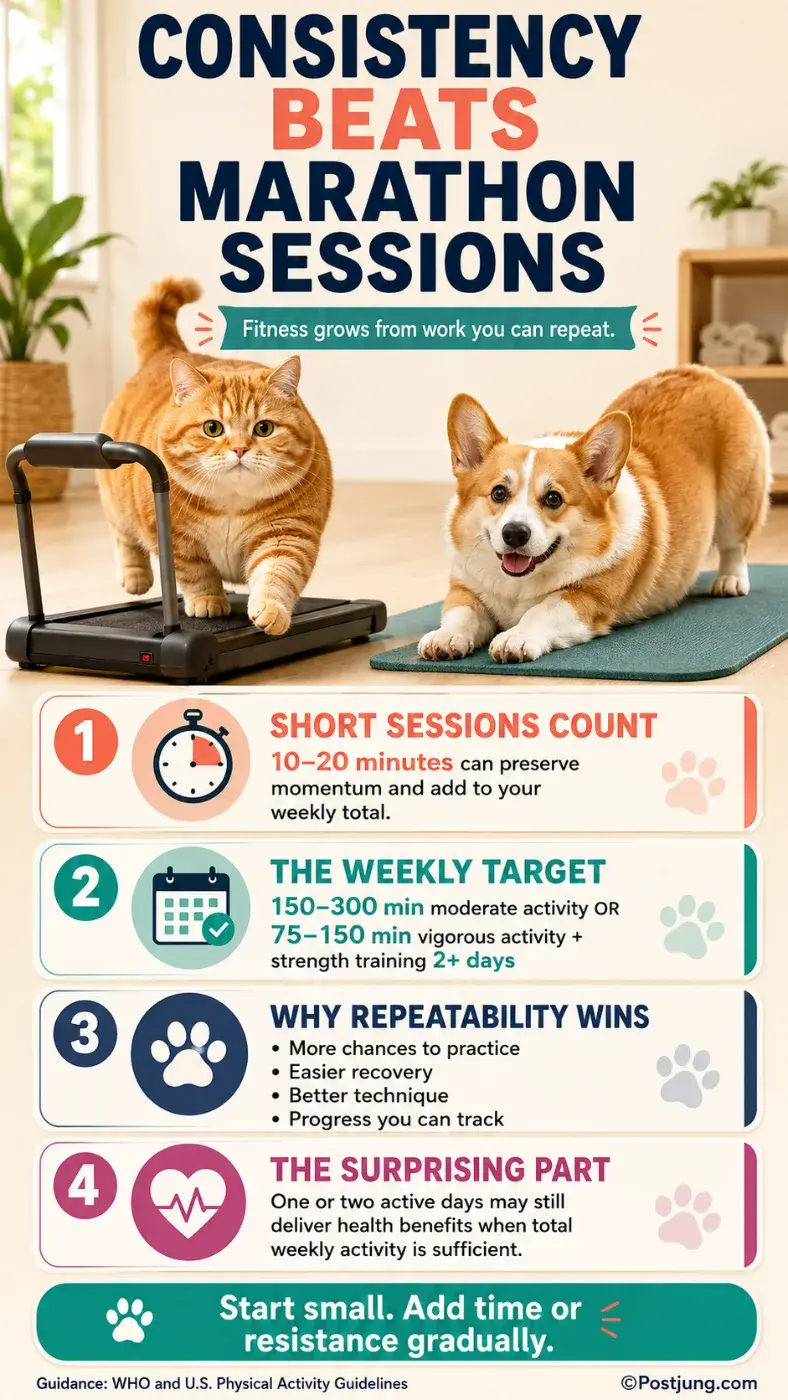
Short sessions are not failed workouts
A lingering fitness myth says exercise only “counts” after reaching a certain minimum duration. Current guidance takes a more flexible view.
The U.S. Physical Activity Guidelines removed the earlier requirement that aerobic activity had to occur in blocks of at least 10 minutes. Activity can be accumulated in smaller portions, which means a brisk walk, a short cycling trip, or a compact strength session can contribute to the weekly total. The guidelines recommend that adults work toward 150 to 300 minutes of moderate-intensity aerobic activity each week, or 75 to 150 minutes at vigorous intensity, plus muscle-strengthening activity on at least two days. U.S. Department of Health and Human Services
The World Health Organization offers similar weekly targets and emphasizes that all physical activity counts. Walking for transportation, household movement, recreation, cycling, and planned exercise can all contribute. World Health Organization
This makes a 15- or 20-minute workout more valuable than people often assume. It may not complete an entire weekly program, but it can preserve momentum and add meaningful activity on a busy day.
Consistency does not mean exercising every day
Being consistent is not the same as maintaining a perfect streak. Nor does it require repeating an identical workout seven days a week.
A consistent plan might involve three gym sessions, several walks, or two strength workouts combined with cycling or recreational sports. The schedule can change from week to week while the broader pattern remains stable.
Rest belongs in that pattern. Muscles, connective tissues, and the nervous system need time to recover, especially after demanding strength, speed, or endurance training. Trying to prove consistency by ignoring pain or exhaustion can eventually make training less consistent.
A better definition is simple: consistency means returning often enough to progress.
Weekly volume still matters
Regularity cannot compensate for a program that contains too little work to support its goal. Five minutes of easy movement each day may be a useful starting point, but it is not automatically equivalent to meeting recommended activity levels.
Resistance-training research also suggests that weekly volume matters. A systematic review and meta-analysis found a dose-response relationship between resistance-training volume and muscle growth, although individual needs and recovery capacity vary. Journal of Sports Sciences via PubMed
Training frequency can help distribute that volume. Instead of forcing every exercise into one exhausting session, a person might divide the work across two or three shorter visits. This can make it easier to maintain effort and technique.
Still, frequency is not magic. Research examining muscle growth suggests that when weekly training volume is matched, simply increasing the number of training days does not necessarily produce meaningfully greater hypertrophy. Journal of Sports Sciences via PubMed
In other words, frequency is often a tool for managing volume, not the sole cause of progress.
The “weekend warrior” exception
There is also reassuring evidence for people who cannot spread exercise evenly across the week.
Observational research has found that adults who concentrate most of their moderate-to-vigorous activity into one or two days may experience health benefits comparable to those who distribute a similar total amount more evenly. One large accelerometer-based study associated both patterns with lower cardiovascular risk compared with inactivity. JAMA via PubMed
That nuance matters. The evidence does not show that a particular schedule is universally superior. It suggests that doing enough activity may matter more than arranging it perfectly.
Concentrated exercise may nevertheless feel physically demanding, especially for beginners or people returning after a long break. Gradually increasing duration and intensity can make the workload more manageable.
Build around the session you can repeat
A practical routine begins with a realistic minimum. That might be a 20-minute walk, a short full-body strength workout, or a few exercises performed at home.
From there, progress can come through small changes: another session, a little more resistance, several extra minutes, or a slightly faster pace. The goal is not to make every workout longer. It is to create enough challenge while preserving the ability and willingness to train again.
Long sessions remain useful when they fit the activity, the person’s goals, and their recovery. Endurance athletes, competitive lifters, and people who simply enjoy extended workouts may need or prefer more time.
For everyone else, the most productive question may not be, “How long can I train today?” It may be, “What can I complete and repeat next week?”
People with chronic health conditions, injuries, pregnancy-related considerations, or a long period of inactivity may benefit from discussing an appropriate starting plan with a qualified health professional.
World Health Organization, U.S. Department of Health and Human Services, JAMA, Journal of Sports Sciences, PubMed
REFERENCES:
https://www.who.int/news-room/fact-sheets/detail/physical-activity
https://health.gov/sites/default/files/2019-09/Physical_Activity_Guidelines_2nd_edition.pdf
https://pubmed.ncbi.nlm.nih.gov/37462704/
https://pubmed.ncbi.nlm.nih.gov/30558493/

เขียนโดย Postjung Insights
 รู้หรือไม่? เปิดรายได้พนักงานส่งพัสดุของแต่ละแอป วันหนึ่งได้เท่าไร
 เปิดรายชื่อโรงเรียนในไทยที่ “ว่ายน้ำ” อยู่ในหลักสูตร เรียนจริงตั้งแต่อนุบาลถึงมัธยม
 โรงเรียนที่มีนักเรียนมากที่สุดในไทย
 5 คณะที่เรียนจบมาแล้ว มีอาชีพรองรับมากกว่าที่คิด
 แปลปกสลาก งวด 1 ต.ค. 69 ส่องตัวเลขจากภาพปกสลากกินแบ่งรัฐบาล
 ตาราง “เด่นเหนือเด่นใต้” งวด 1 ต.ค. 69 เปิดข้อมูลตามโพย เลขไหนอยู่ตรงไหน
 อำเภอที่มีชื่ออำเภอสั้นที่สุด 3 อำเภอเท่านั้นในประเทศไทย
 เปิด 5 โรงเรียนหญิงล้วนเก่าแก่ของไทย ที่มีประวัติยาวนานกว่าศตวรรษ
 ส่องเลข 3 สำนักพิมพ์ งวด 1 ต.ค. 69 ตัวไหนมีข้อมูลตรงกัน
 Google ยอมรับแล้ว! Gemini AI เข้าถึงระบบบริษัทจริง 3 แห่ง ระหว่างการทดสอบความปลอดภัย
 เลขเด็ดปฏิทิน "หลวงปู่โต๊ะ" งวดวันที่ 1 ตุลาคม 69..ส่องเลย เลขไหนให้โชค!
 อุทยานเขาใหญ่เรียกตัว “ตีนผี” หลังขับจี้ช้างป่าพ่อลูก ลั่นระยะ 50 เมตรต้องจำให้ขึ้นใจ5 คณะที่เรียนจบมาแล้ว มีอาชีพรองรับมากกว่าที่คิดเปิดรายชื่อโรงเรียนในไทยที่ “ว่ายน้ำ” อยู่ในหลักสูตร เรียนจริงตั้งแต่อนุบาลถึงมัธยมGoogle ยอมรับแล้ว! Gemini AI เข้าถึงระบบบริษัทจริง 3 แห่ง ระหว่างการทดสอบความปลอดภัยเลขเด็ดปฏิทิน "หลวงปู่โต๊ะ" งวดวันที่ 1 ตุลาคม 69..ส่องเลย เลขไหนให้โชค!
 ทำไมของพลาสติกเก่าบางชิ้นถึง “เหนียว” ขึ้นมาเอง ทั้งที่ไม่ได้เปื้อนอะไร?อุทยานเขาใหญ่เรียกตัว “ตีนผี” หลังขับจี้ช้างป่าพ่อลูก ลั่นระยะ 50 เมตรต้องจำให้ขึ้นใจ
 English Edition