Smart Pet Collars Can Help—But They Still Have Blind Spots

Smart collars can locate a wandering pet and reveal changes in daily activity. Their usefulness, however, still depends on batteries, network coverage, proper fit, and careful interpretation.
A smart collar can tell you that your dog left the yard or that your cat has been unusually inactive. What it cannot provide is a guarantee that your pet will always be found—or a diagnosis explaining every change in behavior.
That distinction matters as pet wearables become increasingly sophisticated. Some collars focus on location, while others monitor movement, rest, sleep, heart rate, respiratory rate, or selected behaviors. The best devices can add useful information to an owner’s observations, but a smart collar is still a supporting tool, not an electronic guardian.
“Smart collar” can mean very different technology
Products sold under the smart-collar label do not all work the same way.
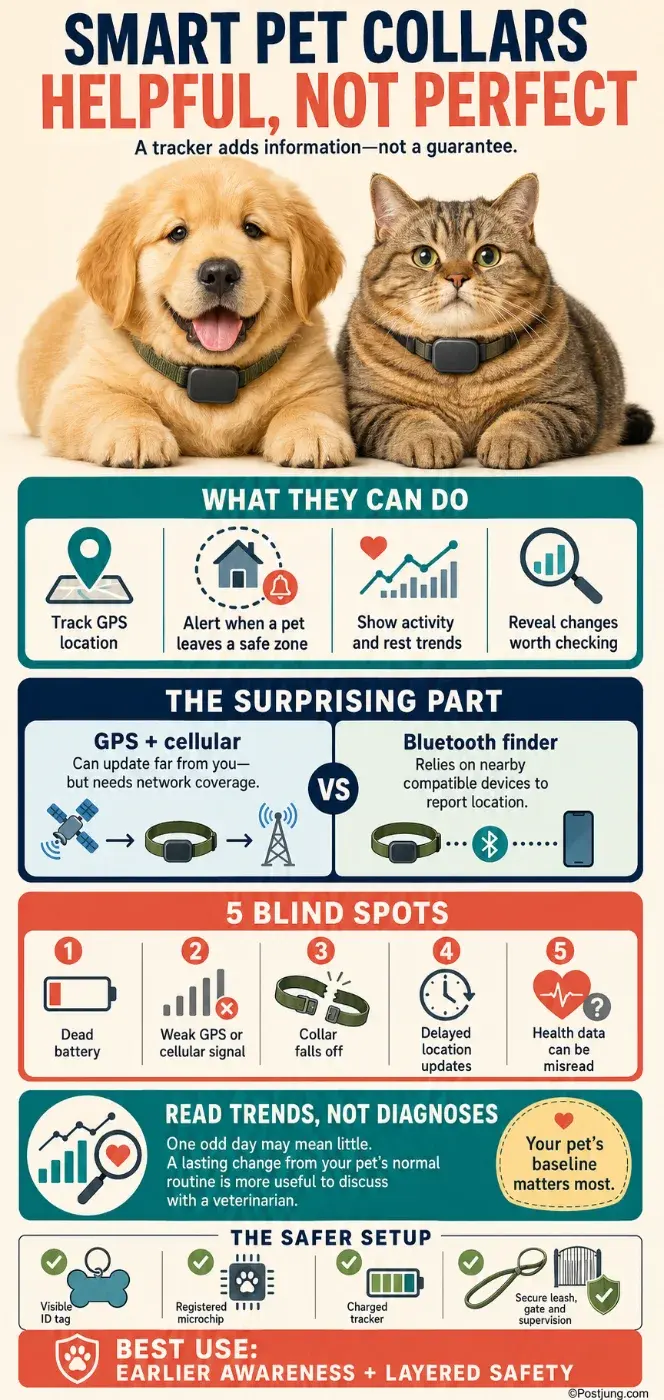
A GPS pet tracker receives location information from satellites. Many models then use a cellular network to send that location to an app, which is why they may require both a service plan and compatible mobile coverage.
A Bluetooth item tracker works differently. It usually reports its position through nearby compatible phones or devices participating in a crowd-finding network. That can work well in a populated neighborhood, but updates may become less frequent when a pet enters a quiet rural area, dense forest, or another place with few participating devices.
Apple’s own guidance notes that its Find Nearby feature depends on the AirTag being within range of the user’s iPhone. That illustrates why an item finder is not the same as live GPS tracking, even if both devices display a location on a map. Apple Support
Before buying anything, owners should determine whether a product uses GPS and cellular service, Bluetooth crowd-finding, Wi-Fi, or a combination of technologies. The difference affects range, update speed, subscription costs, and performance outside cities.
Location tracking still has failure points
A GPS collar can be extremely helpful when a dog slips through a gate or runs after an animal. Geofencing features may also notify an owner when a tracker leaves a designated area.
But location data is not uninterrupted magic. Buildings, indoor spaces, forests, terrain, and limited satellite visibility can affect positioning. A GPS collar that relies on cellular service may know where it is but be temporarily unable to transmit that information.
Battery life also changes with the model, signal quality, and tracking frequency. Tractive, for example, says battery performance varies according to device type, cellular conditions, and how intensively the tracker is used. Live or frequent location updates generally demand more power than occasional check-ins. Tractive Help Center
A collar can also fall off, become damaged, or be removed. Owners should therefore check its fit, charging status, attachment, and app connection regularly—ideally before a hike, road trip, boarding stay, or other situation in which escape would be especially difficult to manage.
Health data is most useful as a pattern
Movement sensors can estimate activity, rest, and sleep-like behavior. More advanced devices may collect resting heart or respiratory data.
Research shows that specific, carefully tested devices can produce valuable measurements. A 2025 veterinary study, for example, used a validated collar-mounted device to collect resting heart and respiratory rates from dogs in their normal environments. Frontiers in Veterinary Science
That does not mean every collar measures every animal equally well. Performance can depend on the sensor, algorithm, placement, coat, fit, movement, and metric being measured. Results validated for one product or use should not automatically be applied to all pet wearables.
The most useful information may be a change from the animal’s own normal pattern. If a normally active dog begins resting far more than usual, the data gives the owner a reason to observe more closely. It does not reveal whether the cause is pain, illness, hot weather, stress, disrupted sleep, or simply an unusually quiet day.
A trend can start a useful conversation with a veterinarian, especially when paired with notes about appetite, mobility, bathroom habits, coughing, scratching, or other visible changes. A concerning reading should not be treated as a diagnosis, and normal-looking data should not override obvious symptoms.
Technology should add layers, not remove them
A smart collar is strongest when it forms one layer of a broader safety plan.
Pets should still have visible identification with a current phone number. Microchipping provides another layer if a collar comes off, although a microchip cannot transmit a pet’s location. It stores an identification number that a veterinary clinic, shelter, or other equipped organization can scan.
The American Veterinary Medical Association recommends that microchipped pets also wear collars with appropriate identification. Owners must keep their registration details current for the chip to be useful. American Veterinary Medical Association
Secure gates, working leashes, recall training, supervision, and an up-to-date photo remain important. No notification can physically stop a frightened pet from entering traffic or moving beyond the tracker’s communication range.
Owners should also review how the collar company stores and shares location or health information. A pet’s location can reveal household routines, so strong account passwords, current software, and carefully managed sharing permissions are sensible precautions.
Smart collars earn their value by making an animal’s movements and routines easier to see. The right expectation is not perfect control. It is earlier awareness and better information—backed by identification, responsible care, and human attention.
KEY TAKEAWAYS:
- GPS pet trackers and Bluetooth item finders use different location systems.
- Tracking performance depends on coverage, satellite visibility, battery power, and attachment.
- Health and activity readings are most useful as trends, not standalone diagnoses.
- Visible ID and a registered microchip remain important even when a pet wears a tracker.
- Smart collars work best as one layer of a larger safety and care plan.
American Veterinary Medical Association, Apple Support, Tractive, Frontiers in Veterinary Science
REFERENCES:
https://www.avma.org/resources-tools/pet-owners/petcare/microchips-reunite-pets-families/microchipping-faq
https://support.apple.com/en-us/109021
https://help.tractive.com/hc/en-us/articles/205664001-How-long-does-my-tracker-s-battery-last
https://www.frontiersin.org/journals/veterinary-science/articles/10.3389/fvets.2025.1667355/full

เขียนโดย Postjung Insights
 รู้หรือไม่? เปิดรายได้พนักงานส่งพัสดุของแต่ละแอป วันหนึ่งได้เท่าไร
 โรงเรียนที่มีนักเรียนมากที่สุดในไทย
 เปิดรายชื่อ 5 โรงเรียนเป้าหมาย เด็กสอบเข้าต้องเตรียมตัวให้พร้อม
 อำเภอที่มีชื่ออำเภอสั้นที่สุด 3 อำเภอเท่านั้นในประเทศไทย
 ราคาทองวันนี้ 21 ก.ย. 69 อัปเดตตลาดทองคำ ทองรูปพรรณแตะ 69,750 บาท
 เปิดรายชื่อ 5 โรงเรียนเอกชนขนาดใหญ่ นักเรียนกว่า 5,000 คนทุกแห่ง
 Ctrip แพลตฟอร์มการท่องเที่ยวของจีน เปิดขายตั๋วสำหรับทริปท่องเที่ยวอวกาศ ของ Virgin Galactic 6 วัน ในราคาประมาณ 24 ล้านบาท
 ส่องเลข 3 สำนักพิมพ์ งวด 1 ต.ค. 69 ตัวไหนมีข้อมูลตรงกัน
 แปลปกสลาก งวด 1 ต.ค. 69 ส่องตัวเลขจากภาพปกสลากกินแบ่งรัฐบาล
 ซาบีดา” เรียกถกด่วน ปมภาพ “ชุดไทย” ถูกนำไปอ้างเป็นชุดกัมพูชา
 หนุ่มขับ Porsche ใจหล่อสุดๆ ติดประกาศเด็กหายไว้รอบคัน..หวังช่วยเผยแพร่ข้อมูลให้ตามหาได้เร็วขึ้น
 เปิด 5 โรงเรียนหญิงล้วนเก่าแก่ของไทย ที่มีประวัติยาวนานกว่าศตวรรษ
 เปิด 5 สินค้าส่งออกของลาวที่คนไทยอาจคาดไม่ถึง หนึ่งในนั้นทำเงินเกือบ 1 พันล้านดอลลาร์ราคาทองวันนี้ 21 ก.ย. 69 อัปเดตตลาดทองคำ ทองรูปพรรณแตะ 69,750 บาทเปิดรายชื่อ 5 โรงเรียนเอกชนขนาดใหญ่ นักเรียนกว่า 5,000 คนทุกแห่งซาบีดา” เรียกถกด่วน ปมภาพ “ชุดไทย” ถูกนำไปอ้างเป็นชุดกัมพูชาเปิดรายชื่อ 5 โรงเรียนเป้าหมาย เด็กสอบเข้าต้องเตรียมตัวให้พร้อมหนุ่มขับ Porsche ใจหล่อสุดๆ ติดประกาศเด็กหายไว้รอบคัน..หวังช่วยเผยแพร่ข้อมูลให้ตามหาได้เร็วขึ้น
 English Edition