Why Treat Calories Add Up So Fast
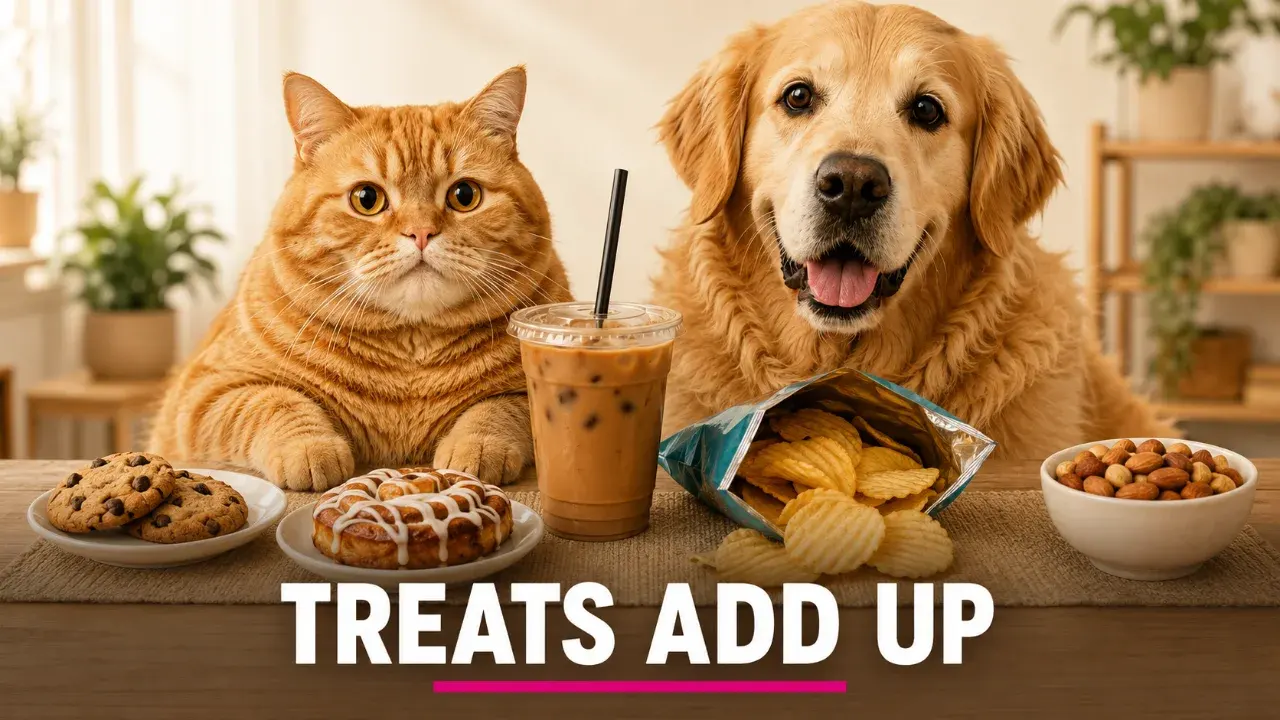
A cookie here and a sweet drink there may not feel like much. Portion size, calorie density, and repeat servings explain why the total can grow surprisingly quickly.
A treat can disappear in a few bites while delivering as many calories as a much larger serving of food. Add a sweet drink, a second helping, or another snack later, and the total can grow before it ever feels like a meal.
That does not make treats inherently bad. It means small size does not always mean few calories—and our eyes are not especially good at calculating energy content.
Treats pack a lot into a small space
Many popular treats combine sugar, fat, and refined flour. These ingredients can produce foods that are compact, pleasant to eat, and relatively high in calories for their size.
Water-rich foods work differently. Fruit, vegetables, broth-based soups, and other foods containing plenty of water can occupy more space and provide greater physical volume for a given number of calories. A small pastry or handful of candy may look modest beside them, even when its calorie count is substantial.
This difference is known as energy density: the amount of energy in a given weight of food. It helps explain why visual size alone can be misleading.
It also explains why “I barely ate anything” can be an honest impression. The food may have been small in volume, but not in energy.
The package may contain more than one serving
Packaged foods introduce another source of confusion. The calories shown on a U.S. Nutrition Facts label usually apply to the stated serving, not automatically to everything inside the package.
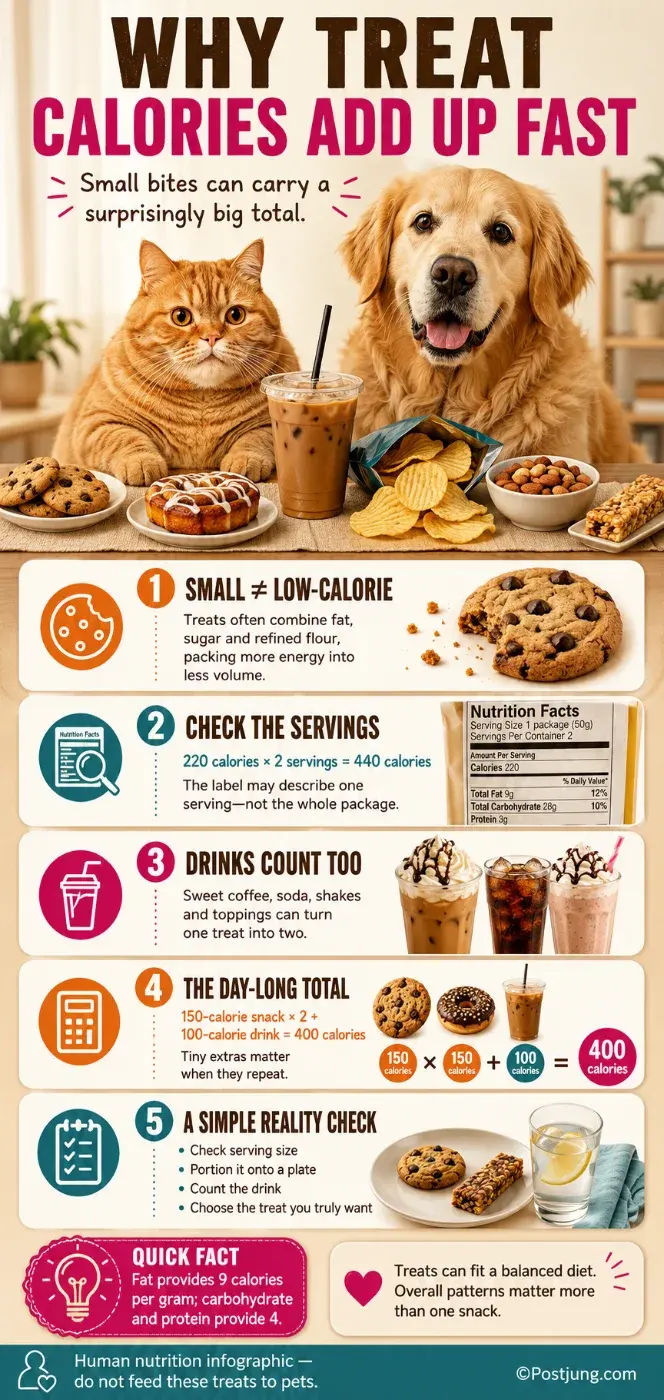
The FDA advises consumers to check both the serving size and the number of servings per container. If a label lists 220 calories per serving and someone eats two servings, the total becomes 440 calories. The serving count changes the whole calculation. U.S. Food and Drug Administration
A resealable bag, sharing-size package, or large bakery item can still be eaten in one sitting. Packaging may influence what feels like a single portion, but the label provides the information needed to calculate the actual total.
Serving size should not be mistaken for a personalized recommendation, either. It is a standardized reference intended to help consumers compare what they eat with the nutrition information.
Drinks are easy to overlook
Calories do not have to be chewed. Sweetened coffee, tea, soda, milkshakes, juice drinks, and flavored beverages can all contribute to the day’s intake.
A drink may feel less substantial than a dessert because it does not look like food and may not satisfy hunger in the same way. It can also accompany a snack rather than replace one.
That pairing matters. The treat may be only part of the total once syrup, cream, sugar, toppings, or a second beverage is included.
This can be especially easy to miss in coffee culture. A person may think of the purchase as “just coffee,” even when the drink functions nutritionally more like a sweet snack.
Repetition matters more than one indulgence
A single treat rarely tells the full story. Calories accumulate across eating occasions, including tastes taken while cooking, office candy, samples, sauces, toppings, and bites from someone else’s plate.
Consider a purely illustrative day: a 150-calorie snack eaten twice plus a 100-calorie drink equals 400 calories. None of the three items looks dramatic on its own. Together, they represent a meaningful addition to the day.
This is why frequency can matter as much as portion size. A routine extra is different from an occasional dessert, even when each individual serving is small.
Personal calorie needs vary with age, sex, height, weight, activity, and other factors. The 2,000-calorie figure printed on U.S. labels is a general reference, not a universal target. U.S. Food and Drug Administration
“Healthy” treats still count
Foods marketed as natural, protein-rich, vegan, gluten-free, organic, or made with fruit can offer qualities a shopper values. Those descriptions do not automatically make a product low in calories.
Nuts, nut butters, dried fruit, granola, energy bars, and smoothies can contain useful nutrients. They can also be calorie-dense or easy to consume in large portions.
The better question is not whether a treat is “good” or “bad.” It is whether the portion, frequency, and nutritional value fit the person’s overall eating pattern.
Likewise, one high-calorie food does not determine someone’s health. The overall pattern matters more than one snack.
Enjoy the treat, but make it visible
Managing treat calories does not require banning dessert or recording every bite. The CDC notes that constant calorie counting is not necessary, although understanding individual calorie needs can be useful. Centers for Disease Control and Prevention
A few simple habits can make the total easier to recognize:
- Check calories per serving and servings per container.
- Put a portion on a plate instead of eating directly from a large package.
- Count sweetened drinks as part of the treat.
- Choose the treat you genuinely want instead of sampling several alternatives.
- Pair a modest portion with a regular meal rather than waiting until extreme hunger.
- Notice repeated extras before focusing on an occasional celebration.
These steps are not about turning food into a math test. They are ways to reduce the gap between what feels small and what the day actually contains.
Treats can fit into a balanced diet. The useful insight is simply that a few unnoticed extras can become a large total—and noticing them gives people more choice, not less.
Anyone managing diabetes, an eating disorder, a medical condition, or a medically prescribed diet should seek personalized guidance from a qualified health professional rather than relying on general calorie advice.
U.S. Food and Drug Administration, Centers for Disease Control and Prevention, National Institute on Aging
REFERENCES:
https://www.fda.gov/food/nutrition-facts-label/calories-nutrition-facts-label
https://www.fda.gov/food/nutrition-facts-label/how-understand-and-use-nutrition-facts-label
https://www.cdc.gov/healthy-weight-growth/about/tips-for-balancing-food-activity.html
https://www.nia.nih.gov/health/healthy-eating-nutrition-and-diet/how-much-should-i-eat-quantity-and-quality

เขียนโดย Postjung Insights
 ซาบีดา” เรียกถกด่วน ปมภาพ “ชุดไทย” ถูกนำไปอ้างเป็นชุดกัมพูชา
 รู้หรือไม่? เปิดรายได้พนักงานส่งพัสดุของแต่ละแอป วันหนึ่งได้เท่าไร
 โรงเรียนที่มีนักเรียนมากที่สุดในไทย
 เปิดรายชื่อ 5 โรงเรียนเป้าหมาย เด็กสอบเข้าต้องเตรียมตัวให้พร้อม
 อำเภอที่มีชื่ออำเภอสั้นที่สุด 3 อำเภอเท่านั้นในประเทศไทย
 เปิด 5 โรงเรียนหญิงล้วนเก่าแก่ของไทย ที่มีประวัติยาวนานกว่าศตวรรษ
 Ctrip แพลตฟอร์มการท่องเที่ยวของจีน เปิดขายตั๋วสำหรับทริปท่องเที่ยวอวกาศ ของ Virgin Galactic 6 วัน ในราคาประมาณ 24 ล้านบาท
 หนุ่มขับ Porsche ใจหล่อสุดๆ ติดประกาศเด็กหายไว้รอบคัน..หวังช่วยเผยแพร่ข้อมูลให้ตามหาได้เร็วขึ้น
 'สควีชชี่'ของเล่นที่กำลังเป็นไวรัลอาจถูกเจ้าหน้าที่ของสนามบินยึดได้ ตรวจสอบให้ดีก่อนนำขึ้นเครื่อง
 เรียก “ป๋อง สุพรรณ” เซียนพระดัง แจงปมมูลนิธิฯ วัดพุทไธศวรรย์
 ตาราง “เด่นเหนือเด่นใต้” งวด 1 ต.ค. 69 เปิดข้อมูลตามโพย เลขไหนอยู่ตรงไหน
 แปลปกสลาก งวด 1 ต.ค. 69 ส่องตัวเลขจากภาพปกสลากกินแบ่งรัฐบาลซาบีดา” เรียกถกด่วน ปมภาพ “ชุดไทย” ถูกนำไปอ้างเป็นชุดกัมพูชาเปิดรายชื่อ 5 โรงเรียนเป้าหมาย เด็กสอบเข้าต้องเตรียมตัวให้พร้อมหนุ่มขับ Porsche ใจหล่อสุดๆ ติดประกาศเด็กหายไว้รอบคัน..หวังช่วยเผยแพร่ข้อมูลให้ตามหาได้เร็วขึ้น
 วาบิ-ซาบิ (Wabi-Sabi) ปรัชญาญี่ปุ่นที่สอนให้เราโอบกอดความไม่สมบูรณ์แบบ
 English Edition